By: Marcus Callahan
Chicago has never had much patience for phoniness. This is a city that can smell a manufactured personality from halfway across the Loop. Its musical history was built by people who meant what they played, from blues musicians working clubs on the South Side to the house pioneers who transformed warehouses into laboratories, and generations of rock, punk, gospel, jazz and hip-hop artists who understood that technique matters, but conviction matters more.
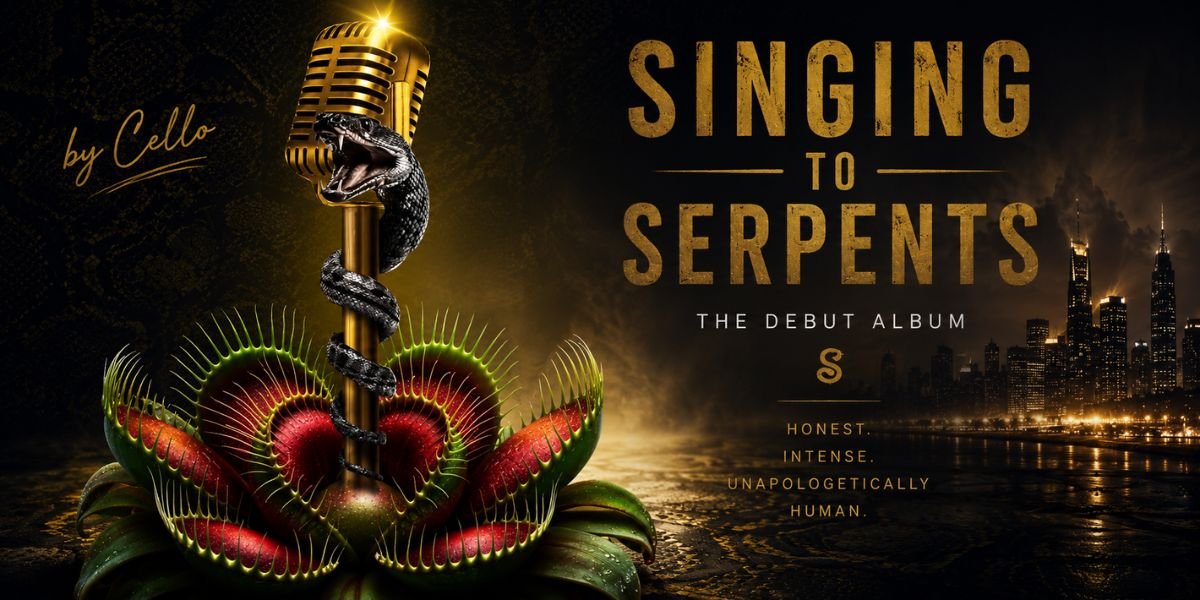
That makes Chicago fertile territory for Cello’s Singing to Serpents.
The nine-song LP is a restless examination of desire, resentment, spirituality, insecurity and the exhausting business of trying to understand yourself while simultaneously trying to be understood by somebody else. Cello doesn’t arrive pretending to possess answers. He brings questions, contradictions and emotional bruises.
Chicago listeners should appreciate the distinction.
Opening track “Stay Here” immediately establishes the album’s emotional temperature. There is longing in the song, but little romantic serenity. Cello takes the familiar desire for another person to remain and pushes it toward fixation. The repetition becomes important: “stay” stops sounding like a casual request and begins carrying the psychological weight of somebody terrified of what happens when the other person walks away.
Imagine it playing during a late-night ride down Lake Shore Drive, Lake Michigan disappearing into blackness on one side while the illuminated skyline hangs on the other. Chicago can look spectacular at night while remaining brutally cold.
“Stay Here” works similarly.
Beauty and discomfort coexist.
“Elevate” changes the posture. Cello reaches for confidence and ambition, but Singing to Serpents repeatedly demonstrates that swagger and insecurity aren’t opposites. Sometimes swagger is simply insecurity wearing a better jacket.
That tension becomes sharper on “Sucks to Be Used.” The song carries anger without pretending anger equals strength. Cello allows resentment to remain complicated. His narrator can be wounded without automatically becoming heroic, which gives the writing a refreshing lack of polish in the best possible sense.
Chicago music has always respected a little dirt beneath the fingernails.
Then come “Full Moon,” “So Long,” and “Cravings,” a stretch that pushes the album deeper into its nocturnal psychology. Desire becomes something simultaneously attractive and threatening. Relationships aren’t safe havens here; they’re places where ego, longing, sexuality, loneliness and fear collide.
It’s tempting to assign Cello a tidy genre, but Singing to Serpents resists that impulse. Alternative music, atmospheric pop, hip-hop cadences, singer-songwriter confession and spoken-word instincts all wander through the record.
Again, that makes sense in Chicago.
This is a city where musical cultures have spent generations talking across neighborhood and genre lines. Cello’s refusal to choose one identity feels less indecisive than instinctive. He follows the emotional requirements of the song instead of a marketing department’s preferred category.
His neurodivergence provides additional context for that approach. Cello is autistic and has ADHD, and he has increasingly spoken about those experiences as part of both his artistic identity and advocacy work. On Singing to Serpents, repetition, emotional intensity, and fixation often feel central to the architecture of the songs.
But autism and ADHD aren’t presented as novelties.
They’re part of the perspective.
That matters because Cello’s greatest accomplishment is making intensely individual experiences accessible without sanding away their specificity. A listener doesn’t need to be autistic to understand obsessive thinking. You don’t need ADHD to recognize a mind refusing to quiet down. You simply need to have spent one sleepless night replaying a conversation that ended six hours earlier.
Chicago provides plenty of appropriate places for that kind of thinking.
An empty CTA platform after midnight will do nicely.
The album’s most intriguing shift comes with “Pray” and “Faith.” After so much romantic and psychological turbulence, Cello turns toward spirituality. Yet he doesn’t suddenly become certain. Belief remains another complicated relationship.
That’s precisely why these songs succeed.
“Faith” isn’t a victory lap for somebody who has discovered every answer. It sounds more like someone reaching into darkness and hoping something reaches back.
There’s something profoundly human about that gesture.
Finally, “Sleeping” arrives not so much as a resolution as an exhale. After the emotional acceleration of everything preceding it, the closing track feels like the hour when the city finally quiets down, the bars have emptied, the trains carry fewer passengers, and morning is close enough to become imaginable.
Cello hasn’t defeated the serpents.
Maybe that’s the point.
The album title suggests confrontation, but Singing to Serpents isn’t about killing the creatures that frighten us. It’s about communicating with them. Anxiety, desire, ego, loneliness, self-doubt, and faith are allowed to speak.
Cello answers with songs.
Chicago understands artists who make beauty from uncomfortable material. Blues itself was built upon that proposition: pain transformed rather than denied.
Singing to Serpents belongs somewhere within that broader tradition, not because Cello is making Chicago blues, but because he understands its fundamental bargain.
Tell the truth.
Make something out of it.
And play it like you mean it.