

By: Jay Kt
Teams can retire old components, introduce managed services, automate deployment, improve security controls, and still leave operations with a system they cannot confidently run. The technical release may be complete. Operational comprehension is still partial.
This gap matters more in 2026 because cloud estates are getting harder to reason about. Flexera’s 2026 State of the Cloud research found that 73% of organizations operate hybrid environments. The same report found that managing cloud spend and security remain leading challenges, at 85% and 82%, respectively. Those numbers describe an operating environment where ownership, context, and decision quality matter as much as architecture.
Why Do AWS Modernization Programs Struggle After Go-Live?
The common failure is treating handover as the final project task.
A delivery team knows why a queue was added, why a timeout changed, which IAM boundary is deliberate, what “normal” latency looks like after a release, and which alarm can wait ten minutes. The receiving operations team often gets the visible artifacts: diagrams, repositories, dashboards, and a support contact.
What it does not automatically receive is operational judgment.
I call the difference handover debt: the gap between what the delivery team knows and what the receiving team can independently observe, decide, and act on. The expensive part is rarely a missing PDF. It is lost causal context behind alarms, guardrails, exceptions, and operating choices.
Handover debt becomes visible only when something changes. A certificate approaches expiry. A downstream API slows. A CloudWatch alarm fires after a deployment. A database connection pool saturates. An engineer then has to reconstruct design intent while the incident clock is already running.
AWS guidance points in the same direction. The Well-Architected Framework recommends baselines, meaningful alert thresholds, established runbooks for known events, playbooks for investigation, named owners, and defined escalation paths. Operational readiness is therefore measurable behavior, not a folder of files.
What Should an AWS Modernization Handover Include?
A useful handover should answer five operational questions:
- What changed? Architecture, dependencies, data paths, security controls, deployment methods, and failure modes.
- Who decides? Named owners for workload health, incidents, access, cost, data, deployment, and vendor escalation.
- How will we know? Metrics, logs, traces, synthetic checks, dashboards, SLOs, and alert thresholds tied to expected behavior.
- What can we do safely? Runbooks with permitted actions, rollback routes, verification steps, and escalation conditions.
- Can the support team prove it? Access tests, incident drills, backup recovery checks, ticket routing, and on-call exercises.
That is a more useful definition of cloud operations handover than “knowledge transfer completed.”
Documentation Should Capture Decisions, Not Just Components
A standard architecture document tells operations what exists. A good operational document explains why it exists and what happens when it behaves differently.
For each material component, document the operating decision behind it. If Amazon RDS Multi-AZ is used, describe the failure behavior the team expects and how application connections recover. If Amazon SQS sits between services, document backlog thresholds, dead-letter handling, replay rules, and the person allowed to initiate replay. If AWS Lambda concurrency is intentionally constrained, record the reason and the symptoms of reaching that boundary.
This is where AWS consulting services can help teams retain operational decisions, ownership, and support context in AWS transition planning before go-live. Teams document target architecture and cutover tasks, then leave operating assumptions embedded in tickets, chat threads, or memory.
A practical documentation set should include:

The useful test is simple. Could an experienced engineer who did not join the project explain the workload’s normal state, degraded state, and recovery path from these materials?
Ownership Must Follow The Incident, Not The Org Chart
“Platform owns infrastructure” is too vague for production.
Ownership should be mapped to events and decisions. Who owns a high 5xx rate? Who can roll back the application? Who approves a security-group change during an incident? Who investigates a cost anomaly? Who restores data? Who contacts a third-party provider when the workload is healthy but the customer journey is failing?
This is the part of AWS modernization that governance documents often miss. A RACI can look complete while an alert still lands in a shared queue with no person accountable for the first action.
For each high-severity signal, record three things: the first responder, the decision owner, and the escalation owner. Those roles may be different. That distinction removes a surprising amount of hesitation during incidents.
Monitoring Should Teach The New Team What “Normal” Looks Like
A dashboard can contain hundreds of metrics and still be operationally weak.
AWS Well-Architected guidance stresses baselines and appropriate alert thresholds, while CloudWatch supports real-time monitoring across AWS resources and applications. The practical requirement is to connect telemetry to workload behavior.
During AWS modernization, build the monitoring narrative alongside the architecture. Operations should know which signals indicate customer impact, which show dependency stress, which predict resource exhaustion, and which are informational.
Every production alarm should answer four questions inside the alert or linked procedure:
- What condition has been detected?
- What customer or business effect is plausible?
- What is the first safe diagnostic action?
- Who owns the next decision?
This prevents the common “dashboard handoff” problem where telemetry exists, yet the receiving team lacks the interpretation layer needed to act.
Runbooks Should Contain Decision Boundaries
Runbooks fail when they read like installation manuals.
An incident runbook needs a trigger, prerequisites, safe actions, stop conditions, verification, rollback, permissions, and escalation criteria. It should also state what the responder must not do without approval.
That last element matters. Modern cloud platforms give engineers fast access to actions with large consequences. A runbook that says “restart the service” is incomplete if it does not explain when a restart is safe, what state may be lost, how dependent services react, and how to confirm recovery.
AWS recommends runbooks for understood events and playbooks for investigation of less familiar events. Its modernization readiness guidance also calls for a DevOps triage runbook integrated with notification systems.
A runbook becomes ready for handover only after someone outside the delivery team has used it successfully.
Support Readiness Should Be Demonstrated Before The Project Exits
Knowledge-transfer sessions create familiarity. They do not prove operational independence.
Before post-modernization support begins, run a controlled readiness exercise. Give the receiving team a realistic event: a failed deployment, rising queue depth, an expired secret in a test environment, a dependency timeout, or a restore request. Then observe what happens.
Can the team find the correct dashboard? Does the alert route correctly? Do they have permission to perform the action? Does the runbook match the actual environment? Is escalation clear? Can they verify that the service has recovered?
AWS’s large-migration guidance describes a similar transition pattern. Workloads enter hypercare after cutover, and once hypercare is complete, the migration team reviews a handoff checklist with the Cloud Ops team before ongoing support takes over.
This is where cloud operations handover becomes an acceptance test rather than a meeting.
A Four-Gate Model For A Smooth AWS Modernization Transition
I use four evidence gates to judge whether a workload is ready to leave the project team.
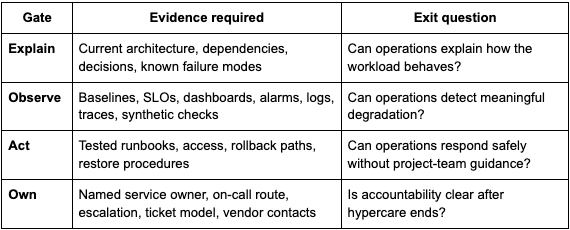
This model changes AWS transition planning because handover evidence is produced during delivery. Monitoring is reviewed when components are introduced. Runbooks are tested before cutover. Ownership is agreed before alerts are created. Support teams join readiness exercises while the project team still has context.
The final handover then becomes a verification point, not a document dump.
How Do You Know The Modernization Is Really Complete?
A useful completion metric is independent recovery.
Pick several plausible operational events and ask the receiving team to diagnose and resolve them using only the production support path. Measure where they stall. Every escalation back to the delivery team should be classified: missing documentation, missing permission, weak monitoring, unclear ownership, incomplete runbook, or missing product knowledge.
Those failures are evidence of remaining handover debt.
For AWS modernization, this is a stronger finish line than “production cutover completed.” The architecture has to survive the departure of the people who built it.
Good post-modernization support begins when the operations team can explain the system, see the right signals, make safe decisions, and recover service through known paths. AWS already provides the services and operational guidance to support that discipline. The harder part is treating operational knowledge as a deliverable with acceptance criteria.
A modernized workload earns its keep on the worst day, when the people on call can recover it without rediscovering the project in live production conditions.