The Chicago Journal

A Whisper That Lingers: CattSue Turns Childhood Loss Into Country Music That Heals

By Graham Hollister

Country music has always understood that the smallest details can carry the greatest emotional weight. A photograph in a drawer, an empty chair at the table, an old coat still hanging behind the door, these are the things from which great country songs have traditionally been constructed. On her deeply personal single “A Whisper on the Wind,” CattSue adds another object to that list: a Mrs. Beasley doll.

It is a wonderfully specific detail in a song that could easily have become overly sentimental. CattSue lost her mother when she was just four and a half years old, an age at which a child understands that somebody has disappeared without necessarily possessing the language to comprehend death. Mrs. Beasley became her companion and source of security during that bewildering period.

Years later, the Jacksonville-based singer-songwriter has returned to those memories and turned them into one of the most affecting independent country releases we’ve heard in some time.

“A Whisper on the Wind” isn’t really a song about death. It’s about what remains.

That distinction is crucial.

CattSue remembers her mother partly through photographs, partly through stories and partly through the emotional imprint left by those first few years together. More painfully, she must also contend with everything she cannot remember. She doesn’t have a clear recollection of her mother’s voice or how it sounded when she said her daughter’s name.

Anyone who has lost somebody after decades together may possess an enormous library of memories. CattSue’s tragedy is different. Her library was never given enough time to fill.

The song handles that absence with admirable restraint.

Rather than attempting to manufacture memories, CattSue acknowledges the spaces where they should have been. In the song’s most poignant passage, she imagines what her mother might tell her now: “My girl, I’m proud of you, go chase your dreams.”

It could have been mawkish. It isn’t.

What makes the sentiment work is that we understand CattSue knows these aren’t words she remembers hearing. They’re words the grown woman needs to imagine the mother saying to the little girl. Songwriting becomes a bridge between them.

That’s country music doing one of the things it does best.

Musically, “A Whisper on the Wind” sits comfortably between contemporary country, Americana and the traditional singer-songwriter ballad. There is polish here, but thankfully not the sort that removes every fingerprint. The arrangement supports rather than dictates the emotional response, leaving enough room for CattSue’s vocal to carry the narrative.

She doesn’t oversing it either.

That might sound like faint praise in an era when vocal fireworks are frequently mistaken for emotional depth, but restraint is one of this record’s strengths. CattSue sings as though she’s sharing a memory rather than auditioning for a television competition. The performance grows naturally from the lyric.

The title itself is particularly effective. A whisper on the wind suggests something impossible to hold yet unmistakably present. It captures CattSue’s relationship with a mother she barely had time to know: not quite memory, not merely imagination, but an enduring sense that love survived the physical separation.

There’s also something pleasingly old-fashioned about the song’s willingness to tell a complete story.

Streaming-era songwriting increasingly encourages artists to arrive at the hook immediately, keep introductions short and avoid testing anyone’s attention span. CattSue seems less interested in satisfying an algorithm than allowing the listener sufficient time to enter the song emotionally.

That’s refreshing.

Her previous single, “Come Home to Me,” brought her international attention through the UK iTunes charts as well as recognition from the Independent Music Network. Those accomplishments demonstrated that an independent American artist can reach listeners well outside her own region. “A Whisper on the Wind,” however, offers something more important than chart statistics: evidence of an identifiable artistic voice.

CattSue’s strength appears to be emotional storytelling without unnecessary decoration.

Country music needs that.

The genre’s commercial end currently stretches across everything from rock and pop to hip-hop influences, while Americana continues to absorb artists who might once simply have been called country singer-songwriters. CattSue seems comfortable somewhere between those definitions, and that’s probably where she should remain. Forcing “A Whisper on the Wind” into a narrower stylistic category would miss the point.

The story comes first.

Most impressive is the song’s refusal to pretend grief eventually disappears. CattSue isn’t offering a tidy three-minute cure for losing a parent. She’s describing how grief changes shape. The frightened little girl carrying Mrs. Beasley eventually becomes a woman capable of looking backward with gratitude alongside sadness.

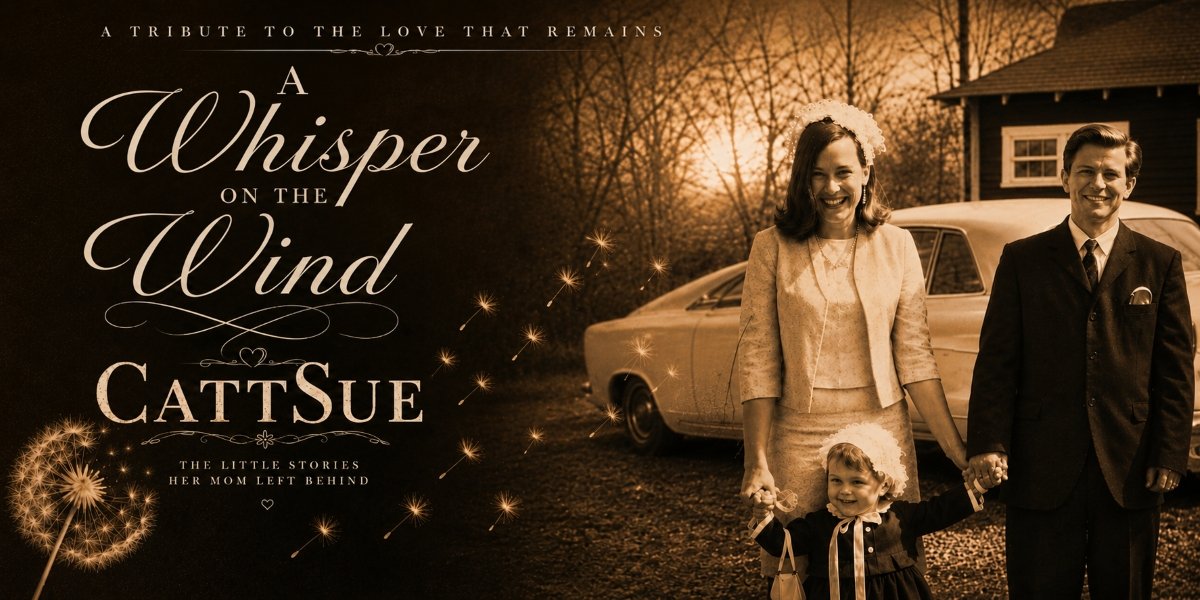
The final emotional image brings those versions of herself together: the child holding her mother’s hand, with Mrs. Beasley in the other.

It’s simple.

It’s specific.

And it stays with you.

“A Whisper on the Wind” may have begun as CattSue’s tribute to her mother, but like the best songs about intensely personal experiences, it gradually stops belonging exclusively to the writer. Listeners inevitably begin filling its spaces with their own mothers, fathers, spouses, friends and people they didn’t get nearly enough time with.

That’s when a personal song becomes a country song.

CattSue has written a good one.

Why AWS Modernization Success Depends on Operational Handover Quality

By: Jay Kt

Teams can retire old components, introduce managed services, automate deployment, improve security controls, and still leave operations with a system they cannot confidently run. The technical release may be complete. Operational comprehension is still partial.

This gap matters more in 2026 because cloud estates are getting harder to reason about. Flexera’s 2026 State of the Cloud research found that 73% of organizations operate hybrid environments. The same report found that managing cloud spend and security remain leading challenges, at 85% and 82%, respectively. Those numbers describe an operating environment where ownership, context, and decision quality matter as much as architecture.

Why Do AWS Modernization Programs Struggle After Go-Live?

The common failure is treating handover as the final project task.

A delivery team knows why a queue was added, why a timeout changed, which IAM boundary is deliberate, what “normal” latency looks like after a release, and which alarm can wait ten minutes. The receiving operations team often gets the visible artifacts: diagrams, repositories, dashboards, and a support contact.

What it does not automatically receive is operational judgment.

I call the difference handover debt: the gap between what the delivery team knows and what the receiving team can independently observe, decide, and act on. The expensive part is rarely a missing PDF. It is lost causal context behind alarms, guardrails, exceptions, and operating choices.

Handover debt becomes visible only when something changes. A certificate approaches expiry. A downstream API slows. A CloudWatch alarm fires after a deployment. A database connection pool saturates. An engineer then has to reconstruct design intent while the incident clock is already running.

AWS guidance points in the same direction. The Well-Architected Framework recommends baselines, meaningful alert thresholds, established runbooks for known events, playbooks for investigation, named owners, and defined escalation paths. Operational readiness is therefore measurable behavior, not a folder of files.

What Should an AWS Modernization Handover Include?

A useful handover should answer five operational questions:

  • What changed? Architecture, dependencies, data paths, security controls, deployment methods, and failure modes.
  • Who decides? Named owners for workload health, incidents, access, cost, data, deployment, and vendor escalation.
  • How will we know? Metrics, logs, traces, synthetic checks, dashboards, SLOs, and alert thresholds tied to expected behavior.
  • What can we do safely? Runbooks with permitted actions, rollback routes, verification steps, and escalation conditions.
  • Can the support team prove it? Access tests, incident drills, backup recovery checks, ticket routing, and on-call exercises.

That is a more useful definition of cloud operations handover than “knowledge transfer completed.”

Documentation Should Capture Decisions, Not Just Components

A standard architecture document tells operations what exists. A good operational document explains why it exists and what happens when it behaves differently.

For each material component, document the operating decision behind it. If Amazon RDS Multi-AZ is used, describe the failure behavior the team expects and how application connections recover. If Amazon SQS sits between services, document backlog thresholds, dead-letter handling, replay rules, and the person allowed to initiate replay. If AWS Lambda concurrency is intentionally constrained, record the reason and the symptoms of reaching that boundary.

This is where AWS consulting services can help teams retain operational decisions, ownership, and support context in AWS transition planning before go-live. Teams document target architecture and cutover tasks, then leave operating assumptions embedded in tickets, chat threads, or memory.

A practical documentation set should include:

The useful test is simple. Could an experienced engineer who did not join the project explain the workload’s normal state, degraded state, and recovery path from these materials?

Ownership Must Follow The Incident, Not The Org Chart

“Platform owns infrastructure” is too vague for production.

Ownership should be mapped to events and decisions. Who owns a high 5xx rate? Who can roll back the application? Who approves a security-group change during an incident? Who investigates a cost anomaly? Who restores data? Who contacts a third-party provider when the workload is healthy but the customer journey is failing?

This is the part of AWS modernization that governance documents often miss. A RACI can look complete while an alert still lands in a shared queue with no person accountable for the first action.

For each high-severity signal, record three things: the first responder, the decision owner, and the escalation owner. Those roles may be different. That distinction removes a surprising amount of hesitation during incidents.

Monitoring Should Teach The New Team What “Normal” Looks Like

A dashboard can contain hundreds of metrics and still be operationally weak.

AWS Well-Architected guidance stresses baselines and appropriate alert thresholds, while CloudWatch supports real-time monitoring across AWS resources and applications. The practical requirement is to connect telemetry to workload behavior.

During AWS modernization, build the monitoring narrative alongside the architecture. Operations should know which signals indicate customer impact, which show dependency stress, which predict resource exhaustion, and which are informational.

Every production alarm should answer four questions inside the alert or linked procedure:

  • What condition has been detected?
  • What customer or business effect is plausible?
  • What is the first safe diagnostic action?
  • Who owns the next decision?

This prevents the common “dashboard handoff” problem where telemetry exists, yet the receiving team lacks the interpretation layer needed to act.

Runbooks Should Contain Decision Boundaries

Runbooks fail when they read like installation manuals.

An incident runbook needs a trigger, prerequisites, safe actions, stop conditions, verification, rollback, permissions, and escalation criteria. It should also state what the responder must not do without approval.

That last element matters. Modern cloud platforms give engineers fast access to actions with large consequences. A runbook that says “restart the service” is incomplete if it does not explain when a restart is safe, what state may be lost, how dependent services react, and how to confirm recovery.

AWS recommends runbooks for understood events and playbooks for investigation of less familiar events. Its modernization readiness guidance also calls for a DevOps triage runbook integrated with notification systems.

A runbook becomes ready for handover only after someone outside the delivery team has used it successfully.

Support Readiness Should Be Demonstrated Before The Project Exits

Knowledge-transfer sessions create familiarity. They do not prove operational independence.

Before post-modernization support begins, run a controlled readiness exercise. Give the receiving team a realistic event: a failed deployment, rising queue depth, an expired secret in a test environment, a dependency timeout, or a restore request. Then observe what happens.

Can the team find the correct dashboard? Does the alert route correctly? Do they have permission to perform the action? Does the runbook match the actual environment? Is escalation clear? Can they verify that the service has recovered?

AWS’s large-migration guidance describes a similar transition pattern. Workloads enter hypercare after cutover, and once hypercare is complete, the migration team reviews a handoff checklist with the Cloud Ops team before ongoing support takes over.

This is where cloud operations handover becomes an acceptance test rather than a meeting.

A Four-Gate Model For A Smooth AWS Modernization Transition

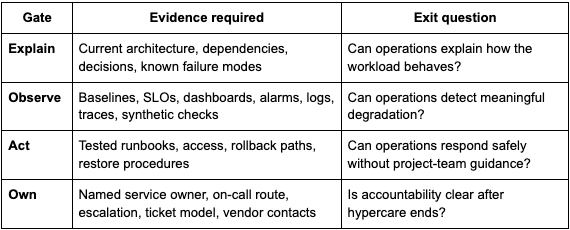
I use four evidence gates to judge whether a workload is ready to leave the project team.

Photo Courtesy: Unsplash.com

This model changes AWS transition planning because handover evidence is produced during delivery. Monitoring is reviewed when components are introduced. Runbooks are tested before cutover. Ownership is agreed before alerts are created. Support teams join readiness exercises while the project team still has context.

The final handover then becomes a verification point, not a document dump.

How Do You Know The Modernization Is Really Complete?

A useful completion metric is independent recovery.

Pick several plausible operational events and ask the receiving team to diagnose and resolve them using only the production support path. Measure where they stall. Every escalation back to the delivery team should be classified: missing documentation, missing permission, weak monitoring, unclear ownership, incomplete runbook, or missing product knowledge.

Those failures are evidence of remaining handover debt.

For AWS modernization, this is a stronger finish line than “production cutover completed.” The architecture has to survive the departure of the people who built it.

Good post-modernization support begins when the operations team can explain the system, see the right signals, make safe decisions, and recover service through known paths. AWS already provides the services and operational guidance to support that discipline. The harder part is treating operational knowledge as a deliverable with acceptance criteria.

A modernized workload earns its keep on the worst day, when the people on call can recover it without rediscovering the project in live production conditions.

Chicago History Museum Workers Ratify First Union Contract After Federal Labor Board Found Retaliation by Former Leadership

Workers at the Chicago History Museum ratified their first union contract on August 25, 2026, closing a chapter that included federal labor law violations, four employee firings, and a formal complaint from the National Labor Relations Board against the Lincoln Park museum’s former leadership. The contract, approved by 96% of union members, comes amid a broader wave of cultural worker organizing that has reshaped labor relations across Chicago’s museum and library landscape.

Key Takeaways

  • Chicago History Museum employees ratified their first union contract on August 25, 2026, with 96% of members voting in favor.
  • The contract includes across-the-board pay increases and improved paid leave for all employees represented by the bargaining unit.
  • The National Labor Relations Board filed a formal complaint in May 2026 alleging that museum management under former president Donald Lassere retaliated against employees who voted to unionize in 2025, including firing four workers.
  • Lassere exited the role in January 2026 after nearly five years as president. New president Michael J. Anderson, named in July, extended offers to all four ousted employees to return.
  • The Chicago History Museum joins the Art Institute of Chicago, Field Museum, Museum of Contemporary Art, Shedd Aquarium, Newberry Library, Adler Planetarium, and the Museum of Science and Industry in organizing with AFSCME Council 31.
  • AFSCME’s Cultural Workers United campaign now represents 50,000 cultural workers nationwide, with 2,500 in Illinois alone.

The NLRB Complaint Alleged Firings, Discipline, and Threats

The path to ratification was defined by conflict. Chicago History Museum employees voted to unionize in February 2025, joining the American Federation of State, County and Municipal Employees Council 31. Shortly after the vote, four employees were fired. Others were disciplined or threatened with termination, according to the NLRB’s findings. The board determined that these actions constituted violations of federal labor law and that management had retaliated against staff for exercising their right to organize.

In May 2026, the NLRB issued a rare formal complaint against the museum, a step the board takes only after its own investigation finds merit to the underlying charges. The complaint named actions taken under former president Donald Lassere, who had led the museum for nearly five years. Lassere exited the position in January 2026. The museum has not publicly detailed the circumstances of his departure beyond confirming the leadership change.

AFSCME Council 31 Executive Director Roberta Lynch described the situation at the Chicago History Museum as “some of the worst anti-union retaliation we’ve seen.” Lynch said the workers’ decision to hold together through the firings, discipline, and federal complaint demonstrated a level of resolve that influenced the broader cultural organizing movement in Chicago. “Facing some of the worst anti-union retaliation we’ve seen, they stood strong together and prevailed,” Lynch said in a statement accompanying the ratification announcement.

New Museum Leadership Signals a Reset

The museum’s labor relations shifted after Lassere’s departure. In July 2026, the Chicago History Museum named Michael J. Anderson as Lassere’s successor. Anderson moved to settle the NLRB complaint by extending offers to all four fired employees to return to the museum. He also publicly committed to negotiating in good faith with the union, a marked change in tone from the prior administration.

Anderson framed the contract ratification as a turning point for the institution. In a statement released on August 25, Anderson said reaching the agreement marked “an important step forward for the museum and our staff.” He described a commitment to building a working relationship with the union “grounded in mutual respect, collaboration, and open communication” and said the institution’s shared focus would remain on supporting staff, serving visitors and communities, and advancing the museum’s mission of preserving and sharing Chicago’s stories.

The contract itself includes across-the-board pay increases and improved paid leave provisions for all employees in the bargaining unit. Specific salary figures and leave details were not disclosed publicly as of the announcement date.

Chicago’s Cultural Unionization Wave Has Reshaped the Sector

The Chicago History Museum contract is not an isolated event. It is the latest in a sequence of unionization victories at Chicago cultural institutions that began in earnest in 2021 and has since expanded to include many of the city’s most prominent museums, libraries, and science centers.

The Art Institute of Chicago was the local tipping point. Workers there voted to unionize with AFSCME in early 2022 and ratified their first contract in 2023. That effort inspired organizing at the Field Museum, where collections specialist Melissa Anderson, a 20-year employee, later cited the Art Institute’s campaign as a morale driver during the Field Museum’s own unionization push. The Field Museum staff organized in 2023.

Since then, workers at the Museum of Contemporary Art, Shedd Aquarium, Museum of Science and Industry, Peggy Notebaert Nature Museum, Newberry Library, and most recently the Adler Planetarium have all voted to join AFSCME Council 31. The Adler vote, completed in late 2025, brought 70 planetarium workers into the union. Separately, staff at the Chicago Botanic Garden organized under the Chicago and Midwest Regional Joint Board of Workers United.

Nationally, AFSCME’s Cultural Workers United campaign, launched in 2020 as the COVID-19 pandemic forced mass layoffs and furloughs at museums and cultural venues, now represents 50,000 workers at museums, libraries, zoos, and other cultural institutions across the country. In Illinois alone, 2,500 cultural workers have formed unions through the campaign. The organizing has not been limited to Chicago. Library workers in suburban Niles-Maine, Oak Lawn, St. Charles, and Waukegan have also joined AFSCME since 2020, a sector that saw no suburban library unions in the state as recently as 2019.

The Broader Context for Cultural Workers in Chicago

The unionization wave has unfolded against a backdrop of financial pressure on cultural institutions. Federal funding for museums, libraries, and other cultural organizations has faced scrutiny at the national level. At the same time, the pandemic exposed long-standing issues in the cultural sector, including low wages relative to cost of living, limited benefits, and a reliance on mission-driven passion to justify below-market compensation.

Workers across Chicago’s institutions have consistently pointed to similar concerns. Pay that did not keep pace with inflation, limited job security, unpredictable scheduling, and a perception that management undervalued frontline staff were common themes in organizing campaigns from the Art Institute to the Adler Planetarium. The Art Institute’s recent decision to outsource custodial staff drew additional scrutiny from its unionized workforce, with employees describing the move as an attempt to reduce the bargaining unit.

The Museum of Science and Industry ratified its own first contract earlier in August 2026, securing an average 8% pay increase for union members and raising the starting wage floor to $18 per hour. That contract established a template that the Chicago History Museum agreement builds on, reinforcing the pattern of institution-by-institution contract ratification that has characterized Chicago’s cultural union movement.

What the Contract Means for the Chicago History Museum

The Chicago History Museum, located at 1601 N. Clark Street in Lincoln Park, sees approximately 150,000 visitors annually. The institution houses collections tied to Chicago’s history, including an extensive costume archive. This fall, the museum will launch “Threads of a Nation: Preserving Presidential Clothing,” an exhibition featuring garments worn by former presidents George Washington, John Adams, and Abraham Lincoln.

With a ratified contract now in place and new leadership publicly committed to a collaborative relationship with the union, the museum enters its next chapter with a different labor framework than the one that defined the Lassere era. For the workers who organized, weathered the firings, and waited through the NLRB process, the contract represents both a resolution and a precedent. For the broader cultural sector in Chicago, it reinforces a pattern that has become clear: the wave is not slowing down.

FAQs

Which Union Represents Chicago History Museum Workers?

Employees are represented by the American Federation of State, County and Municipal Employees Council 31, the same union that represents cultural workers at the Art Institute of Chicago, Field Museum, Shedd Aquarium, Museum of Contemporary Art, and other Chicago institutions.

What Did the NLRB Find at the Chicago History Museum?

The National Labor Relations Board filed a formal complaint in May 2026 alleging that museum management under former president Donald Lassere retaliated against employees who voted to unionize in 2025. The retaliation included firing four workers and disciplining or threatening others.

Who Is the New President of the Chicago History Museum?

Michael J. Anderson was named president in July 2026. Anderson extended return offers to the four fired employees as part of settling the NLRB complaint and committed to negotiating in good faith with the union.

How Many Chicago Cultural Institutions Have Unionized?

Since 2021, workers at the Art Institute of Chicago, Field Museum, Museum of Contemporary Art, Shedd Aquarium, Museum of Science and Industry, Peggy Notebaert Nature Museum, Newberry Library, Adler Planetarium, Chicago History Museum, and the Chicago Botanic Garden have all organized. AFSCME Council 31 alone represents 2,500 cultural workers in Illinois.