By: Conor Murray
For the better part of a decade, the guitar was eulogized. Streaming algorithms favored trap hi-hats over power chords, and the conventional wisdom held that rock music had aged out of cultural relevance. That consensus is now being dismantled, one distorted riff at a time.
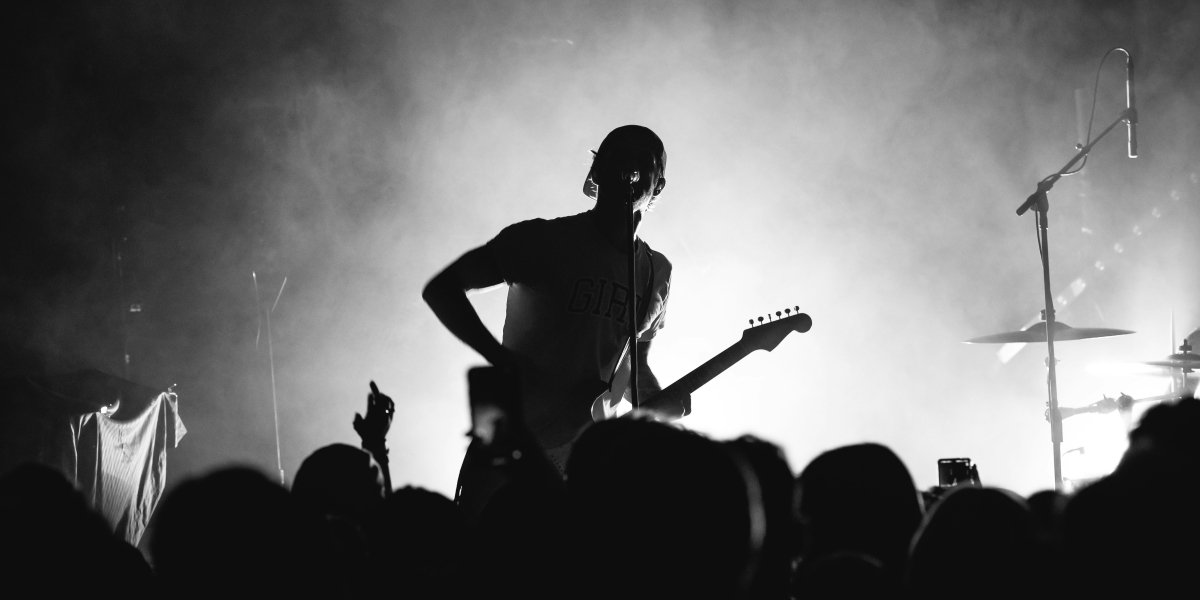
Walk into any mid-sized venue on a Friday night in Chicago, Austin, or Brooklyn and you’ll find something that would have seemed unlikely just five years ago: rooms full of people in their early twenties losing themselves to guitar-driven music. Not as an ironic throwback. Not as a niche affectation. As genuine, chest-thumping, communal experience. The guitar’s obituary, it turns out, was written far too soon.
The Premature Death of Rock
The narrative of rock’s decline was always more complicated than the headlines suggested. Yes, guitar-driven music lost ground on the pop charts throughout the 2010s. Yes, streaming data initially seemed to confirm that younger listeners were gravitating toward hip-hop, pop, and electronic music almost exclusively. And yes, major labels responded to those signals by redirecting resources away from rock acts and toward whatever was trending on the platform dashboards.
But cultural movements rarely die cleanly. They submerge. They mutate. They find new channels. And while the mainstream was busy writing rock’s eulogy, something was quietly happening in DIY venues, on college radio stations, on Bandcamp pages and SoundCloud accounts and independent Spotify playlists curated by people who had never stopped believing in the power of six strings and a well-placed drum fill.
Rock wasn’t dying. It was reorganizing.
The Indie Vanguard
The current resurgence isn’t being led by arena-filling legacy acts, though some of those continue to draw enormous crowds. It is being driven by a wave of independent and indie-adjacent artists who have learned to operate with the agility of the digital era while maintaining the sonic vocabulary of guitar-driven music at its most expressive.
These are artists who grew up on streaming but fell in love with records. Who discovered Led Zeppelin and Pixies and Radiohead and Pavement through algorithm rabbit holes and older siblings’ hand-me-down vinyl. Who understood intuitively that there was something in the texture of a distorted guitar, the dynamics of a live band, the physical weight of a real drum kit, that no amount of digital production polish could replicate.
The result is a body of work that feels simultaneously nostalgic and urgent, music that honors the tradition it comes from without being imprisoned by it. These artists aren’t playing retro rock. They’re playing rock as a living language, one with something new to say.
Why Now?
Timing is everything in culture, and the conditions for rock’s resurgence have been building for years. Pandemic-era isolation created a profound hunger for music that felt physical, communal, and emotionally unguarded, qualities that guitar-driven rock delivers more viscerally than almost any other genre. When live music returned, audiences didn’t just want to attend concerts. They wanted to be inside them, pressed against a stage, feeling the bass in their sternum.
At the same time, a generation that came of age on algorithmically curated playlists has begun to push back against the frictionless, context-free nature of that listening experience. There’s a growing appetite for albums as complete statements, for artists with genuine aesthetic identities, for music that requires something from the listener. Rock and indie, genres built on exactly those values, are positioned perfectly to meet that appetite.
Social media has played its part too. TikTok, for all its reputation as a platform for hyper-compressed pop moments, has also become an unexpected vector for guitar music discovery. Clips of live performances, studio sessions, and bedroom recordings of artists playing real instruments have found enormous audiences among younger users who respond to the authenticity and craft on display. The algorithm, it turns out, is agnostic. It amplifies what people actually watch, and people are watching guitarists.
The Critics Are Paying Attention
Where artists lead, serious criticism follows. The conversation around guitar-driven music has shifted noticeably in recent years, with critics who once dismissed the genre’s commercial prospects now engaging with its current wave on genuinely enthusiastic terms. Publications that once devoted their limited rock coverage to legacy act anniversaries are now dedicating real estate to emerging guitar bands, recognizing that the story being written right now is as compelling as any in the genre’s history.
Voices like those behind Ezra Calloway rock reviews represent the kind of engaged, knowledgeable criticism that this resurgent moment deserves, writing that approaches guitar-driven music with the analytical rigor and cultural seriousness it has always merited, and that helps new listeners find their way into a genre richer and more varied than any single chart position could suggest.
Good criticism matters enormously during a genre’s resurgent moment. It contextualizes, it champions, it connects new listeners to the deeper catalog that gives current work its meaning. The fact that rock and indie are generating serious critical engagement again is not incidental to their resurgence. It is part of it.
The Sound of 2025
What does the current wave of guitar-driven music actually sound like? The honest answer is: many things at once. That internal diversity is one of its greatest strengths.
On one end of the spectrum, there are acts leaning into noise and abrasion, post-punk influenced bands with angular riffs, clipped rhythms, and lyrics delivered with a kind of controlled intensity that owes as much to Wire and Gang of Four as to anything released in the past decade. On the other end, there are artists making something far warmer and more melodic, introspective singer-songwriters whose guitar work is acoustic and fingerpicked, whose songs unfold slowly and reward patient listening.
Between those poles lies an enormous and genuinely exciting middle ground: bands blending shoegaze textures with pop songwriting instincts, artists pairing heavy riffs with vulnerable lyrical content, producers finding ways to make guitar music that sounds contemporary without abandoning the analog warmth that gives the instrument its emotional power.
The genre is not monolithic. It never was. But in 2025, its internal range feels wider and more creatively alive than it has in years.
The Live Music Connection
No discussion of rock’s resurgence would be complete without acknowledging the role of live performance. The relationship between guitar-driven music and the concert experience is not incidental, it is foundational. These are songs built to be played loud, in rooms, for people.
As live music continues its post-pandemic recovery, the pipeline between emerging guitar acts and dedicated live audiences is strengthening in ways that benefit the entire ecosystem. Artists are building loyal fanbases through relentless touring. Venues are rediscovering the commercial viability of booking guitar bands. Festival programmers are allocating more prominent slots to indie and rock acts after seeing the audience response firsthand.
This live infrastructure matters because it creates the kind of deep, sustained connection between artist and audience that streaming numbers alone cannot manufacture. A fan who has seen a band play in a sweaty three-hundred-capacity room is a different kind of fan than one who added a song to a playlist. They are an evangelist. And evangelists build movements.
A Genre Reclaiming Its Narrative
What is perhaps most striking about guitar-driven music’s current moment is the confidence with which its practitioners are operating. There is no defensiveness, no nostalgia-seeking, no anxiety about cultural relevance. The artists making the most compelling rock and indie music right now seem genuinely unbothered by the question of whether guitar music belongs in the conversation, because for them and their audiences, that question was never seriously in doubt.
They are simply making the music they believe in, finding the audiences that were always waiting for it, and building something that looks, increasingly, like a movement with real momentum behind it.
The guitar isn’t back because the industry decided to revive it. It’s back because it never stopped being one of the most expressive, emotionally direct instruments human beings have ever put their hands on. That’s not a trend. That’s a fact. And a new generation is discovering it for the first time, with all the intensity and devotion that discovery deserves.