
By: Jean Apache
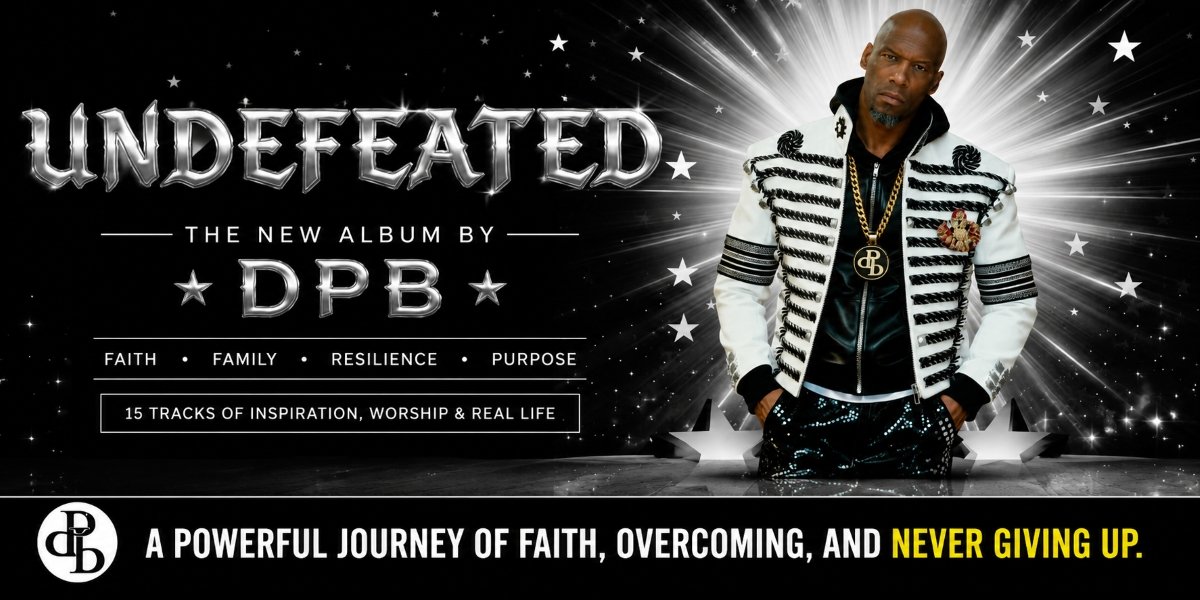
Longevity is one of music’s rarest achievements. It demands adaptability without surrender, growth without abandoning identity, and enough conviction to keep creating when the spotlight shifts elsewhere. On Undefeated, veteran Christian hip-hop artist DPB doesn’t simply celebrate surviving more than three decades in the music industry; he explains why he’s still standing.
The 15-track collection functions as both autobiography and declaration, weaving together hip-hop, worship, gospel, funk, and inspirational pop into an album whose heartbeat is perseverance. Throughout the record, DPB repeatedly returns to one central idea: victory isn’t measured by chart positions or accolades but by remaining faithful through life’s storms.
That message comes into focus immediately with “I Feel So Good Today (Happy Mix),” a vibrant opener built around infectious optimism. Rather than presenting happiness as a fleeting emotion, DPB frames it as a spiritual discipline. The repeated refrain, “I’m up when I’m down”, captures the album’s outlook in one memorable phrase. Joy becomes an act of faith rather than circumstance, and the energetic production reinforces that conviction without feeling forced.
The title track, “Undefeated 3.0,” is the album’s emotional centerpiece. Here, DPB recounts betrayal, disappointment, endurance, and ultimate triumph, but refuses to cast himself as the hero. Instead, every victory is attributed to God’s faithfulness. It’s a subtle distinction that gives the song emotional credibility. In an era where self-made narratives dominate much of popular music, DPB consistently redirects the spotlight toward the source of his strength.
One of Undefeated‘s greatest strengths is its willingness to move comfortably between celebration and worship.
“God Mode” bursts with revival energy, blending rhythmic verses with declarations of healing and divine authority. Likewise, “Power in the Name of (Jesus Anthem)” feels purpose-built for congregational participation. Its repetitive structure isn’t accidental; it’s designed to unite listeners in proclamation rather than simply entertain them.
Yet the album’s most compelling moments often arrive when DPB lowers the volume and tells his own story.
“Back in the Day” stands among the record’s finest achievements. Rather than relying solely on nostalgia, the song uses memory to examine spiritual inheritance. Images of a praying mother, a faithful grandmother, church rehearsals, neighborhood block parties, and front porch conversations become more than pleasant recollections; they become evidence of the foundation that continues to sustain him today. It’s one of those rare songs that honors the past without becoming trapped inside it.
That same honesty appears on “Let It Go,” arguably the album’s most vulnerable composition. Addressing addiction, bitterness, rejection, loneliness, and emotional wounds, DPB refuses easy answers. The repeated invitation to “let it go” becomes less of a slogan than an ongoing process of surrender. The track demonstrates that Christian music can acknowledge brokenness without losing sight of hope.
The worship centerpiece, “Consume Me,” slows the album’s momentum beautifully. Stripped of the rhythmic urgency found elsewhere, it creates space for contemplation. Rather than showcasing technical vocal performance, the song succeeds because of its sincerity. It feels less like a studio recording than a spontaneous prayer captured in real time.
Throughout the album, DPB’s songwriting favors clarity over complexity. His lyrics aren’t constructed to impress through dense metaphors or elaborate internal rhyme schemes. Instead, they communicate directly, allowing testimony to remain the focal point. For some listeners, that simplicity may feel unconventional in contemporary hip-hop. For others, it becomes one of the album’s defining virtues. Every line serves the message.
Production remains equally focused. Instead of chasing current sonic trends, Undefeated embraces classic hip-hop rhythms, gospel influences, and polished contemporary production. The result is an album that sounds timeless rather than fashionable, a record more interested in longevity than immediacy.
What ultimately elevates Undefeated is its authenticity.
Nothing here feels manufactured to fit a playlist or capitalize on current musical movements. Every song reflects an artist who has experienced success, disappointment, ministry, family, and personal growth, and who has emerged with both gratitude and purpose intact.
After more than thirty years in Christian music, DPB could easily rely on past accomplishments. Instead, Undefeated demonstrates that his creative fire continues to burn brightly. The album serves as both a celebration of where he’s been and an affirmation that his journey is far from complete.
In the end, Undefeated isn’t simply about overcoming adversity. It’s about discovering that true victory isn’t found in avoiding life’s battles but in remaining faithful through every one of them. That’s a message that resonates long after the music fades.