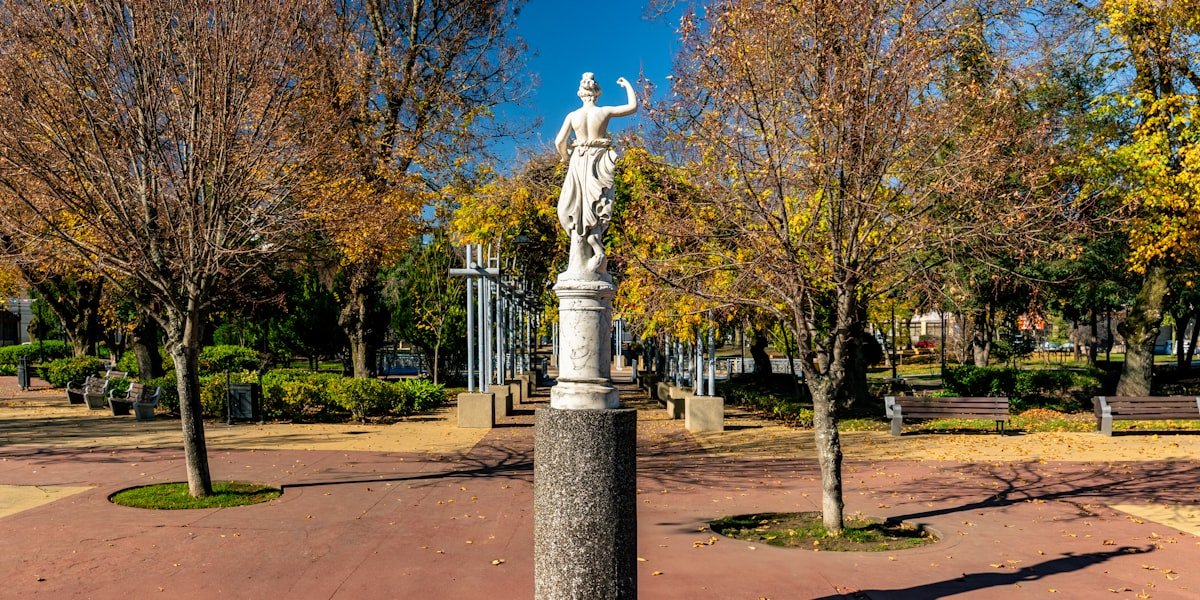
Artist Amanda Williams unveiled “Other Washingtons” on August 6, 2026, surrounding the 1902 George Washington statue in Washington Park with nearly 40 flagpoles honoring other people who share the Washington surname. The installation drew what Williams called “an amazing turnout” of honorees, family members and neighborhood residents at the unveiling.
Key Takeaways
- Amanda Williams unveiled “Other Washingtons” on August 6, 2026, around the 1902 George Washington statue in Washington Park.
- The installation includes nearly 40 flagpoles, each with a flag or banner honoring a different person surnamed Washington.
- Honorees range from Booker T. Washington, George Washington Carver, Dinah Washington and Grover Washington Jr. to Chicagoans like former mayor Harold Washington and Benjamin Washington, band director at Dr. Martin Luther King Jr. College Preparatory High School.
- The project is part of the Chicago Monuments Project, a city initiative launched in 2020 with the Department of Cultural Affairs and Special Events, the Chicago Park District and Monument Lab, funded partly through DCASE and the Andrew W. Mellon Foundation.
- A companion website, otherwashingtons.com, will keep collecting stories so the flag roster can change as the physical banners weather and are replaced.
The project signals a shift in how Chicago is willing to treat its oldest public monuments, not by removing them but by building new narratives directly around them. Rather than replace the George Washington statue, Williams has used it as scaffolding for a different kind of civic memory, one that asks who actually gets to stand for history in a neighborhood whose demographics look nothing like they did in 1902.
The August 6 Unveiling Drew Honorees and Neighborhood Residents to Washington Park
The unveiling took place at the statue’s site in Washington Park, where Williams’ installation now surrounds the original bronze figure with flagpoles carrying flags and biographical banners. Depending on where a visitor stands while walking or driving past, the statue is either partially visible or completely obscured by the surrounding flags, a physical effect that echoes the piece’s larger argument about which figures get foregrounded and which get buried.

Williams described the crowd in direct terms during a live interview on Chicago Tonight just minutes after the installation went up. She said the event brought together actual honorees, neighborhood community leaders, and everyday Bronzeville and Washington Park residents, and told the program she sees the piece as a “first foray” into what will become an anchor for Washington Park.
Nearly 40 Flags Mix Famous Names With Neighbors
Nearly 40 flagpoles ring the statue, each carrying a flag or a banner with a short biography of someone named Washington. The list mixes household names with people known mainly to their own block. Historical and cultural figures include educator Booker T. Washington, scientist George Washington Carver, and musicians Dinah Washington and Grover Washington Jr.
Local Chicagoans get equal billing. The banners name the late mayor Harold Washington, early childhood educator Candice Washington, and Benjamin Washington, band director at Dr. Martin Luther King Jr. College Preparatory High School, who Williams noted would be marching down the same street that weekend during the Bud Billiken Parade. The biographies were written by the Washingtons being honored or by people connected to them, which means the archive reads less like a museum label and more like a set of community testimonials.
That crowdsourced structure did not happen overnight. Williams said the project began roughly a year earlier with a banner posted near the statue, which had been fenced off since 2020, asking passersby a single question: who is their favorite Washington. She followed that with workshops around the neighborhood, including a session with a knitting group at a Presidents Day event on 55th Street, to gather the stories that eventually became banner text.
Williams Frames the Piece as Repair, Not Erasure
Williams was explicit that the goal was not to tear anything down. She connected the new work to an earlier series of painted, condemned South Side homes, saying, “Color(ed) Theory was about the injustice, George gets to be about the reparations.” She described “Other Washingtons” as tied to “a national story, a more historic story” rather than a purely local one.
Her reasoning links the statue’s original context to the neighborhood surrounding it today. Williams argued that George Washington’s relevance to the present-day neighborhood looks fundamentally different from the conditions surrounding that same area in 1902, and that the founding mythology George Washington represents helped produce the redlining, segregation and generational wealth gap the neighborhood still contends with. “It’s not an accident,” she said, calling the outcomes a direct result of decisions made under the first president’s era.
That argument gives the installation stakes beyond aesthetics. Williams has built a career on making inequity visible in physical space, from the color choices on abandoned South Side homes to a 2022 project that planted 6 acres of red tulips to mark the boundaries of historic redlining. “Other Washingtons” extends that practice from documenting harm to proposing a form of repair, built literally around a monument tied to the history she is describing.
The Chicago Monuments Project Provides the Framework
“Other Washingtons” is one output of the Chicago Monuments Project, an initiative the city launched in 2020 to review public statues and art connected to controversial figures and to fund new, more inclusive memorials. The Department of Cultural Affairs and Special Events, the Chicago Park District and Monument Lab have worked together on the effort, commissioning new monuments through a partnership between DCASE and the Andrew W. Mellon Foundation.
That funding structure matters because it puts institutional weight behind a question that started as an artist’s provocation. It also places Williams’ work alongside other recent commissions tied to the same review process, suggesting Chicago’s response to controversial monuments increasingly runs through addition and reinterpretation rather than removal alone.
The Archive Is Meant to Keep Growing
The physical flags are only part of the project. A companion website, otherwashingtons.com, is meant to operate as a living archive where visitors can submit names and stories about Washingtons who shaped their lives, whether famous or entirely unknown, and see extended versions of the banner biographies. Because the outdoor flags will weather and eventually need replacing, new stories submitted online are expected to cycle into the physical installation over time, meaning the roster of nearly 40 honorees is not fixed.
Williams said she hopes an institution will eventually partner with the project to house the archive on a permanent basis, which would turn a temporary public art installation into something closer to a standing community record. Whether a museum, library or university takes on that role remains an open question, and so does how long the flagpoles themselves will stay up in Washington Park before the next phase of the project takes shape. What the August 6 unveiling made clear is that a single 1902 statue can still be turned into a live argument about whose names Chicago chooses to put on a pedestal.
FAQs
What Is “Other Washingtons”?
It is a public art installation by Amanda Williams surrounding the 1902 George Washington statue in Washington Park with nearly 40 flagpoles honoring other people named Washington, unveiled on August 6, 2026.
Who Are Some of the People Honored on the Flags?
The banners include historical figures like Booker T. Washington, George Washington Carver, Dinah Washington and Grover Washington Jr., as well as Chicagoans including former mayor Harold Washington, early childhood educator Candice Washington and Benjamin Washington, a band director at Dr. Martin Luther King Jr. College Preparatory High School.
Is the Original George Washington Statue Being Removed?
No. The statue remains in place at the center of the installation. Depending on a visitor’s vantage point, the flags either partially reveal or fully obscure the bronze figure.
What Is the Chicago Monuments Project?
The city established this effort in 2020 to examine public monuments and statues tied to disputed historical actors and support replacement artworks that center underrepresented narratives, with oversight from the Department of Cultural Affairs and Special Events, the Park District and Monument Lab.
How Were the Honorees Chosen?
Amanda Williams began the project about a year before the unveiling by posting a banner near the fenced-off statue asking passersby who their favorite Washington was, then held neighborhood workshops, including one with a knitting group on 55th Street, to gather stories.
Will the List of Honorees Ever Change?
Yes. A companion website, otherwashingtons.com, lets visitors submit new names and stories, and those submissions are expected to cycle into the physical flags as they weather and get replaced.
What Other Public Art Has Amanda Williams Made in Chicago?
Williams has painted condemned homes on the South Side in colors tied to Black culture and, in 2022, planted 6 acres of red tulips to mark the boundaries of historic redlining.