
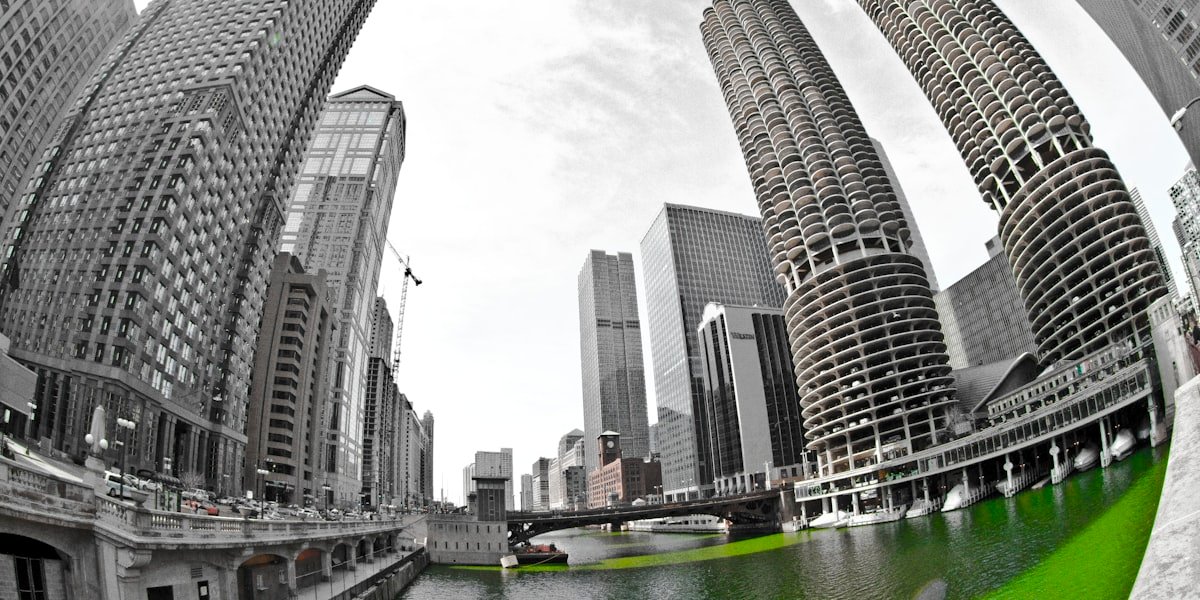
The Chicago River dye that turns the water emerald green every St. Patrick’s Day has sparked curiosity and confusion for more than six decades. Despite thousands of spectators lining the riverbanks each March and millions more watching online, the exact formula and application process remain closely guarded secrets. The annual tradition continues to baffle Chicago residents and visitors who wonder how the transformation happens, what the dye contains, and why the color fades so quickly.
What Makes the Chicago River Dye Work?
The Chicago River dye uses a vegetable-based powder that dissolves in water and reflects light in a way that creates the signature bright green color. The dye itself starts as an orange powder before it hits the water. Once dispersed in the river, a chemical reaction occurs that shifts the visible spectrum, producing the vivid green hue that lasts several hours.

The powder is applied from boats that motor slowly up the river, with crew members using large sieves to distribute it evenly across the surface. The process takes roughly 45 minutes to complete the initial pass, and the color typically remains visible for four to five hours before diluting and fading. Water temperature, current speed, and weather conditions all influence how long the green persists.
The Plumbers Union Local 130 has controlled the dyeing operation since 1962, and the organization treats the precise formula as proprietary information. No permits or public records detail the chemical composition, and the union has declined repeated requests from journalists and city officials to disclose the ingredients. This secrecy fuels ongoing speculation about what exactly goes into the river each year.
Why Does the Color Fade So Fast?
The Chicago River dye is designed to be temporary and environmentally safe, which means it must break down quickly after application. The dye particles disperse downstream as the river flows toward the Chicago Sanitary and Ship Canal, and sunlight accelerates the breakdown of the pigment molecules. Within a few hours, the concentration drops below the threshold needed to maintain the bright green appearance.
River flow rates also vary depending on recent rainfall and water management operations controlled by the Metropolitan Water Reclamation District. During years with higher flow, the dye dilutes faster and travels farther downstream. Conversely, calmer conditions allow the color to linger near the original application zone between Michigan Avenue and Columbus Drive.
The ephemeral nature of the spectacle is part of its appeal. Spectators who arrive even an hour or two after the dyeing often find the color noticeably dimmer, and by late afternoon the river typically returns to its usual murky gray-green. This limited window creates urgency and drives crowds to the riverfront early on parade day.
How Did the Tradition Start?
The first use of Chicago River dye occurred in 1962, when members of the plumbers’ union decided to mark St. Patrick’s Day with a dramatic visual statement. The idea reportedly came from the union’s business manager, who noticed that a tracer dye used to detect illegal sewage discharges left a bright stain on workers’ clothing. Recognizing the potential for a public spectacle, the union tested the concept on a small scale before committing to a full river dyeing.
Early applications used far more dye than modern efforts, sometimes keeping the river green for several days. Environmental concerns and evolving regulations prompted the union to reduce the quantity significantly over the decades. By the 1990s, the formula had been adjusted to minimize ecological impact while still producing the iconic color.
The tradition has become one of Chicago’s most recognizable annual events, drawing comparisons to other cities’ St. Patrick’s Day celebrations but remaining unique in its scale and execution. No other major urban river undergoes a similar transformation, and attempts to replicate the effect elsewhere have met with limited success or regulatory obstacles.
What Are the Environmental Concerns?
Critics have questioned whether the Chicago River dye poses risks to aquatic life or water quality, but independent testing has not identified significant harm. The dye is marketed as vegetable-based and non-toxic, though the lack of full disclosure leaves some environmental advocates uneasy. The Illinois Environmental Protection Agency does not require public reporting for the dyeing, classifying it as a temporary decorative application rather than an industrial discharge.

Fish and other organisms in the river show no documented behavioral changes during or after the dyeing, and water samples collected hours after application have not revealed elevated levels of harmful compounds. Still, the secrecy surrounding the formula prevents thorough third-party analysis. Transparency advocates argue that a tradition affecting a major public waterway should operate with full chemical disclosure, especially as environmental standards grow stricter.
The river itself remains heavily managed and far from a pristine natural system. Decades of industrial use, combined with ongoing sewage overflow events during heavy rains, mean the Chicago River already faces significant pollution challenges. The annual dyeing represents a minor addition compared to these baseline stressors, but the symbolism of deliberately altering the water’s appearance continues to spark debate.
Why Keep the Formula Secret?
The plumbers’ union maintains that the secrecy protects the integrity of the tradition and prevents unauthorized or unsafe copycat attempts. By controlling the formula and application technique, the union ensures the dyeing proceeds safely under the supervision of experienced personnel. Releasing detailed instructions could lead to amateur efforts that create environmental damage or safety hazards.
The mystery also serves a marketing function, generating media coverage and public fascination that might diminish if the process became routine knowledge. The annual dyeing garners national and international attention, reinforcing Chicago’s brand as a city that celebrates boldly and creatively. The union’s role as guardian of the secret has become part of the lore, adding an element of exclusivity to an otherwise public event.
Some skeptics suggest the secrecy persists because full disclosure might reveal the dye is less exotic than the buildup implies, or because regulatory scrutiny would increase if all ingredients were known. Without independent verification, the debate over transparency versus tradition remains unresolved.
How Has the Practice Changed Over Time?
The amount of Chicago River dye used has decreased substantially since the 1960s, when the union reportedly dumped 100 pounds or more into the water. Modern applications use a fraction of that quantity, reflecting both improved dispersal techniques and environmental considerations. The boats and equipment have also evolved, with purpose-built vessels replacing improvised craft from the early years.
Timing has shifted as well. Originally, the dyeing occurred on St. Patrick’s Day itself, but the city now schedules it for the Saturday before the holiday to maximize public attendance. This adjustment aligns the spectacle with the downtown parade, creating a concentrated day of festivities that draws larger crowds than a midweek event would.
Media coverage has expanded dramatically, with live television broadcasts and social media streams replacing the limited newspaper photos and brief TV mentions of earlier decades. The global reach of digital platforms has turned a local tradition into an internationally recognized event, though the core ritual of boats spreading green dye remains unchanged.
The Chicago River dye continues to captivate audiences precisely because it combines simplicity with mystery, offering a fleeting transformation that defies easy explanation and resists duplication.