
A lender deciding whether to open a revolving line is asking one question: how can it be sure this company will pay the money back? Operating history is the easiest answer. If you don’t have it, you can still offer other evidence, and some forms of evidence are stronger than others.
Think of it as a ladder. Rung 1 is the strongest substitute for a track record, and the rungs get weaker as you go down. The order below reflects general underwriting logic, not a formula used by any specific lender. Examples are illustrative.
Why a Line Is Harder Than a Loan
A loan is a single decision about a fixed amount. A line of credit lets you borrow again and again, for as long as it stays open, so the lender is effectively approving future borrowing that it can’t see. New companies therefore often find lines harder to get than short-term products. Limits often start small, and many providers ask for a minimum period in business.
Reviewing a sample product description, such as Fundivi business lines of credit, helps you see which requirements apply and what you’d need to bring to the conversation.
Rung 1: Cash on Deposit
Strength: Highest. What it proves: The lender can recover its money with almost no risk.
A secured line backed by a savings account or certificate of deposit can be available to companies with hardly any history. Say a founder pledges a $20,000 CD paying 3.5%, and a bank offers a line for 90% of that, or $18,000, at 9%. With the line fully drawn for a year, interest would be $1,620 and the CD would earn $700. That’s a net carrying cost of $920, or about 5.1% of the amount borrowed.
The catch: The cash remains locked up while the line is open. You’re essentially renting access to your own money, while building a payment record.
Rung 2: Hard Assets and Receivables
Strength: High. What it proves: There’s something valuable to sell if things go wrong.
Equipment, vehicles, inventory, and real estate may support a secured line. Invoices owed by reliable customers also count here, and may work better than machinery. Lenders apply advance rates and discount assets that are specialized, aging, or difficult to resell.
How to strengthen it: Provide a clear asset list with purchase dates and proof of ownership, plus an aging report for receivables.
Rung 3: An Inherited Operating History
Strength: High to moderate. What it proves: The business has worked before, even if you’re new.
If you bought an existing company or a franchise, you may be able to present its past financials or the franchise system’s performance data. A two-month-old owner with a business that has been operating for eleven years is in a completely different spot from a true startup.
How to strengthen it: Gather purchase agreements, prior returns, and transition plans. Show that key staff and customers stayed.
Rung 4: Signed Contracts and Recurring Revenue
Strength: Moderate. What it proves: Revenue is likely, not merely hoped for.
Executed contracts with creditworthy customers provide meaningful evidence. Memberships and subscriptions can be similarly persuasive, particularly when churn is low. Letters of intent count for much less, and a customer list without commitments counts for less still.
How to strengthen it: Summarize each contract’s value, length, and cancellation terms on one page.
Rung 5: Processor and Bank Data
Strength: Moderate. What it proves: Actual sales, even if for only a short time.
Three to six months of statements can provide reviewers a small but real sample. For merchants, processor volume is particularly direct evidence. A StreetInsider release on card-processing loans describes one financing launch based around such receipts, which shows how much weight card activity can carry. Remember, that’s a separate product from a revolving line.
How to strengthen it: Keep the account positive, avoid returned items, and don’t mix personal spending into it.
Rung 6: The Owner’s Personal Strength
Strength: Moderate to low, as a sole support. What it proves: You have managed money well, and you can back the debt.
High personal credit, outside income, and liquid savings do real work for a new company. Often, this is the primary basis for startup credit, especially business credit cards. Still, it speaks to you, not to the company, and it usually comes with a personal guarantee.
How to strengthen it: Reduce revolving balances, fix report errors, and document non-business income.
Owners already carrying other payments should factor those in, as a lender will. This list of loans for businesses with existing debt offers a view of how other obligations are treated. Compare any option against the line on total dollars.
Rung 7: A Co-Applicant or Guarantor
Strength: Moderate to low. What it proves: Somebody stronger is prepared to take responsibility.
An established business partner or investor may add credibility. Their obligation is real, however, and the lender’s attention will turn straight to them if there’s a problem.
Rung 8: Industry Experience
Strength: Low on its own. What it proves: You probably know how this business works.
A dozen years running kitchens for someone else matters when you open your own restaurant. Community and SBA-oriented lenders might give this real weight, while automated underwriting may not see it.
Rung 9: Projections and a Business Plan
Strength: Lowest. What it proves: You’ve thought carefully about the future, nothing more.
A plan is necessary for certain lenders and insufficient for all of them. Treat it as supporting material for the rungs above it. Where it can help most is in explaining why a line, rather than a loan, suits how your cash moves through the year.
Climbing Your Own Ladder
Take Sable & Thread, a fictional alterations shop six months old. It has modest deposits, a $12,000 machine paid in full, and an owner with solid credit. That’s rungs 2, 5, and 6, and an offer of a $25,000 unsecured line may be possible but isn’t assured. Suppose it draws $10,000 for 60 days.
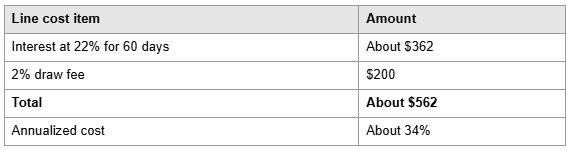
Had it taken a $25,000 lump-sum loan at 22% over 12 months, interest alone would be about $3,078. For irregular, short needs, paying only on what’s used is the main attraction of a line. Watch out for draw fees, monthly maintenance charges, and any requirement to pay down the balance periodically.
Checking Out Lenders
Once you know your best rungs, focus on lenders that accept those forms of proof. Compare Small Business Loans lists Fundivi first, with an editor’s choice label, on its small business lender rankings page. Look into how that site is compensated by the companies it lists, and don’t let a ranking decide things before you’ve seen the limit, draw fees, and renewal terms.
A Short Path Upward
Many owners go through a sequence, beginning with a secured card or small secured line, adding trade accounts with suppliers that report payments, and moving to an unsecured line as records accumulate. Use a line in small amounts, repay it promptly, and avoid drawing to the limit, since a line that stays fully drawn can look like a sign of strain. Each stage adds a bit more evidence, and that evidence is what shortens the ladder for next time.
Frequently Asked Questions
How soon can a new business get a line of credit?
A secured line or business credit card may be possible right away for qualified applicants. Unsecured lines often require more history.
What credit score do I need?
Requirements differ. Better scores generally widen your options, especially when the business has little record.
Is a business credit card a line of credit?
It’s a form of revolving credit and is frequently the first one a new company gets. Compare APRs and any cash-advance charges.
Do I pay interest on the full limit?
Normally only on what you draw, though some lines charge maintenance or unused-line fees.
Can my limit go up?
Often, after a record of responsible use and rising deposits. Ask what the review schedule looks like.
Can a line be cancelled?
Yes. Many agreements allow reductions or cancellation if your finances change, so don’t treat one as permanent capital.
Should I keep a line open even if I don’t use it?
Often, if the costs are low. An unused line can be useful when something unexpected happens.
Disclaimer: This article is for general informational purposes only and does not constitute financial, lending, legal, tax, or investment advice. The examples, figures, rates, costs, and scenarios presented are illustrative only and do not represent actual offers or guaranteed terms. Requirements, pricing, approval criteria, repayment structures, fees, and credit decisions vary by lender, product, and applicant. Readers should review the specific terms of any financing offer carefully and consult a qualified financial or legal professional before making financing decisions.