The Chicago Journal

The Hidden Supply Chain Behind Modern Communications Infrastructure


Modern communications infrastructure depends on more than undersea cables and data centers. The less-visible layer, the equipment used to manufacture and process the components inside that infrastructure, is where some of the most important and least-covered businesses operate.

Specialty fiber optic equipment is one example. A handful of companies, most of them small, most of them nowhere near a major tech hub, build the machines that make modern fiber-based communications physically possible.

The component story most people miss

Every modern communication system that uses fiber optics depends on a specific manufacturing capability: the ability to splice optical fibers together with extreme precision. The fibers themselves are roughly the diameter of a human hair, and the cores carrying the actual light signal are smaller still, often around 9 microns across.

Joining two fibers means aligning those cores within fractions of a micron. Then heating the glass to temperatures reaching 2,000°C using a controlled electrical arc. Fusing the ends. Verifying that the resulting splice has acceptable optical loss. That sequence gets repeated thousands of times in a major cable installation, in a submarine cable manufacturing run, in the production of a fiber laser or gyroscope or specialty sensor (pick one, the process is the same).

The equipment that does this work, called fusion splicers, comes from a small number of manufacturers worldwide. Standard splicers handle telecom-grade single-mode fiber. Specialty splicers are built for the harder cases: large mode area fibers used in high-power lasers, polarization-maintaining fibers for navigation systems, photonic crystal fibers that show up in advanced sensing and quantum applications. Different problems, different equipment.

That specialty subcategory is where companies like 3SAE Technologies operate. Headquartered in Franklin, Tennessee, 3SAE has been building specialty fusion splicing and glass processing equipment since around 2000, supplying customers across submarine cable manufacturing, defense, aerospace, and advanced research.

Why specialty matters here

Standard fusion splicers are commodity products. They work fine for telecom fiber, the high-volume application that drives most of the global splicer market. But they cannot handle specialty fibers, where the geometry, materials, and operational requirements differ enough that standard equipment cannot reliably produce a good splice.

Specialty fiber applications matter increasingly. Fiber lasers show up in industrial cutting and welding, defense systems, medical devices, advanced research. Gyroscopes built on fiber optics handle navigation for aircraft, ships, and missiles, and that list is getting longer as autonomous vehicles start needing the same precision. Specialty sensing is growing too, structural monitoring, oil and gas exploration, quantum computing research.

All of those applications depend on components that have to be manufactured with specialty equipment. Without the equipment, the components cannot be built reliably. The systems downstream from that just do not work. It is a short chain, and every link matters.

The supply chain implications

There is a strategic dimension to specialty equipment manufacturing that gets less attention than it deserves. Much of the equipment used in defense, aerospace, and critical infrastructure has to be sourced domestically or from trusted allies. ITAR regulations (the International Traffic in Arms Regulations, which govern export of defense-related items) restrict which equipment can be sold where. That is not a loophole or a preference. It is law. Domestic supply chain requirements layer on top of that, affecting what gets specified for sensitive applications.

That creates structural demand for U.S.-based specialty equipment manufacturers serving defense, aerospace, and government markets. The customer base is not huge. But it is well-funded and technically demanding, and it is locked into domestic suppliers for the sensitive stuff in ways that do not change based on price.

3SAE’s customer base reflects this dynamic. Submarine cable manufacturers, fiber laser builders, defense contractors, aerospace companies, research institutions: they all rely on domestic specialty equipment for at least part of their production. Some of that is regulatory. Some is just risk management. The company has been in that space long enough that the relationships, the technical depth, the operational track record are all there.

What technical depth actually looks like

In specialty hardware markets, technical depth is more than product specifications. It is the accumulated operational knowledge that lets a manufacturer produce equipment that works consistently across the variations a customer base will throw at it.

3SAE’s patented Ring of Fire wide area plasma technology is one example of how that depth shows up in practice. Standard splicers use a two-electrode design that creates a relatively narrow heat zone. The three-electrode approach produces a more uniform heat distribution, which gives operators significantly better control over how the glass melts and fuses. That matters enormously for specialty fibers, where the heating profile determines whether the splice survives at all.

The three-electrode design also enables glass processing operations that two-electrode systems cannot reliably perform. Tapering, for instance, is where the fiber diameter gets gradually reduced over a defined length to enable optical mode matching. Lensing shapes the fiber tip to focus the output beam. Combiner manufacturing is a different thing entirely: multiple input fibers fused into a single output for high-power laser systems. None of these are interchangeable. Each one matters to a specific set of customers who cannot get the same result from standard equipment.

Those capabilities are not just marketing differentiators. They are the operations that make certain types of advanced fiber optic components physically possible. Without specialty equipment that can perform them reliably, the components cannot be made, and the downstream systems cannot be built.

The economic geography

One detail worth pulling from the specialty manufacturing story is how widely distributed these companies are geographically. Coastal tech hubs get most of the attention in business coverage, but a lot of the specialty hardware that the broader economy depends on gets built in places that do not fit the typical narrative.

Middle Tennessee works for fiber optic equipment manufacturing because the technical workforce is available, the cost structure is reasonable, and the customer base is global enough that geographic location does not matter much. Equipment ships to customers around the world. Engineering teams can attract and retain talent that might be more expensive in coastal markets. Business operations stay closer to the customer industries, like defense and aerospace, that increasingly have a presence across the Southeast and Midwest.

That distributed pattern shows up across specialty industrial categories. Specialty hardware manufacturers tend to cluster in places like Tennessee, Indiana, Pennsylvania, North Carolina. Often privately held. Often run by engineers rather than financial managers. The time horizons are longer, which is part of why they can sustain the kind of technical depth that venture-backed competitors usually cannot.

The takeaway

The hidden supply chain behind modern communications infrastructure runs through companies most people will never hear about. Specialty equipment manufacturers like 3SAE sit upstream of the visible economy, making possible the components that make possible the systems that make possible the connectivity everyone takes for granted.

It is not a glamorous business. The customer base is small, the products are highly technical, and success gets measured in microns of precision and decibels of optical loss. Nobody is tracking user growth here.

But it is a real business. A durable one. 3SAE has been quietly at this for over two decades, and the broader economy genuinely depends on what it produces, whether or not anyone is paying attention to that fact.

Worth noting, even if it does not fit the narratives that dominate most business coverage. A lot of the most important industrial work in the country gets done in exactly this way.

The Rise of Dashcams and Real-World Accountability

Dashcams were once seen as gadgets for hobbyists or commercial fleets. That has changed. Everyday drivers are installing dashcams at record rates, turning a niche accessory into standard equipment in personal vehicles across the United States.

The reasons are practical. A dashcam records what happens on the road in real time, capturing video evidence that can support a driver’s version of events long after an incident is over. For people who spend hours commuting, road-tripping, or driving for work, that record offers something memory and witness statements often cannot. It provides an objective account of what occurred.

Why Dashcam Adoption Keeps Climbing

Several factors are pushing dashcam ownership higher. Hardware has become more affordable, with capable models available at consumer price points. Storage has improved, allowing hours of high-resolution footage on small memory cards. Many newer dashcam units include GPS, parking mode, and dual-channel recording that captures the road ahead along with the cabin or rear view.

The growth also tracks broader concerns about road safety. Drivers who have seen viral crash videos or experienced near-misses themselves often decide that recording their own drives is a reasonable precaution. Insurance considerations play a role as well. Some insurers offer discounts when a dashcam is installed, and many policyholders find that submitting footage speeds up the claims process.

How Footage Changes Accident Claims and Disputes

When two drivers disagree about who caused a collision, the absence of evidence often leads to a he-said, she-said outcome. Insurance carriers may split fault or rely on circumstantial details like vehicle damage patterns. Dashcam footage cuts through that uncertainty. It shows lane positions, signaling, speed estimates, and the actual sequence of events.

That clarity matters for everyday disputes too. A driver accused of running a red light can demonstrate that the light was yellow when they entered the intersection. A rear-end claim can be supported or refuted depending on what the recording shows about following distance and braking. Hit-and-run incidents, which used to leave victims with little recourse, now often include identifying details captured by a dashcam, including license plates and vehicle descriptions.

For drivers pursuing a personal injury claim after a collision, that kind of recorded detail can make the difference between a contested case and a clear-cut one. Insurance adjusters have adjusted their workflows around this reality. Many carriers now accept video files as part of a standard claim submission, and drivers who can produce clear recordings typically see faster resolutions and fewer drawn-out negotiations.

Dashcams and Traffic Stops

Routine traffic stops are another area where dashcam recordings have changed the dynamic. A driver who receives a citation for an alleged moving violation may have footage showing the actual speed, lane position, or signal use at the time of the stop. That can matter when fighting a traffic ticket in Illinois, where the difference between a contested and uncontested case often comes down to what evidence is available.

The same dynamic applies to more serious driving-related charges. In DUI cases, the moments leading up to a stop can be relevant. Video can document driving behavior, road conditions, and the circumstances that prompted enforcement action. While dashcam evidence is not a silver bullet, it adds another layer of objective information to a record that has historically relied on officer observations and witness recollections.

The Role of Consumer Tech in Serious Cases

Dashcam evidence is also appearing in more serious matters. In cases involving reckless driving allegations or significant injury, video can establish details that police reports and witness statements may miss. Footage of the moments before a crash can show whether a driver was distracted, whether another vehicle made an unexpected move, or whether road conditions contributed to the outcome.

For victims pursuing injury claims, recordings can demonstrate the severity of an impact or the behavior of the at-fault driver in the seconds leading up to a collision. That kind of evidence helps establish the facts at a level of detail that was rarely available a decade ago.

Derek Martin, founder of Driver Defense Team, notes that the spread of in-vehicle camera use is part of a larger trend. Smartphones, doorbell cameras, and connected vehicle data have all expanded the pool of evidence available in driving-related disputes. A small camera mounted on a windshield fits into that ecosystem as a direct source of information about what actually happened on the road.

What Drivers Should Know Before Relying on Footage

Owning a recording device does not automatically guarantee a favorable outcome. Footage must be preserved correctly, since many units overwrite older recordings once the memory card fills up. Drivers who experience an incident should remove or back up the relevant file as soon as possible. Time-stamps, audio quality, and camera placement all influence how useful a recording will be later.

Anyone involved in a crash or traffic matter where video exists should consult with a qualified attorney to understand how the evidence fits into their specific situation. The growth of consumer recording technology has changed what is possible in establishing accountability behind the wheel, though the legal value of any single recording still depends on the facts of the case.

The Buycologist on Why Customer Data Is Incomplete and What Brands Should Focus on Instead

By: Natalie Johnson

The Confidence Problem

Companies have more access to customer data than at any point in history. Dashboards update in real time, analytics platforms track every click and conversion, and AI tools promise deeper insight with less effort, creating the sense that certainty has finally arrived. Yet many of the decisions built on that certainty still fall short, with campaigns underperforming, products missing the mark, and messaging failing to connect in ways that are difficult to explain, even when the data appeared to support the strategy.

For Dr. Chris Gray, the consumer psychologist known as The Buycologist, this is one of the defining problems in modern marketing. Brands are not struggling because they lack information. They are struggling because data often creates more confidence than understanding. What looks like precision can conceal a much deeper interpretive gap.

The Illusion of Precision

Metrics are powerful because they offer clarity, turning behavior into numbers, patterns into charts, and outcomes into something that feels measurable and controllable, even when that clarity is incomplete. Data captures what happened. It can show that a customer clicked, purchased, abandoned, or returned. What it cannot do on its own is explain why those actions made sense to the person taking them.

That gap is where Gray has spent decades working. His core belief is straightforward: behavior always makes sense from the consumer’s point of view, even when the reasoning behind that behavior remains invisible to the systems used to track it. That is where his work becomes especially valuable. Gray helps brands move beyond surface-level reporting and into the deeper psychological interpretation that gives behavior meaning, using data not as the answer but as the starting point for understanding what customers are really trying to achieve.

When brands treat metrics as complete explanations rather than partial signals, they risk building strategies on an incomplete picture.

When Data Becomes a Shortcut

Inside many organizations, data has become a substitute for deeper investigation. Dashboards are consulted, patterns are identified, and decisions are made quickly because the numbers appear to validate the direction. Over time, that creates a subtle but important shift. Instead of asking what the data might be missing, teams begin to assume that the data already contains the answer, and assumptions go unchallenged because they seem supported by evidence, even when that evidence lacks context.

Gray sees this frequently. A single data point is taken as representative of a broader truth, and interpretation is layered on top without examining whether the conclusion actually reflects the customer’s experience. The result is not just incomplete understanding, but misplaced confidence.

The Missing Layer: Human Motivation

What data often lacks is not volume but depth, because consumer behavior is shaped by far more than patterns alone. It is influenced by emotional needs, identity, situational pressure, perceived risk, and the internal logic that makes a decision feel right in a specific moment, none of which are captured cleanly in a dashboard.

A purchase might reflect convenience, but it could also reflect anxiety, habit, aspiration, or the desire to feel prepared. A click might signal interest, but it might also be driven by curiosity, boredom, or a fleeting emotional trigger. Without understanding the underlying motive, the behavior itself can be misread.

This is where Gray’s approach stands apart. His work is not about replacing data, but about going deeper than it. By combining behavioral signals with qualitative insight and psychologically grounded research, The Buycologist helps brands uncover the motives that raw analytics cannot reveal on their own. The result is not merely better reporting. It is better judgment, sharper strategy, and a clearer understanding of what is actually driving customer behavior.

The Pattern Recognition Trap

Modern analytics systems are designed to identify patterns, which is both their strength and, in many cases, their limitation. Patterns reflect what has already worked, reinforce past behavior, and make it easier to repeat successful outcomes. Over time, this can narrow a brand’s field of vision, since what falls outside the pattern becomes harder to detect even if it represents a meaningful shift in consumer behavior.

This creates a trap. Brands become highly effective at recognizing and scaling what already exists, but less capable of identifying what is emerging. The more they rely on pattern recognition alone, the more they risk missing signals that do not yet fit established models.

Why Optimization Can Lead to Stagnation

Optimization is often treated as progress because conversion rates improve, engagement increases, and processes become more efficient. These are real gains, but they are not always the same as growth. When optimization is based on incomplete interpretation, it tends to refine what already exists rather than uncover something better, which means brands improve the performance of existing strategies without questioning whether those strategies are fundamentally correct.

Over time, this leads to incremental gains instead of meaningful breakthroughs. The system becomes better at doing the same thing, not at discovering a more effective approach.

The Gap Between Signals and Reality

One of the most persistent challenges in data-driven marketing is the gap between observable signals and actual motivation. Clicks, views, and purchases are often treated as direct indicators of intent, when in reality they are expressions of behavior that require interpretation. A person may take the same action for very different reasons, and those reasons matter when shaping strategy.

Gray’s perspective is that behavior must be understood from the inside out. It is not enough to know what happened. Brands need to understand what the customer was trying to accomplish, what need they were attempting to fulfill, and how that decision made sense within their broader experience. Without that layer of understanding, signals can point in the right direction while still missing the underlying reason the behavior occurred.

What High-Performing Brands Do Differently

The brands that consistently perform well with data tend to approach it differently, and that difference is often rooted in the kind of psychological interpretation Gray brings to the table. In his work with brands, the strongest teams do not treat data as an answer. They treat it as an invitation to investigate further.

They question the data instead of accepting metrics as conclusions, and they remain aware that every data point exists within a broader context. They seek understanding beyond patterns, combining quantitative data with qualitative insight, psychology, and observation to interpret what the numbers cannot explain on their own. Most importantly, they prioritize meaning over volume. Instead of accumulating more data, they focus on making better sense of the data they already have, because interpretation becomes the advantage, not access.

What Data Can’t Tell You

The role of data is not to replace human understanding but to support it by guiding questions, highlighting patterns, and revealing areas worth exploring, even though it cannot fully explain the human motivations that drive behavior. That is the gap Chris Gray has built his work around. The Buycologist helps brands bridge the distance between what customers do and why they do it, turning incomplete information into more grounded, more human strategy. In a market saturated with dashboards and signals, that ability becomes a serious advantage.

The competitive edge is no longer access to information, since most organizations already have more than enough of it. The advantage lies in the ability to interpret that information correctly and to see beyond what is immediately visible. Brands that rely solely on analytics risk optimizing themselves into a narrow view of their customers. By contrast, brands that combine data with genuine psychological insight are better equipped to understand what people actually want and why those wants matter. In a market defined by information, the difference is not who has the most data. It is who understands it best.

Bonphotage on How Fine Art Film Photography Preserves Real Wedding Moments

By Matt Emma

Bonphotage, a Chicago-based luxury wedding and videography studio, operates by embracing a philosophy that takes most couples a moment to articulate and an entire lifetime to feel. There is a quality to a film photograph that no digital file has yet fully replicated. It lives in the grain and the way light pools and softens at the edges of the frame.

It is evident in the particular warmth that analog chemistry produces when it meets the specific light of a late afternoon ceremony. Film interprets the moment, and that interpretation carries an emotional resonance that tends to deepen rather than diminish over time.

Fine art film photography occupies a distinct and increasingly sought-after position within the luxury wedding market. As digital photography has matured into a technically flawless discipline, a countermovement presents itself among couples and photographers who believe flawlessness is not the same as feeling.

What Film Does That Digital Cannot

The conversation surrounding film versus digital in wedding photography is often framed as a matter of aesthetics. In truth, the distinction runs considerably deeper than visual style. Film photography is a discipline of commitment.

Every frame costs. There is money and time involved, and the consideration of a finite number of exposures available on a single roll. That cost changes the way a photographer sees.

Such discipline produces a fundamentally different kind of image, and the photographs that result are the product of vision and intention. A frame on film represents a considered creative decision, and couples who receive a curated gallery of film images are receiving the genuinely rare proof that someone was truly watching and invested in interpreting what was happening in front of the lens.

The medium has a unique relationship with light that digital sensors have historically struggled to match. Film responds to natural light with an organic warmth and gradation that flatter skin tones across a remarkably wide range of complexions and lighting conditions.

“There is a softness to film that makes people look like themselves at their most beautiful; not a filtered version of themselves, but the real thing, just seen more generously,” says Lynzie Hazan, founder of Bonphotage.

Authenticity and the Analog Moment

Fine art film photography and documentary storytelling share a natural affinity, and that affinity is not accidental. Both disciplines are grounded in the belief that the most powerful images are found rather than constructed. The job of the photographer is then to be sufficiently attentive and technically prepared to capture what is genuinely happening, as opposed to engineering a version of events that photographs well.

Documentary film photography at a wedding can function somewhat differently from its digital counterpart. Because each exposure is considered and deliberate, the photographer tends to move through a wedding day with a heightened sense of presence. There is no reviewing the back of the camera between moments.

The photographer must trust their preparation, their eye, and their read of the room, which tends to make them more attuned to the quiet, unscripted moments that define a wedding day far more honestly than any posed portrait.

“Film doesn’t editorialize the way heavily processed digital images sometimes can,” says Hazan. “It shows you what was there, the light, the feeling, the truth of a moment, without adding a layer of interpretation that pulls you out of the memory.”

The Heirloom Standard

There is a reason that the photographs most people hold onto across generations were almost universally shot on film. The medium does age beautifully. Color film develops a warmth and richness over decades that only deepens its emotional resonance, while black and white film achieves a timeless gravity that places its subjects outside of any particular era.

A wedding photograph shot on film in 2025 will likely look more compelling in 2055 than a heavily edited digital file from the same day, and this boils down to chemistry, not nostalgia.

The distinction matters because wedding photographs are among the very few objects a couple will own that were made specifically to outlast them and be passed to children, and perhaps to grandchildren, as evidence that something beautiful and real occurred. Film is equal to that responsibility in a way that few other photographic media are.

“We think about the couple opening a box of prints forty years from now,” says Hazan. “We want those images to stop them cold because they resonate and are true.”

Choosing a Photographer Who Understands the Medium

For couples drawn to fine art film photography, the selection process requires an additional layer of discernment. Not every photographer who offers film shooting has a genuine command of the medium.

Film demands a technical foundation that differs meaningfully from digital work, and couples should ask to see extensive film portfolios, inquire about which labs a photographer uses for development and scanning, and explore whether the photographer shoots film exclusively or integrates it with digital capture.

The integration question is worth examining carefully, as many photographers use film selectively while relying on digital for the faster-paced documentary work of a reception. That hybrid approach has genuine merit, particularly for couples who want the heirloom quality of film in certain images while maintaining comprehensive coverage of the full wedding day.

Fine art film photography is a philosophy, a commitment to presence, intention, and the belief that the most honest images of a wedding day are the ones made by someone who understood exactly what they were looking at when they pressed the shutter. For couples who want their wedding photographs to carry that kind of weight, the medium is worth seeking out.

Bonphotage is a Chicago-based luxury photography and cinematography studio founded in 2014 by Lynzie Hazan, a former international corporate attorney. Named among the top photographers in the world, the studio has documented over 1,000 weddings across more than 45 countries, with editorial work featured in Harper’s Bazaar, The Knot, and Women’s Wear Daily.

Richard Fallquist’s Great Works and Me Opens the Door to the Classics Without the Usual Pretension

By: Marita Murray

A lot of books about the Western canon carry themselves like guarded museums. You can practically hear the velvet rope sliding into place before you even finish the introduction. Great Works and Me takes the opposite approach. Richard Fallquist writes as if he genuinely wants ordinary people to feel welcome inside literature, music, painting, mythology, and philosophy instead of feeling threatened by them. That difference matters more than it sounds.

The book is built around a surprisingly simple observation. Most people are not avoiding the classics because they are lazy or incapable. They are avoiding them because somewhere along the way, culture became associated with embarrassment. People worry about reading the wrong translation, misunderstanding symbolism, listening to the “wrong” version of Beethoven, or exposing how little they know. Fallquist seems deeply aware of that insecurity, and instead of mocking it or flattening it into motivational slogans, he calmly works around it.

What makes the book effective is that it does not treat the canon like a sacred ranking system. Fallquist approaches great works as interconnected conversations stretching across centuries. A Greek myth bleeds into Renaissance painting. A novel echoes inside an opera. A symphony reshapes the emotional atmosphere of an era. He is constantly linking forms together in ways that feel intuitive rather than academic. The result is less like sitting through a lecture and more like walking through a city with someone pointing out hidden architectural details you would have otherwise missed.

Fallquist himself comes from an unusual background for this kind of project. After spending fifty years working as a consulting actuary, he turned toward cultural advocacy with the enthusiasm of someone rediscovering ideas that had quietly shaped his life all along. Oddly enough, that late career shift helps the book enormously. There is none of the professional critic’s territorial defensiveness here. He sounds like a person who learned these works because he loved them, not because he needed credentials attached to them.

The tone stays conversational throughout, sometimes almost wandering, but in a way that feels human rather than sloppy. Fallquist will move from literature to music to painting without warning, following thematic connections rather than a rigid academic structure. At times, the book feels like listening to an intelligent friend think out loud after dinner. Some readers looking for heavily footnoted criticism or dense historical analysis may find the framework too loose. Personally, I think that looseness is part of its charm. It lowers the psychological barrier that keeps so many people from engaging with the arts in the first place.

What I appreciated most was the absence of cultural snobbery. Fallquist repeatedly gives readers permission to begin imperfectly. He recommends accessible editions, recordings, museum resources, and entry points without making accessibility sound like an intellectual compromise. That generosity runs through the entire book. He understands that curiosity usually grows through invitation, not intimidation.

There is also something quietly moving about the project itself. A man who spends decades in a technical profession and later in life decides to advocate for literature, music, and art carries a message of intellectual renewal. The book never says this directly, but it lingers underneath every chapter. It is never too late to become a more attentive reader, listener, or observer.

By the end, Great Works and Me feels less like a syllabus and more like permission. Permission to approach the classics without fear of getting them wrong. Permission to wander slowly through culture instead of consuming it competitively. In a moment where so much discussion around art feels performative, Fallquist offers something refreshingly sincere.

Richard Fallquist’s Great Works and Me: Enhancing Your Life with Classics, Lit, Music, and Art explores how timeless works of culture can deepen everyday life and personal understanding. Readers can find the book on Amazon.

Barry Maher’s The Great Dick Crashes Literary Satire Into Occult Horror With Glorious Bad Intentions

By: MR Dowling

Some novels politely ask for your attention. The Great Dick: And the Dysfunctional Demon kicks open the door smelling like whiskey, grave dirt, bad decisions, and 3 a.m. regret. Barry Maher’s fiction debut is chaotic, vulgar, weirdly intelligent, occasionally unhinged, and far more emotionally aware than it first pretends to be. The book operates like somebody fed literary satire, supernatural horror, noir sleaze, and existential panic into a blender and decided not to put the lid on.

The opening alone tells you this thing has no interest in behaving normally. Maher begins with a Harvard professor in the late 1960s riffing on Moby Dick, The Great Gatsby, and the possibility of a modern American masterpiece titled The Great Dick. It sounds absurd because it is absurd. But buried underneath the joke is the novel’s entire nervous system. Maher is interested in ego, masculinity, self-invention, appetite, fraudulence, and the uniquely American habit of mistaking excess for identity.

Then the story jumps into 1982 Southern California, and things immediately start sweating through their shirt collars.

Steve Witowski is one of those protagonists who would probably smell terrible in real life but remain fascinating anyway. Failed songwriter. short-term criminal. Running from drug trouble. Permanently circling self destruction while still carrying just enough self awareness to recognize it happening. When he intervenes in a violent assault against a woman named Victoria, he accidentally drags himself into a collapsing universe involving occult rituals, desecrated graves, sex, paranoia, manipulative charisma, and eventually a demon that may or may not be feeding directly off everyone’s worst impulses.

What makes the novel work is that Maher never fully separates horror from comedy. The book is funny constantly, but not in a clean setup punchline way. More in the exhausted, morally compromised laughter that happens when people realize their lives have become grotesque beyond repair. Steve’s narration especially crackles with cynical desperation. He keeps trying to posture like a noir antihero while visibly unraveling underneath it.

The California setting matters enormously here. Maher captures a version of early 1980s Southern California that still feels spiritually trapped inside the wreckage of the Sixties. Everybody seems hungover from failed liberation fantasies. The bars, backrooms, crumbling church spaces, cheap apartments, washed out dreamers, aging rebels, and chemically damaged seekers all feel sticky with disappointment. There is rot underneath nearly every interaction.

And yet the novel is not nihilistic. That surprised me. For all its profanity, grotesque humor, and occult chaos, small moments of shame and tenderness keep surfacing unexpectedly. Steve is selfish, frightened, sexually reckless, and frequently pathetic, but Maher allows flickers of vulnerability to leak through the performance. Those glimpses keep the character from collapsing into parody.

The demon itself becomes increasingly fascinating because the novel refuses to make it purely external. There is a constant sense that everybody here is already carrying private forms of corruption long before the supernatural enters the picture. The horror works precisely because it amplifies emotional weaknesses already festering beneath the surface.

Stylistically, Maher writes with this wired late night momentum that feels perfect for the material. The prose barrels forward recklessly but still lands sharp observations when you least expect them. At times the book feels like Raymond Chandler wandering through a satanic panic fever dream after staying awake for four consecutive days.

Readers demanding realism, moral clarity, or narrative restraint will probably hate this novel on sight. Honestly, that almost feels like proof the book is doing something right. The Great Dick is deliberately abrasive, deliberately excessive, and fully aware of its own ugliness. But underneath all the demonic chaos and comic filth is a surprisingly sharp meditation on desperation, identity, and the stories damaged people tell themselves to avoid confronting who they have become.

It is messy. It is loud. It occasionally feels possessed.

And it is very difficult to forget.

The Great Dick: And the Dysfunctional Demon by Barry Maher offers readers a bold and unconventional story filled with humor, insight, and sharp observations. You can find the book on Amazon.

Bonphotage on Balancing Innovation and Authenticity in Wedding Imagery

Bonphotage, a luxury wedding and cinematography studio, has devoted over a decade to building a body of work that refuses easy categorization. Not quite photojournalism, not quite editorial, their images are entirely at home in the pages of publications like Harper’s Bazaar and Women’s Wear Daily. The distinguishing factor of Bonphotage’s work is a philosophy that holds innovation and authenticity in deliberate, productive tension.

In the past 15 years, wedding photography has substantially changed, and today’s couples arrive to book their wedding photographer with carefully curated visual references, mood boards populated by years of saved images, and expectations shaped by the constantly moving aesthetic trends.

Some studios are chasing those trends, while Bonphotage studies them to determine what’s worth carrying forward and what belongs to a passing moment. While the former produces images that feel current, the latter produces those timeless images that feel true.

The Foundation Beneath Every Frame

Every wedding that Bonphotage photographs is treated as a case worth making. Here are two people, here is the world they’ve built together, here is why it matters. The studio’s editorial sensibility comes from that instinct toward meaning over mere beauty.

Documentary storytelling is central to the Bonphotage method, so rather than engineering moments and directing couples through a series of staged interactions, the studio’s approach prioritizes genuine emotional currency.

Tears that fall without prompting, laughter that erupts between sentences, the quiet weight of a parent’s hand on a shoulder are the sorts of frames that endure.

“Authenticity isn’t something you can manufacture on a wedding day,” says Lynzie Hazan, the founder of Bonphotage, who left her corporate law career to establish and grow her globally recognized wedding photography studio. “It’s something you have to earn by making people feel seen rather than photographed.”

Committing to earned authenticity informs the decisions the studio makes. This includes every choice, from the way Bonphotage structures a wedding day timeline to the lens choices made during a first dance. The standard is refinement minus the artifice, and maintaining that standard requires constant recalibration.

Innovation as an Act of Editing

There’s a version of innovation in wedding photography that prioritizes novelty. While other studios are pursuing new equipment, new angles, and new post-processing aesthetics that announce themselves loudly in each frame, Bonphotage takes a quieter view.

For the studio, genuine innovation means expanding what’s possible within the frame while never abandoning the emotional core that makes wedding imagery matter from the word go. Reframing the approach from what’s new to what’s useful allows choices to be made that serve the story being told through images and video.

Bonphotage has photographed celebrity weddings, destination weddings, intimate gatherings with as few as twenty guests, and elaborate multi-day celebrations spanning continents. Each context demands different vocabulary, and the studio’s ability to adapt its visual language is, itself, a form of creative innovation.

While a beachside ceremony in Greece may call for something different than a candlelit cathedral in Prague, what stays consistent is the underlying commitment to images that carry emotional weight that surpasses their surface beauty.

Cinematography has become an increasingly important dimension of the Bonphotage offering, and the studio approaches moving image work with editorial rigor equal to that which it brings to still photography.

“Film allows us to capture the texture of a wedding day in a way that photographs alone can’t fully hold. The sound of vows being exchanged, the energy in the room during the first dance, those are things that deserve to be preserved with the same care as any still image,” says Hazan.

Integrating photography and cinematography under a single creative vision gives couples a coherent visual archive as opposed to two parallel but disconnected records of their day.

Luxury Defined by Intentionality

Among the studios operating on the luxury side of the wedding photography market, Bonphotage occupies its own position defined less by price point than by intentionality. Every element of the client experience, from the initial consultation to final image delivery, reflects the studio’s belief that documentation and artistry are not competing values.

The studio occupies editorial spaces where visual standards are uncompromising. Celebrity clients have trusted Bonphotage with moments that exist, by definition, where private and public life intersect.

Navigating that space requires a particular kind of discretion and emotional intelligence. The ability to be fully present without being intrusive is key to quality work. Such qualities have developed across hundreds of weddings on multiple continents, allowing the studio to operate at an elite level where the margin of error is practically nonexistent.

The Bonphotage portfolio reads less like a catalog of weddings and more like a collection of human moments brought together to tell a story.

“We think of ourselves as archivists of love, treating every detail as worthy of the utmost attention,” says Hazan.

Carrying the Standard Forward

The conversation around innovation and authenticity in wedding photography was never unique to a single studio. It’s the defining tension of the craft itself, and every photographer who picks up a camera on a wedding day must balance shaping what they observe with bearing witness to the events of the day.

The answer to that balance lives somewhere in the middle and requires a genuine point of view about what wedding imagery is actually for. Trends will continue to cycle through the industry as lighting aesthetics shift, editing styles fall in and out of favor, and new tools consistently promise to change what’s possible in the frame.

What endures is the couple at the center of the image, and the studios that understand this are those whose work ages gracefully, outlasting the trends of the day. Bonphotage represents one of the clearest articulations of that understanding currently working in the luxury wedding space.

More than a decade into building a globally recognized body of work, the studio has demonstrated that innovation and authenticity are complementary forces to be cultivated congruently. The images that result carry the weight of the conviction in every frame.

Wedding photography, at its best, has always been about making something that lasts. The balance Bonphotage strikes is the masterclass in how.

Bonphotage is a Chicago-based luxury photography and cinematography studio founded in 2014 by Lynzie Hazan, a former international corporate attorney. Named among the top photographers in the world, the studio has documented over 1,000 weddings across more than 45 countries, with editorial work featured in Harper’s Bazaar, The Knot, and Women’s Wear Daily. Learn more at bonphotage.com.

Expanding Excellence with a Strategic Move into Chicago’s Legal Landscape

In an increasingly interconnected legal environment, growth is no longer defined solely by scale, but by the ability to deliver consistent, high-quality advocacy across jurisdictions. For one established firm, the expansion into Chicago marks not only a geographic milestone but a deliberate step toward broadening impact, deepening community engagement, and reinforcing a client-first philosophy that has guided its work in other major markets.

Chicago, often regarded as a microcosm of the United States, presents a unique and compelling opportunity. With its rich diversity, complex legal ecosystem, and expansive population, the city mirrors and amplifies the dynamics seen in other metropolitan hubs like Atlanta. For the firm, this expansion is rooted in a clear objective: to extend its reach and provide meaningful legal support to a wider range of individuals. The move is less about entering a new market for its own sake and more about fulfilling a broader mission, helping more people work through challenging moments with trusted legal guidance.

Establishing the Practice Across State Lines

Successfully practicing law across state lines requires more than foundational expertise. It demands a thorough understanding of local statutes, procedural nuances, and cultural expectations. In preparation for entering Illinois, the firm undertook extensive research to ensure alignment with state-specific legal frameworks. While acknowledging jurisdictional differences, leadership maintains that the core principles of effective legal practice remain unchanged. Mastery of the craft, grounded in diligence, preparation, and experience, transcends geography. This perspective allows the firm to maintain consistency in its standards while adapting thoughtfully to local requirements.

Establishing credibility in a new market is often one of the most critical and challenging steps for any legal practice. Rather than focusing exclusively on building relationships within traditional legal circles, the firm has prioritized partnerships with medical providers. This strategic decision reflects a deeply held belief that strong client representation begins with proper care and documentation. By connecting clients with reputable medical professionals who can provide timely treatment and thorough records, the firm strengthens its case preparation. This approach not only supports the legal process but also underscores a commitment to client well-being beyond the courtroom.

A Universal Mindset for Client Advocacy

Despite variations in procedural rules from one jurisdiction to another, the firm approaches client advocacy with a universal mindset. The legal process centers on people, individuals seeking justice, clarity, and resolution during difficult times. According to the firm’s leadership, these fundamental needs do not change based on location. By following a consistent approach to case management and client communication, the firm extends its established methodology while remaining responsive to local nuances. The emphasis remains on understanding each client’s experience and translating that into effective legal representation.

To keep its strategies both locally informed and rigorous, the firm places significant emphasis on continued education. As members of the Illinois Bar, attorneys are required to complete ongoing legal training. The firm goes beyond minimum requirements, investing additional time and resources into mastering the intricacies of Illinois law. This proactive approach helps the team distinguish between state-specific differences and apply considered strategies for each case, supporting representation that is both informed and substantive.

Scaling Operations Without Sacrificing Service

Operationally, expansion into a major metropolitan area like Chicago calls for thoughtful scaling. Rather than attempting to manage increased demand with limited resources, the firm has adopted a growth model centered on strategic hiring. By bringing in additional specialists and expanding its support staff, the firm aims to maintain personalized attention for each client. This commitment to quality over quantity reflects a broader philosophy. Growth should enhance service, not dilute it.

In a city known for its competitive legal market, differentiation often becomes a focal point. The firm approaches this challenge with a different mindset. Instead of attempting to redefine itself to stand out, it remains grounded in the values and practices that have shaped its work so far. Authenticity, consistency, and a commitment to excellence serve as the foundation of its strategy. By focusing on delivering thoughtful representation rather than reacting to competitors, the firm positions itself as a steady presence in the market.

Engaging With Chicago’s Communities

Beyond litigation, the firm recognizes the importance of community involvement and social responsibility. Chicago, like many major cities, is home to historically underrepresented communities that often face barriers to accessing quality legal services. With a diverse team and client base, the firm is committed to meeting individuals where they are, both literally and figuratively. This means engaging directly with communities, understanding their unique needs, and providing tailored legal support that reflects those realities. On a personal level, the expansion also carries added significance, with existing familial ties to the city further strengthening the firm’s connection to the community.

Looking ahead, the firm’s vision for its Chicago presence is both ambitious and grounded. The goal is not only to extend the work it has built in Atlanta but to establish itself as a dependable voice for the people. Reliability, compassion, and dedicated advocacy are central to this vision. Clients, the firm believes, want more than just representation. They want to feel heard, understood, and effectively supported. By prioritizing these elements, the firm aims to build lasting relationships and provide meaningful service that extends beyond individual cases.

At a personal level, this expansion reflects a deeper sense of purpose. Guided by faith and a commitment to service, the firm’s leadership views growth as an opportunity to make a broader impact. With the resources and experience to help more individuals, the decision to expand is rooted in a belief that success carries a responsibility to give back. Having already made a significant difference in Atlanta, the firm now looks to bring that same level of dedication and care to Chicago, and potentially beyond.

In an industry where reputation is earned through results and trust is built over time, this expansion represents more than a new office. It is a continuation of a mission to provide exceptional legal advocacy, support clients, and serve communities with integrity and purpose.

To learn more about how Greathouse Trial Law can help you, visit Greathouse Trial Law, LLC or call 888-82-FG-LAW.

Disclaimer: This article is intended for general informational purposes only and does not constitute legal advice. Reading this article does not establish an attorney-client relationship between the reader and Greathouse Trial Law, LLC. Past case results are no guarantee of future outcomes, as each legal matter is unique and depends on its specific facts and circumstances. Anyone seeking legal counsel should consult a qualified attorney licensed in their jurisdiction.

Eugene Pallisco on Weight Lifting for Posture and Weight Loss

Weight-lifting is a form of resistance training that helps build strength, improve posture, and support healthy weight management. Fitness trainer Eugene Pallisco explains that it also plays a key role in correcting the physical strain caused by long hours of sitting and screen use. Many people develop rounded shoulders, tight hips, and reduced mobility from a sedentary routine, and structured strength training provides a direct way to address those imbalances while improving overall movement.

How Weight Lifting Improves Posture

Poor posture develops when certain muscle groups weaken while others tighten. Eugene Pallisco says, “Most posture issues come from imbalance, not just inactivity. Strength training helps restore that balance.” By targeting the upper back, core, and posterior chain, resistance training helps realign the body and support a more upright position.

Key exercises that support posture include:

• Rows to strengthen the upper back

• Deadlifts to engage the posterior chain

• Shoulder retraction movements to counter forward rounding

Over time, these movements improve spinal support and reduce discomfort linked to desk work and prolonged sitting.

How Weight Lifting Supports Weight Loss

Weight lifting plays a direct role in fat loss by increasing energy expenditure and improving metabolic efficiency. Building lean muscle raises your resting calorie burn, so your baseline energy use grows throughout the day. This effect supports gradual, sustainable weight loss while preserving strength and muscle mass.

The Science Behind Weight Lifting

Weight lifting works through mechanical tension placed on muscle fibers. This creates small amounts of stress that trigger muscle protein synthesis, a process where the body repairs and strengthens tissue. Eugene Pallisco explains, “Your body adapts to the demands you place on it. If the demand increases over time, strength and muscle follow.”

In addition to muscle repair, the nervous system becomes more efficient. This improves coordination, stability, and overall force production. Hormonal responses also support recovery, making consistent training a key factor in long-term progress.

Choosing the Right Training Load

Using the right weight is critical for both safety and results. The load should feel challenging while still allowing controlled movement and proper technique. Lifting too light limits adaptation, while excessive weight increases the risk of poor form.

A practical approach is to finish each set feeling challenged while maintaining full control of the movement. This ensures the muscles are being effectively stimulated without unnecessary strain.

Why Progressive Overload Matters

Progressive overload is the foundation of strength development. This means gradually increasing the demands placed on the body over time. That can involve adding weight, increasing repetitions, or improving execution.

Without progression, the body has no reason to adapt. Small, consistent increases lead to steady improvements in strength and muscle development.

The Value of Compound Movements

Compound exercises train multiple muscle groups at once, making them highly efficient. Movements like squats, presses, and rows build strength across the body while improving coordination.

These exercises also mirror real-world movement patterns, which support functional strength and daily performance.

Recovery and Its Role in Progress

Training creates the stimulus, yet recovery is where adaptation happens. Sleep quality, rest days, and stress levels all influence how effectively the body rebuilds.

Neglecting recovery can slow progress and increase fatigue. A balanced routine includes both structured workouts and intentional rest.

Nutrition as a Foundation

Nutrition supports every stage of training. Protein helps repair muscle tissue, while carbohydrates provide the energy needed for performance. Without adequate intake, progress becomes limited regardless of effort.

Hydration and overall diet quality also influence recovery and energy levels, making them essential components of any program.

Balancing Volume and Frequency

Training volume refers to the total amount of work performed, while frequency relates to how often you train. Both need to align with recovery capacity.

Too much volume or frequency can reduce effectiveness. A balanced plan allows for consistent progress while minimizing fatigue.

A Practical Takeaway

Weight lifting provides a structured way to counter the effects of a sedentary lifestyle while supporting fat loss and better posture. Eugene Pallisco emphasizes consistency and progression as the key drivers of results.

When training is approached with proper technique, balanced programming, and attention to recovery, it becomes a reliable method for improving strength, movement quality, and overall health.

About Eugene Pallisco

Fitness expert and licensed trainer Eugene Pallisco works in Dallas, Texas. Since he began working with motivational fitness mentors in high school, Eugene has devoted a significant amount of time to sculpting and molding his training philosophy, which is centered on improving others. Before starting his private training firm in the fitness industry, he gained more expertise by working one-on-one with gym patrons after beginning as a group fitness teacher.

Disclaimer: The content in this article is for informational purposes only and is not intended as professional medical or fitness advice. Consult with a licensed healthcare provider or fitness expert before starting any new exercise or diet program, especially if you have pre-existing health conditions. Results may vary based on individual circumstances, and proper form, technique, and caution should always be exercised during physical activities.

Inside SlashData’s 20-Year Mission to Decode Developer Trends and Shape the Future of Software

Technology moves fast. New tools, platforms, and trends appear almost every year. But while many companies focus only on what is happening now, few take the time to understand how things evolve over the long term. This is where SlashData stands out.

Founded in 2005, SlashData has spent more than two decades studying software developers. While others chase headlines, the company focuses on something more stable: data collected over time and actionable insights. This long-term approach allows them to see patterns that others might miss.

Developers are often the first to adopt new technologies. By studying their behavior, SlashData can understand where the industry is heading before those trends become obvious to everyone else.

Why Developers Hold the Key to the Future

Most people think about technology from the user’s point of view. But the real drivers of technology and those who set the trends are the developers behind every app, platform, or service, making decisions about tools, languages, and systems. These decisions shape the direction of the entire tech industry.

SlashData believes that developers are not just users of technology, they are its builders and early adopters. When developers start using a new tool or shifting their preferences, it often signals a bigger change ahead.

By focusing on developers, SlashData provides insights that go deeper than surface-level trends. It helps companies understand not just what is popular, but why it is becoming popular.

Building One of the Richest Developer Datasets

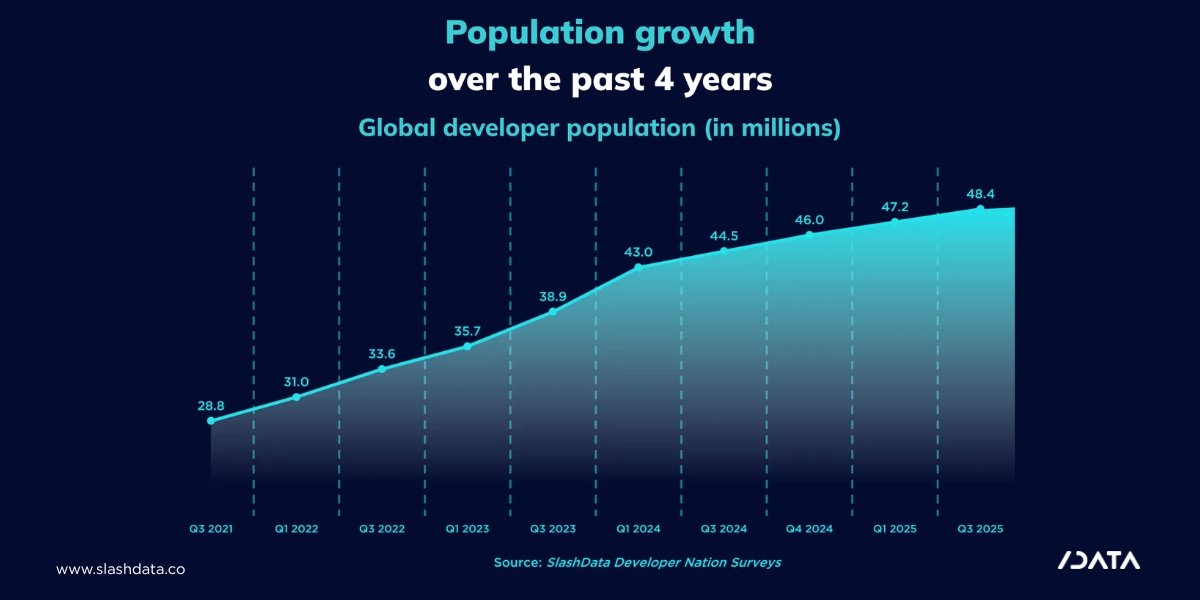
Over the years, SlashData has built a large and detailed dataset based on independent, recurring surveys and research. This dataset spans more than 20 years, making it one of the most comprehensive sources of developer insights available.

Collecting data is only part of the process. What makes SlashData different is how seriously it treats data quality. The company uses strict methods to ensure that responses are accurate and reliable. This includes filtering out low-quality or rushed answers and carefully designing surveys to get meaningful results.

This focus on quality is important. In today’s world, there is a lot of data, but not all of it can be trusted. SlashData’s approach helps companies rely on insights that are based on solid evidence.

Turning Data into Real Decisions

Data on its own is not enough. What matters is how it is used. SlashData works closely with companies to turn insights into actions. This could mean helping a company decide which features to build, which markets to enter, or how to improve engagement with developers.

Many of the world’s leading technology companies have worked with SlashData, including Google, Microsoft, and Salesforce. These companies rely on data to guide important decisions, and SlashData provides the clarity they need.

The process usually starts with understanding the client’s problem. From there, SlashData designs research that answers specific questions. The result is not just information, but guidance that can be used in real-world situations.

Helping Companies Navigate the AI Era

The rise of artificial intelligence has made the technology landscape even more complex. There are new tools, new platforms, and new ways of working. For many companies, it can be difficult to know where to focus.

SlashData helps cut through this complexity. By studying how developers are adopting AI tools, the company can identify which trends are real and which are just hype. This allows businesses to make smarter decisions about where to invest their time and resources.

For example, understanding which AI coding tools developers prefer can help companies choose the right platforms. It can also guide product development and marketing strategies.

What’s Next?

After more than 20 years, SlashData continues to focus on the future. The company’s goal is not just to understand what is happening today, but to predict what will happen next.

By combining long-term data with careful analysis, SlashData helps companies stay ahead of change. In a world where technology evolves quickly, this kind of insight is more valuable than ever.