By: Amarachukwu Jacinta Abosi
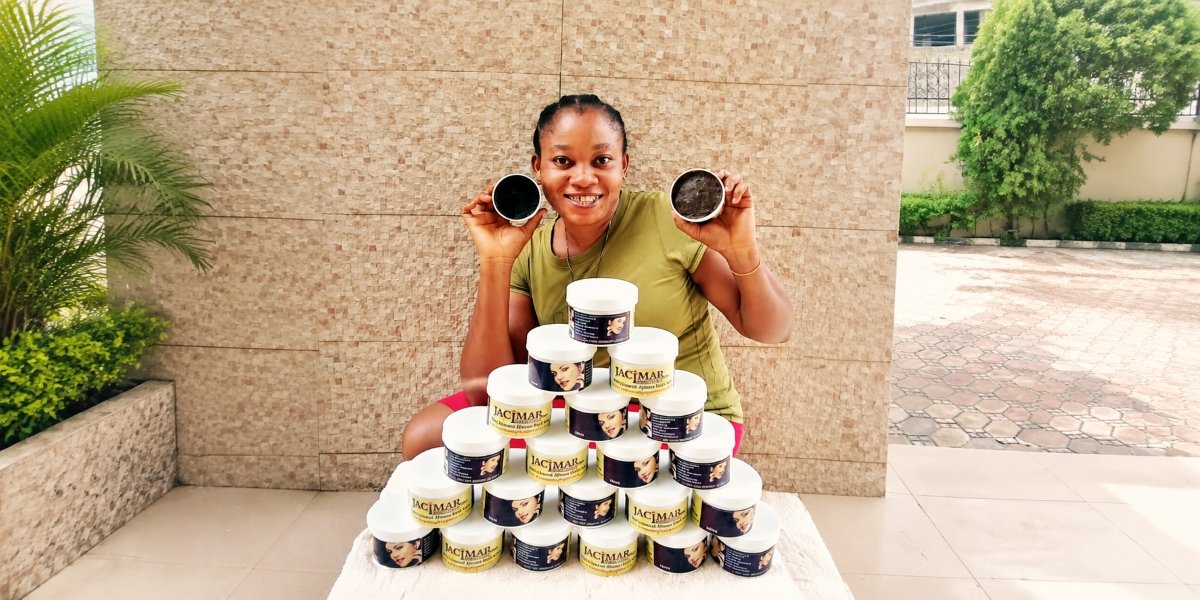
Founding a natural skincare brand looks, from the outside, like a fairly simple proposition. Source good ingredients, mix them, pour them into a nice bottle. Having built Jacimar Organics Therapy Limited from a kitchen counter into a functioning manufacturing operation, I can tell you that the gap between that outside impression and the actual work is enormous. The difference lives almost entirely in stages of the process most customers never see or think about.
Stage One: Ingredient Sourcing and Vetting

Every formulation starts long before any mixing happens, with the unglamorous work of vetting suppliers. “Organic” and “natural” raw materials (shea butter, plant oils, botanical extracts) vary meaningfully in quality depending on where they are sourced, how they are processed, and how they are stored before they ever reach a formulator’s hands. Two batches of shea butter labeled identically can behave completely differently in a formulation if one was processed with more residual moisture, or stored at a higher temperature, than the other. Part of building a reliable product line is building a relationship with suppliers rigorous enough that this variability gets caught before it ever reaches a customer, not after.
Stage Two: Formulation Trials
Once ingredients are sourced, the real formulation work begins, and it rarely goes right on the first attempt. A stable cream or lotion is, chemically speaking, an emulsion: a mixture of water and oil phases that do not naturally want to stay combined, held together by an emulsifier chosen specifically for the formulation’s other ingredients, its intended texture, and the conditions it will be stored under. Getting that balance right requires real trial and error, adjusting ratios, adjusting mixing temperatures, adjusting the order in which ingredients are introduced, and treating each failed batch as data rather than as a simple loss.
Stage Three: Stability and Shelf-Life Testing
This is the stage most absent from smaller, less rigorous operations in the natural products space, and the one I consider non-negotiable. A formulation that looks and smells perfect on the day it is made tells you almost nothing about how it will behave a month later, especially in a humid climate like Lagos. Real stability testing means deliberately storing samples of every batch under a range of temperature and humidity conditions and checking, at set intervals, for separation, discoloration, changes in scent, or microbial growth, building an actual shelf-life determination rather than guessing at one.
Stage Four: Preservation and Microbial Safety
Anything containing water, which includes most creams, lotions, and many soaps, is a potential growth medium for bacteria, mold, and yeast unless it is properly preserved. “Natural” preservation is a genuinely difficult formulation challenge, because many of the preservative systems consumers associate with “chemical” products exist specifically because naturally derived alternatives are often less broad-spectrum or less stable over time. Choosing and validating an adequate preservation system, through actual microbial challenge testing rather than assumption, is one of the most consequential and most frequently under-addressed steps in bringing a natural personal-care product to market safely.
Stage Five: Quality Control at Scale
The final, ongoing challenge is consistency, making sure that batch fifty behaves the same way as batch one. This requires documented protocols (precise measurements, recorded mixing times and temperatures, consistent testing checkpoints) applied every time, not just during initial development. It is the least visible part of the entire process, and the part most responsible for whether a brand can be trusted to perform the same way every time a customer reaches for it.

A Starting Checklist for Aspiring Founders
For anyone considering this path, a realistic starting checklist looks something like this: vet your suppliers before you fall in love with a recipe; budget real time and material cost for formulation trials that will fail before one succeeds; build stability testing into your timeline from the very first batch, not after a customer complaint; treat preservation as a formulation problem to solve rigorously, not a marketing constraint to work around; and document your process obsessively enough that consistency becomes structural, not a matter of luck.
None of this requires a pharmaceutical-scale laboratory. It requires the discipline of treating a cream, a soap, or a shampoo with the same seriousness a scientist would bring to any other formulation destined to touch the human body, because that is, in fact, exactly what it is.
Readers can learn more about Jacimar Organics Therapy Limited through the brand’s Instagram and Facebook pages. Amarachukwu Jacinta Abosi also shares more about her entrepreneurial journey on her LinkedIn.
Disclaimer: This article is provided for general informational and educational purposes only. It is not intended to replace professional advice, guidance, testing, or consultation. Readers should conduct their own research and consult appropriately qualified professionals before making decisions.