
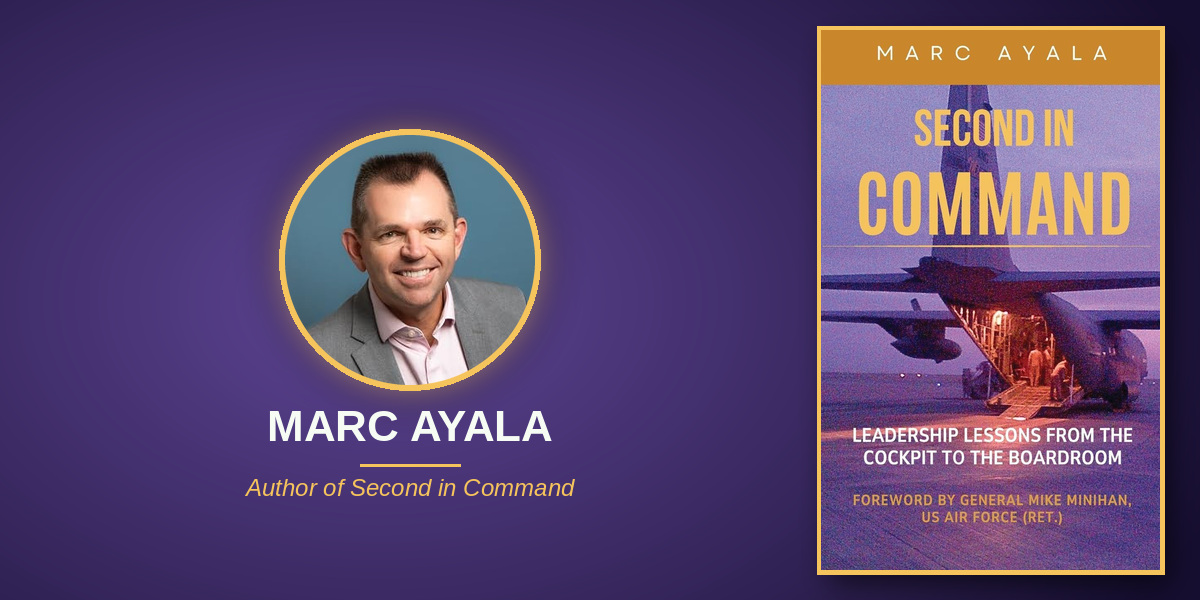
By: Oliver Parker
Before Marc Ayala sat across from a whiteboard with a marker explaining organizational dynamics, he sat in a cockpit scanning the Afghan countryside at zero dark thirty, wearing night vision goggles, calling out altitude and airspeed while his loadmasters prepared to drop thousands of pounds of supplies over a Forward Operating Base where soldiers were down to their last ammunition.
That kind of biography changes what leadership means.
Second in Command: Leadership Lessons from the Cockpit to the Boardroom is not written from the perspective of someone theorizing about high-performance teams. It is written by someone who was in them, under conditions where the gap between a good team and a mediocre one was not measured in revenue or client retention but in whether people came home. Ayala brings that weight into every chapter, and he does it without melodrama, without the performed humility common to military memoirs, and without losing sight of the practical question the book is built around: what does genuine leadership look like for the person who is not at the top?
The Copilot Leadership Checklist that anchors the book presents ten principles. But what makes them stick is the sequencing of the stories Ayala chooses to carry each one. The book opens with a war game exercise at Nellis Air Force Base where a flight of F-16 fighters abandons its escort mission to chase higher-value simulated kills, leaving Ayala’s C-130 exposed and, by the rules of the exercise, destroyed. The debrief becomes a public lesson in what happens when personal statistics override collective mission. The F-16 flight lead, to his credit, finds Ayala later and apologizes. The lesson is not that people are selfish. The lesson is that the wrong goals, pursued energetically, produce the wrong outcomes no matter how talented the people pursuing them.
From that opening the book travels to Oman, then Afghanistan, then into an Instructor Navigator role at Little Rock Air Force Base where a young Marc Ayala has to decide whether to hold a senior officer to the same accountability standard he would hold anyone else. Each story is self-contained and each carries a specific instructional payload. But read in sequence, they build something larger than a list of leadership principles. They build a portrait of a person learning, across years and deployments and genuinely harrowing nights, what it means to be the kind of professional that others can depend on when the situation falls apart.
The chapter on Integrity is the most morally demanding section of the book. Ayala is four rotations deep into Afghanistan, exhausted and spiritually depleted, questioning whether any of it has purpose. His crew carries out a combat airdrop in support of soldiers under direct fire. Then they are turned around immediately to evacuate a casualty. The casualty turns out to be the Taliban fighter who triggered an IED that just wounded one of our soldiers. Ayala describes the moment the discovery lands on the flight deck with the kind of clarity that only comes from actually having been there. He describes his own impulse to do something that would have ended his career and his integrity in a single second. What stopped him was not policy. It was a foundation that held under pressure. That distinction, between compliance and character, between doing the right thing because the rules say so and doing it because of who you are, is the difference the book is quietly making across all ten chapters.
There is also a tenderness in these pages that the genre does not always allow. The dedication is to all those who served in the Global War on Terror and to the “unseen heroes back home that made it all possible.” The community Ayala builds in Afghanistan, part-time Air National Guard members who are coaches and firefighters and small business owners and parents, spending NFL Sundays arguing over whose barbecue is better, is rendered with genuine affection. It reminds the reader that the people building these crews and executing these missions are whole people, not assets, and that the leadership philosophy being developed in these chapters was forged in relationships that lasted long after the deployments ended.
Second in Command rewards readers who believe that leadership is worth taking seriously, that the principles governing how a crew flies together in combat are the same principles governing whether a team trusts each other in a conference room, and that the person in the second seat is never as peripheral to the outcome as the org chart suggests.
Find Second in Command: Leadership Lessons from the Cockpit to the Boardroom by Marc Ayala on Amazon and discover what a career in military aviation reveals about the leadership qualities that hold up under the kind of pressure that never appears in a business school case study.