By: Kattie Muniz
“What is bachata dance?” Ask a Chicagoan this Labor Day week stretch and you’re liable to get more than a definition. You’ll get an invitation to a Hyatt ballroom turned Caribbean patio, to twining guitar music that once drifted through Santo Domingo’s bars, and to the city-spanning buzz that makes Chicago feel like the Dominican Republic’s northern cousin for four unforgettable nights.
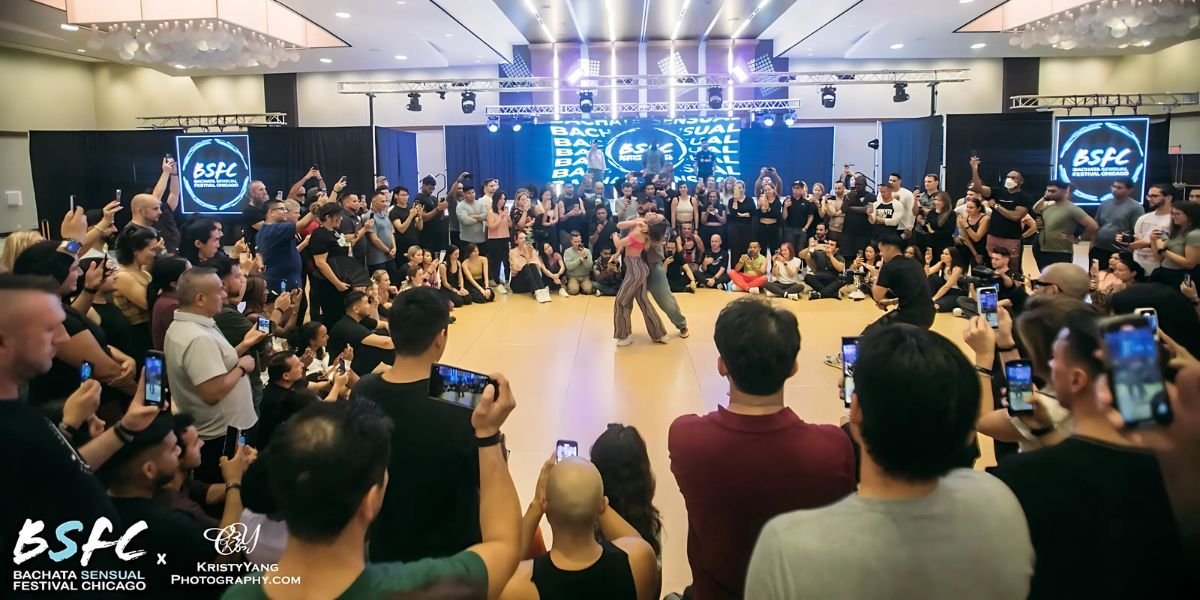
From September 4-8, 2025, the Bachata Sensual Festival Chicago returns to Rosemont’s Hyatt Regency O’Hare, pulling dancers from more than 30 states and a dozen countries. It is the weekend when the Midwest’s rail hub briefly restyles itself as America’s bachata capital — proof that a social dance born in marginalized Dominican patios now commands a prime spot on Chicago’s cultural calendar.
Why Chicago Keeps the Beat
Long before the festival planted its flag, the city’s Latin clubs primed the dance floors. Weekly socials at venues like Alhambra Palace, La Victoria, and Guild Row give locals a chance to listen to and to bachata music, as well as salsa, merengue, and other forms of Latin dance well past midnight. Add Latin Street’s 25-year-old studio network and you have a built-in audience of bachata dancers hungry for guest artists and late-night practice.
That base matters. Festivals thrive where students already take bachata class, listen to bachata music, and swap videos of their favorite bachata artists on group chats. In Chicago, the pipeline from weeknight lessons to international dance festivals feels seamless.
A Festival That Turns O’Hare Into the Malecón
Founder Damian Guzman — Puerto Rican transplant, Bachata Sensual America pioneer, and the mind behind Houston’s acclaimed spring event — picked Chicago for its geographic reach and its restless dance-floor energy. Last year’s inaugural edition almost sold out; this year’s sequel adds more late-night socials and a curated lineup that spans every style of bachata dance:
Dominican-style footwork labs that drill the basic bachata steps, hip movement, and playful syncopations.
Modern bachata dance sessions that blend ballroom dance styling with urban bachata body waves and dips.
Sensual bachata intensives led by Spanish ambassadors Jorelle & Monica and Brian & Alex, breaking down the isolation techniques and fusion-style bachata moves that dominate viral reels.
Sensual bachata master camps by some of the world’s most renowned couples, such as Korke & Judith, Pablo & Raquel, and Luis & Andrea.
DJs program everything from bolero-inspired first bachata recordings to faster music that pushes social dancers into sleek fusion dance patterns, and this edition also includes an amazing concert by bachata international sensation Dani J, visiting from Spain. The result: a 3:00 A.M. room where a basic dance sequence from traditional bachata meets the sweeping body rolls of bachata sensual in the span of a single song.
From Santo Domingo to the South Side
The term bachata once meant “back-yard party.” In the 1960s, the dance developed alongside guitar music and anguished bolero lyrics in working-class neighborhoods of Santo Domingo, the country of origin that still claims bachata as a national treasure. For decades, bachata style was considered “marginalized music,” dismissed by elites and banned from mainstream radio.
Yet, the bachata dance style continued to evolve. Juan Luis Guerra’s polished arrangements, Romeo Santos’s crossover hits, and a wave of bachata musicians modernized the sound. Dancers followed suit: classic basic steps gave rise to bachata moderna’s turn patterns and, eventually, the close-embrace, isolation-driven sensual dance that Korke & Judith codified in Cádiz.
That lineage will be on full display in Chicago, from workshops on characteristic Dominican bachata to showcase pieces dripping with body waves and dramatic dips.
Learning the Language of Connection
For newcomers wondering how to take their first bachata class, the festival’s beginner boot camps strip the moves down to a basic bachata four-count: side, together, side, tap. Instructors drill the footwork, then layer in turns, body isolation, and that unmistakable hip pop. Veterans chase mastery — workshopping ballroom-inspired frame, experimenting with fusion-style footwork, or perfecting the subtle lead-and-follow cues that make social dance style bachata feel effortless.
Like most Latin partner idioms, the exchange is wordless yet striking: the lead issues a gentle signal through posture, the follow replies in kind. Whether you dance bachata in Santo Domingo or Chicago, every subtle redirect echoes the moment bachata began as a backyard serenade. The genre blends bolero’s romance with merengue’s pulse — a characteristic of bachata that lets partners glide across traditions while the crowd soaks up the swirl of Latin music.
Such give-and-take proves that music and dance form a shared tongue: “We dance from the first guitar pluck to the hush of the final lyric,” shares Guzman. “And in that dialogue, strangers become partners without ever speaking a word.”
When the Beat Drops, the City Changes
At midnight on Saturday, the lights dim, and an emcee reminds the crowd that bachata originated as the voice of the barrio. Moments later, a bachata song by Antony Santos melts into a Juan Luis Guerra classic, and 1,000+ dancers glide in synchronized body waves — a living timeline of different bachata eras played out in real time.
By dawn, strangers have become partners. Chicago has collected another cache of bachata social stories — whispers of fusion-style bachata experiments, of first dips gone right, of guitar-fueled urban bachata tracks that will live on in memory long after the weekend ends.
Know Before You Go
Dates: September 4th-8th, 2025.
Venue: Hyatt Regency O’Hare, Rosemont.
Passes: Tiered day and full-weekend options, with additional volunteer discounts available.
Pro Tip: Pack comfortable shoes. Ballrooms at Chicago festivals run cooler than Caribbean salons, but the dance floors are larger, and you’ll cover miles in basic steps alone.
Chicago may not be the place where bachata was created, but for one weekend, it becomes the country’s most electrifying answer to that evergreen question: “What is bachata dance?” The answer is a fusion of history and modern dance, marginalized music reclaimed and reimagined, a social dance style that invites everyone onto the floor, and, in early September, it is Chicago’s heartbeat.