
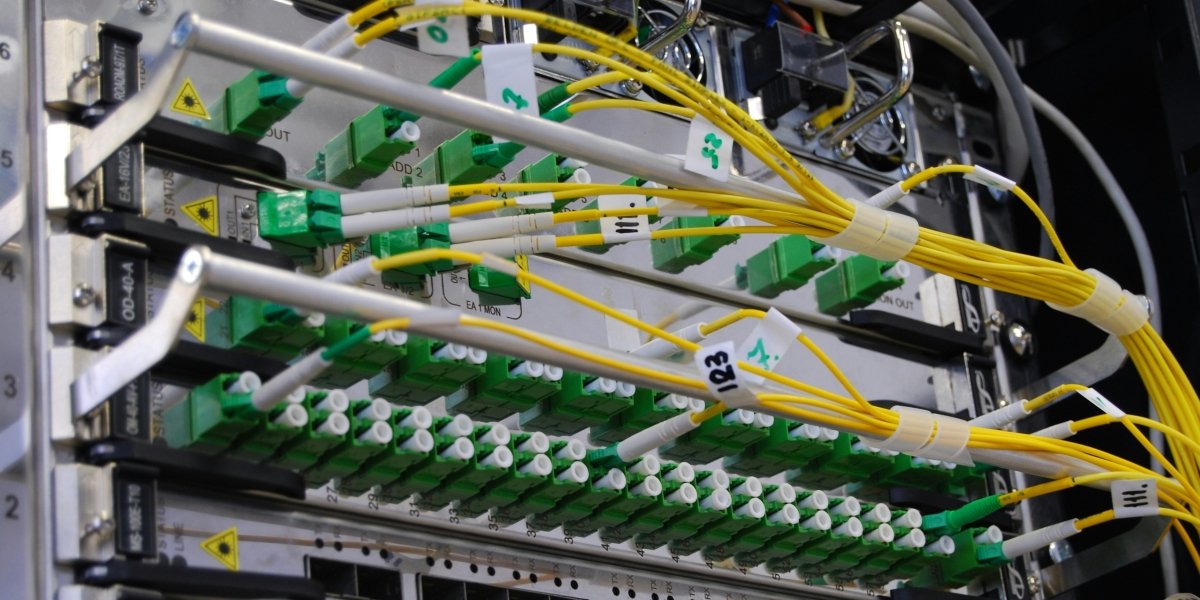
Modern communications infrastructure depends on more than undersea cables and data centers. The less-visible layer, the equipment used to manufacture and process the components inside that infrastructure, is where some of the most important and least-covered businesses operate.
Specialty fiber optic equipment is one example. A handful of companies, most of them small, most of them nowhere near a major tech hub, build the machines that make modern fiber-based communications physically possible.
The component story most people miss
Every modern communication system that uses fiber optics depends on a specific manufacturing capability: the ability to splice optical fibers together with extreme precision. The fibers themselves are roughly the diameter of a human hair, and the cores carrying the actual light signal are smaller still, often around 9 microns across.
Joining two fibers means aligning those cores within fractions of a micron. Then heating the glass to temperatures reaching 2,000°C using a controlled electrical arc. Fusing the ends. Verifying that the resulting splice has acceptable optical loss. That sequence gets repeated thousands of times in a major cable installation, in a submarine cable manufacturing run, in the production of a fiber laser or gyroscope or specialty sensor (pick one, the process is the same).
The equipment that does this work, called fusion splicers, comes from a small number of manufacturers worldwide. Standard splicers handle telecom-grade single-mode fiber. Specialty splicers are built for the harder cases: large mode area fibers used in high-power lasers, polarization-maintaining fibers for navigation systems, photonic crystal fibers that show up in advanced sensing and quantum applications. Different problems, different equipment.
That specialty subcategory is where companies like 3SAE Technologies operate. Headquartered in Franklin, Tennessee, 3SAE has been building specialty fusion splicing and glass processing equipment since around 2000, supplying customers across submarine cable manufacturing, defense, aerospace, and advanced research.
Why specialty matters here
Standard fusion splicers are commodity products. They work fine for telecom fiber, the high-volume application that drives most of the global splicer market. But they cannot handle specialty fibers, where the geometry, materials, and operational requirements differ enough that standard equipment cannot reliably produce a good splice.
Specialty fiber applications matter increasingly. Fiber lasers show up in industrial cutting and welding, defense systems, medical devices, advanced research. Gyroscopes built on fiber optics handle navigation for aircraft, ships, and missiles, and that list is getting longer as autonomous vehicles start needing the same precision. Specialty sensing is growing too, structural monitoring, oil and gas exploration, quantum computing research.
All of those applications depend on components that have to be manufactured with specialty equipment. Without the equipment, the components cannot be built reliably. The systems downstream from that just do not work. It is a short chain, and every link matters.
The supply chain implications
There is a strategic dimension to specialty equipment manufacturing that gets less attention than it deserves. Much of the equipment used in defense, aerospace, and critical infrastructure has to be sourced domestically or from trusted allies. ITAR regulations (the International Traffic in Arms Regulations, which govern export of defense-related items) restrict which equipment can be sold where. That is not a loophole or a preference. It is law. Domestic supply chain requirements layer on top of that, affecting what gets specified for sensitive applications.
That creates structural demand for U.S.-based specialty equipment manufacturers serving defense, aerospace, and government markets. The customer base is not huge. But it is well-funded and technically demanding, and it is locked into domestic suppliers for the sensitive stuff in ways that do not change based on price.
3SAE’s customer base reflects this dynamic. Submarine cable manufacturers, fiber laser builders, defense contractors, aerospace companies, research institutions: they all rely on domestic specialty equipment for at least part of their production. Some of that is regulatory. Some is just risk management. The company has been in that space long enough that the relationships, the technical depth, the operational track record are all there.
What technical depth actually looks like
In specialty hardware markets, technical depth is more than product specifications. It is the accumulated operational knowledge that lets a manufacturer produce equipment that works consistently across the variations a customer base will throw at it.
3SAE’s patented Ring of Fire wide area plasma technology is one example of how that depth shows up in practice. Standard splicers use a two-electrode design that creates a relatively narrow heat zone. The three-electrode approach produces a more uniform heat distribution, which gives operators significantly better control over how the glass melts and fuses. That matters enormously for specialty fibers, where the heating profile determines whether the splice survives at all.
The three-electrode design also enables glass processing operations that two-electrode systems cannot reliably perform. Tapering, for instance, is where the fiber diameter gets gradually reduced over a defined length to enable optical mode matching. Lensing shapes the fiber tip to focus the output beam. Combiner manufacturing is a different thing entirely: multiple input fibers fused into a single output for high-power laser systems. None of these are interchangeable. Each one matters to a specific set of customers who cannot get the same result from standard equipment.
Those capabilities are not just marketing differentiators. They are the operations that make certain types of advanced fiber optic components physically possible. Without specialty equipment that can perform them reliably, the components cannot be made, and the downstream systems cannot be built.
The economic geography
One detail worth pulling from the specialty manufacturing story is how widely distributed these companies are geographically. Coastal tech hubs get most of the attention in business coverage, but a lot of the specialty hardware that the broader economy depends on gets built in places that do not fit the typical narrative.
Middle Tennessee works for fiber optic equipment manufacturing because the technical workforce is available, the cost structure is reasonable, and the customer base is global enough that geographic location does not matter much. Equipment ships to customers around the world. Engineering teams can attract and retain talent that might be more expensive in coastal markets. Business operations stay closer to the customer industries, like defense and aerospace, that increasingly have a presence across the Southeast and Midwest.
That distributed pattern shows up across specialty industrial categories. Specialty hardware manufacturers tend to cluster in places like Tennessee, Indiana, Pennsylvania, North Carolina. Often privately held. Often run by engineers rather than financial managers. The time horizons are longer, which is part of why they can sustain the kind of technical depth that venture-backed competitors usually cannot.
The takeaway
The hidden supply chain behind modern communications infrastructure runs through companies most people will never hear about. Specialty equipment manufacturers like 3SAE sit upstream of the visible economy, making possible the components that make possible the systems that make possible the connectivity everyone takes for granted.
It is not a glamorous business. The customer base is small, the products are highly technical, and success gets measured in microns of precision and decibels of optical loss. Nobody is tracking user growth here.
But it is a real business. A durable one. 3SAE has been quietly at this for over two decades, and the broader economy genuinely depends on what it produces, whether or not anyone is paying attention to that fact.
Worth noting, even if it does not fit the narratives that dominate most business coverage. A lot of the most important industrial work in the country gets done in exactly this way.