
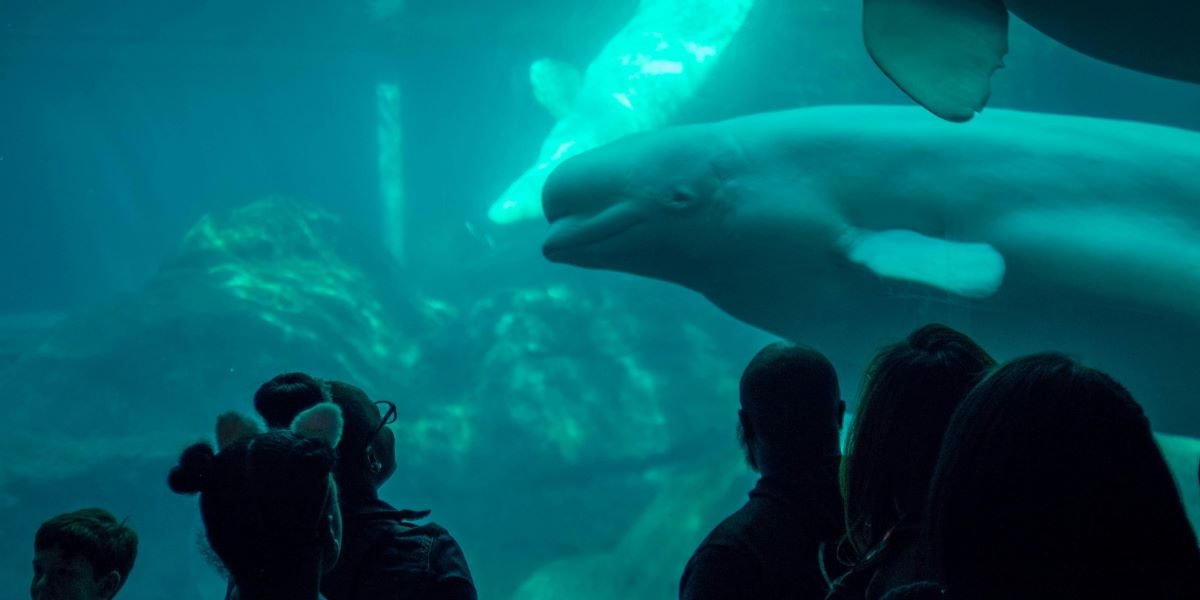
Four female beluga whales arrived at Chicago’s Shedd Aquarium on August 13 after an overnight cargo flight from Toronto, doubling the number of rescued Marineland belugas now living in the aquarium’s 3-million-gallon Abbott Oceanarium and advancing an unprecedented international effort to rehome 30 whales from a financially distressed marine park that had threatened to euthanize the animals if new facilities could not be found.
Key Takeaways
- Four female belugas named Caspian (27), Peekachu (23), Secord (22), and Rain (20) arrived at Shedd Aquarium on August 13 after being transported by truck from Marineland in Niagara Falls, Ontario, to Toronto Pearson airport, then flown to Chicago aboard a Boeing 777 cargo plane.
- The new arrivals join four other female belugas, named Acadia, Lillooet, Osiris, and Sierra, that arrived from Marineland on July 21, bringing Shedd’s total beluga population to 16.
- Shedd plans to receive up to two additional belugas from Marineland, potentially bringing its total Marineland rescues to 10.
- A consortium of four U.S. aquariums and one Spanish aquarium has committed to taking all 30 Marineland belugas, with the goal of completing all transfers by August 31.
- Marineland, which closed to the public in 2024, had threatened to euthanize the belugas after Canada’s Minister of Fisheries denied permits for a proposed sale to a Chinese theme park.
Transport Operation Moved Belugas by Truck, Police Convoy, and Cargo Plane
The logistics behind the August 12-13 transfer reflected the complexity of moving marine mammals across international borders. Shedd staff traveled to Marineland’s facility in Niagara Falls, Ontario, on August 12 to prepare the steel transport containers used for the move. Each container was customized to the individual animal, with specialized stretcher sizes, water-filled interiors, and foam padding tailored to accommodate the physical dimensions and behavioral tendencies of each whale.
The four belugas were lifted by crane into their containers, loaded onto trucks, and driven in a police-escorted convoy to Toronto Pearson International Airport. There, they were loaded onto a Boeing 777 cargo plane alongside two additional Marineland belugas bound for Georgia Aquarium in Atlanta. The flight departed Toronto and arrived in Chicago overnight, with the four Shedd-bound whales entering the Abbott Oceanarium on Thursday morning.
Charlie Jacobsma, Shedd’s director of animal behavior and training, described the operation as one where every detail is tailored to the individual animal. The transport team included veterinarians specializing in marine mammal medicine and animal care specialists who accompanied the belugas throughout the entire journey, monitoring each whale continuously from the moment it left the water in Niagara Falls until it entered the pool in Chicago.
Eight Rescued Belugas Now Settling into Abbott Oceanarium
The four August arrivals, Caspian, Peekachu, Rain, and Secord, were chosen to travel together because of their preexisting social bonds at Marineland. Beluga whales are a highly social species, and the decision to move bonded groups together is a deliberate welfare measure designed to reduce stress during transport and accelerate adjustment to new surroundings. Shedd observed the same approach with the first group of four belugas, Acadia, Lillooet, Osiris, and Sierra, that arrived July 21. Those whales were also selected as a sub-pod based on their established relationships.
Shedd staff have reported early signs of affiliative behavior among the rescued belugas, including rubbing together, calm and synchronized swimming, and other cooperative interactions. Jacobsma noted that belugas take cues from one another, meaning the presence of familiar whales nearby provides confidence to new arrivals as they explore unfamiliar habitats and encounter unfamiliar caretakers.
None of the Marineland belugas has been put on public display at Shedd, and the aquarium has not set a timeline for when that might happen. The whales are being kept in areas of the Abbott Oceanarium that are out of view of guests, a decision driven by the pace of each animal’s adjustment rather than a fixed institutional schedule. Dr. Karisa Tang, lead veterinarian and vice president of animal health at Shedd, cautioned that transport efforts of this magnitude are inherently difficult, and the aquarium expects to learn more about the rescued belugas’ health and condition in the coming days and weeks.
Marineland’s Financial Collapse Forced an International Rescue Timeline
The rescue operation stems from a cascading series of events at Marineland, a longtime tourist attraction in Niagara Falls, Ontario, that closed its doors to the public in 2024. The park had been cited by the Canadian government for animal welfare concerns, and its financial situation deteriorated to the point where it could no longer support the ongoing care of its 30 beluga whales.
In September 2025, Marineland applied for permits to sell the belugas to a theme park in China. Canada’s Minister of Fisheries, Joanne Thompson, denied those permits, stating the transfer was not in the whales’ interest. Marineland responded by warning that its only remaining options were relocation or euthanasia, citing what it described as a critical financial state.
Earlier in 2026, Marineland and Canada’s Accredited Zoos and Aquariums reached out to Shedd and several other facilities accredited by the Association of Zoos and Aquariums to investigate a rescue solution. After reviewing feasibility plans and logistics, U.S. and Canadian authorities provided the necessary authorizations for an emergency rescue, recognizing the urgency of the situation. The consortium that emerged includes Shedd Aquarium in Chicago, Georgia Aquarium in Atlanta, SeaWorld in San Antonio, and one Spanish aquarium. SeaWorld San Antonio received seven belugas on August 3, and additional transfers are scheduled through the end of August, with the goal of moving all 30 whales out of Marineland by August 31.
Animal Welfare Groups Raise Questions About Long-Term Outcomes
The rescue has drawn support from conservation and animal welfare communities, but it has also prompted questions about what comes next for the belugas once they are settled in their new facilities. Camille Labchuk, executive director of Animal Justice, a Toronto-based animal law advocacy group, raised concerns about whether the receiving aquariums will breed the rescued belugas. The question carries weight because breeding programs would perpetuate captive beluga populations rather than working toward a model where the species lives in more naturalistic settings.
Separately, Lori Marino, co-founder and president of the Whale Sanctuary Project, has been developing a $15 million open-water sanctuary in Port Hilford Bay, Nova Scotia, designed to provide a more naturalistic environment for captive cetaceans. Marino acknowledged that the aquarium placements are an improvement over the Marineland situation but pushed for a broader conversation about the long-term future of captive beluga care.
The Marineland rescue also carries a complicated historical context. In 2021, Mystic Aquarium in Connecticut received five belugas from Marineland. Two of those whales died within the first year, drawing criticism from animal welfare organizations and raising questions about the risks inherent in long-distance cetacean transfers. Shedd has emphasized its own track record, noting more than 50 years of animal rescue experience and deep institutional expertise in beluga care, as the basis for its involvement in the current operation.
Shedd May Receive Two More Belugas Before August 31 Deadline
Shedd Aquarium has indicated it plans to receive up to two additional belugas from Marineland, which would bring its total Marineland rescues to 10 and its overall beluga population to 18. Andrew Burns, a longtime advisor and lawyer for Marineland, confirmed that the timeline for those additional transfers is still being finalized. As of August 13, 11 belugas and four dolphins remained at the Marineland facility in Niagara Falls.
The pace of the operation reflects the urgency of the situation. With Marineland unable to sustain care and the consortium committed to clearing the facility by the end of August, the transfer schedule has moved at a speed that marine mammal rescues rarely require. Marineland described the operation as unprecedented, asserting that the coordinated relocation is the animals’ only viable path to survival.
For Shedd, the rescued belugas represent both a welfare commitment and a long-term operational expansion. The Abbott Oceanarium, a cold-water habitat that holds 3 million gallons, was designed with the capacity to support a larger beluga population. The aquarium has positioned the rescue as consistent with its institutional mission, framing the incoming whales as animals that will receive individualized care, access to diverse nutritional seafood, clean water, and round-the-clock monitoring for the remainder of their lives.
FAQs
Can the Public See the Rescued Belugas at Shedd Aquarium?
Not yet. None of the Marineland belugas has been put on public display. The whales are being housed in areas of the Abbott Oceanarium that are out of view of guests while they settle into their new environment. Shedd has not set a timeline for when the rescued belugas will be visible to visitors, stating that the process is being guided by each animal’s individual pace of adjustment.
Why Were the Belugas Rescued from Marineland?
Marineland, a marine park in Niagara Falls, Ontario, closed to the public in 2024 and faced severe financial constraints that left it unable to care for its 30 beluga whales. After Canada’s Minister of Fisheries denied permits for a proposed sale to a Chinese theme park, Marineland warned that the whales would be euthanized if new homes were not found. A consortium of accredited aquariums in the U.S. and Spain agreed to take all 30 whales in an emergency rescue operation.
How Many Belugas Will Shedd Aquarium Have in Total?
Shedd had eight belugas before the Marineland rescue began. With eight Marineland belugas already in residence and plans to receive up to two more, Shedd’s total beluga population could reach 18. The aquarium’s 3-million-gallon Abbott Oceanarium was designed with the capacity to support an expanded population.