Eleyet McConnell’s “Your Eyes” and the Radical Business of Growing Old Together

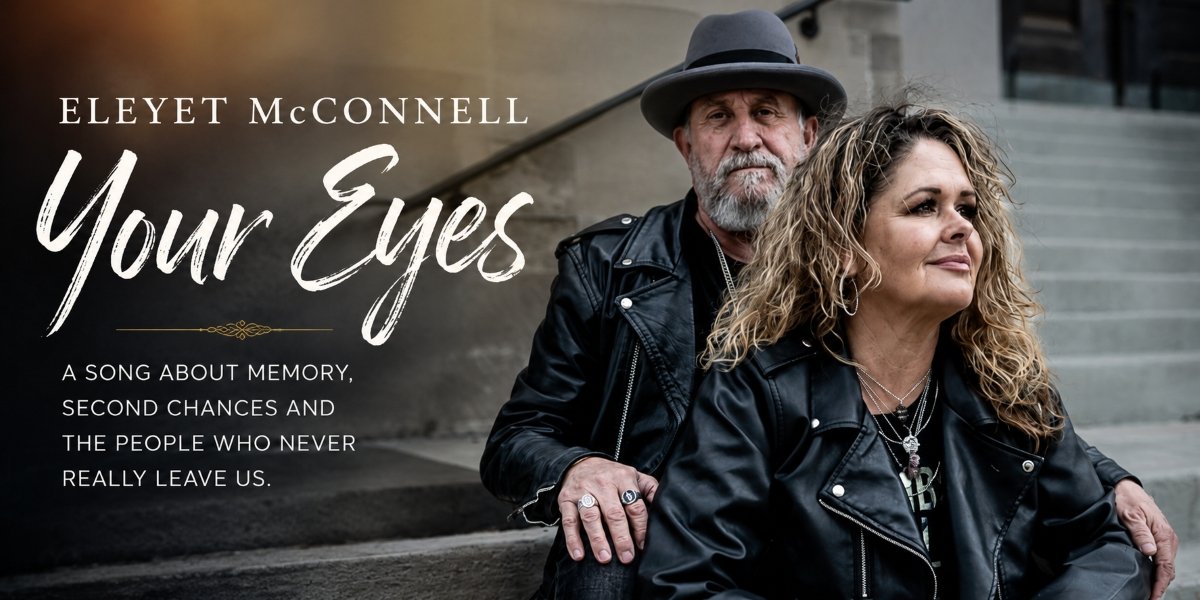
By: Julian Blackwood
By the time rock and roll discovered the power ballad, it had already figured out sex, heartbreak, jealousy, cars, death, teenage rebellion, and at least fourteen different ways to describe Saturday night. What it never got particularly good at was adulthood. Not getting older as tragedy, mind you, but getting older as an achievement. Staying. Remembering. Looking at somebody after the years have done their damage and deciding the view is still pretty good.
Which brings us to Eleyet McConnell’s “Your Eyes,” a piano-driven ballad with strings, no apparent embarrassment about being one, and even less interest in convincing anybody under 25 that emotional maturity is cool.
Good for them.
The Ohio husband-and-wife duo have demonstrated considerably more muscle elsewhere on The Journey. “The Ledge” comes armed for confrontation, the sort of classic-rock bruiser that understands guitars are useful for more than decorating choruses. “Your Eyes” goes in the opposite direction. Instead of turning everything up, Angie and Chris McConnell strip everything back.
Piano. Strings. Voice. Song.
Turns out that’s plenty.
Chris McConnell has explained that the song began with an unexpected sighting of a high-school heartbreak in Walmart. Yes, Walmart. Forget Paris in the rain. Forget the last train out of Manhattan. This is American romance in the twenty-first century: fluorescent lights, shopping carts, and suddenly seeing somebody who can collapse several decades of your life into approximately three seconds.
Chris didn’t approach her. Instead, he wondered whether they could pick up a conversation where they had left it years before. By the time he exited the store, he had the bones of a song. He brought it to his wife. Angie, displaying either remarkable marital confidence or the superior instincts of a songwriter, added the bridge.
There’s your love story.
And it’s a better one than the song’s premise initially suggests, because “Your Eyes” isn’t really about wishing you’d ended up with somebody else. It’s about recognizing the strange persistence of human connection. People disappear. Years accumulate. Hair turns gray. But certain faces remain filed somewhere in the brain, waiting for an accidental encounter beside the household goods aisle to bring everything roaring back.
Angie McConnell understands this immediately.
Her vocal is the record.
Plenty of singers could attack a ballad like this with sufficient lung capacity to frighten nearby wildlife. McConnell doesn’t. She sings it like somebody remembering rather than auditioning. That distinction matters.
Her instrument has power, but what makes the performance work is the withholding of it. She lets phrases settle. She permits the piano to occupy emotional territory that lesser singers would immediately colonize with melisma. When the arrangement expands, she expands with it rather than attempting to outrun it.
Think less vocal Olympics, more Linda Ronstadt’s instinct for making plain language hurt. There’s some of Karen Carpenter’s conversational intimacy in the quieter passages, some Melissa Etheridge grit underneath the polish, and enough of Ann Wilson’s authority to remind you that restraint only works when the listener senses what the singer could unleash.
But comparisons get you only so far.
Angie sounds like Angie, which is the harder accomplishment.
Producer Patrick Himes wisely leaves the song alone. That sounds like faint praise until you consider how many ballads have been murdered by producers convinced that every emotional statement requires another layer. Here, piano establishes the architecture and Kimmi Samson’s strings provide dimension without turning the arrangement into orchestral wallpaper.
The strings are especially effective because they don’t announce: FEEL SOMETHING NOW.
They suggest.
That’s rarer than it should be.
The songwriting operates according to the same principle. “Your Eyes” doesn’t hide behind elaborate imagery. Its central idea is memory expressed through the physical detail that survives most vividly: another person’s eyes. The sentiment could become Hallmark material quickly, except the McConnells introduce something most love songs desperately avoid.
Age.
Gray hair enters the picture.
So does friendship.
That changes everything.
Suddenly this isn’t another song promising eternal passion from people who haven’t survived a mortgage together. It understands companionship as romance’s less glamorous but considerably tougher older sibling.
And because Angie and Chris are themselves married collaborators, there’s an amusing extra dimension to Chris writing about encountering an old flame and Angie becoming the person who completes the song. The past supplies the spark; the present finishes the composition.
Try getting that from an algorithm.
What Eleyet McConnell accomplishes with “Your Eyes” is neither revolutionary nor particularly fashionable. They’ve written a traditional ballad using traditional tools and traditional emotions. Anyone demanding formal innovation should look elsewhere.
But tradition isn’t the same thing as irrelevance.
A song this straightforward lives or dies on whether you believe the people performing it. There are no production tricks substantial enough to conceal dishonesty. No fashionable sonic abstraction to provide cover. Just melody, words, arrangement, and Angie McConnell standing in the middle of them.
You believe her.
That’s why the record works.
In a musical culture perpetually selling youth back to the young, “Your Eyes” makes a modest case for accumulated experience. Memory matters. Companionship matters. The people who knew us before we became whoever we think we are now matter.
And sometimes the old-fashioned power ballad still matters too.
Especially when somebody remembers how to sing one instead of merely performing it.