There is a moment in every mystery when the past stops feeling safely buried. A name resurfaces. An old television listing appears. A forgotten sketch flickers back to life. A story that once sounded impossible suddenly feels possible enough to demand another look.
What if Ferris Bueller, the charming rule-breaker who became one of the defining movie characters of the 1980s, was not entirely fictional?
That question opens Saving Ferris Butler, an independently produced documentary about forgotten comedy pioneer Ferris Butler, the earliest years of New York cable access, an infamous season of Saturday Night Live, legendary songwriter Beverly Ross and one man’s claim that his name and personality may have helped inspire John Hughes’s Ferris Bueller’s Day Off.
Yet this is more than Hollywood lore. It is a rescue mission asking whether a film can return an overlooked artist to history before his story disappears.
Before Bueller, There Was Butler
From 1974 to 1979, Butler created Waste Meat News, a wild New York cable-access comedy program that predated today’s independent digital channels. A 1976 TV Guide listing helps establish its place in television history. Its handmade spirit anticipated the do-it-yourself comedy that later flourished online.
Ferris eventually reached network television as a writer and performer during the turbulent 1980–81 season of Saturday Night Live. The original cast and Lorne Michaels had departed, and producer Jean Doumanian’s new company entered beneath extraordinary pressure. The season became remembered for turmoil and critical hostility, but that broad judgment often erased the artists who took genuine creative risks inside it.
One of Butler’s memorable contributions was “Leather Weather,” featuring Denny Dillon and Charlie Rocket. Strange, visual and provocative, the sketch captures an artist determined to create material that could not be ignored.
Ferris has maintained for decades that he may have inspired Ferris Bueller. The unusual shared name is only the beginning. Butler recalls legendary improvisational teacher Del Close telling him that his name and personality would make a great character. John Hughes emerged from Chicago’s comedy and advertising world, creating intriguing circumstantial connections.
There is no document in which Hughes declares that he based Ferris Bueller on Ferris Butler. The film does not manufacture a smoking gun. It assembles memories, testimony and context, then allows viewers to decide whether the resemblance represents direct influence, coincidence, mythology, or some combination of all three.
The mystery attracts the audience, but Butler’s humanity becomes the real story. His life moved through underground television, Studio 8H, taxi driving, Las Vegas and painful financial loss. He stood close to the center of American popular culture and still found himself fighting to prove he had ever been there.
Ferris was also married to Beverly Ross, the celebrated songwriter who co-wrote “Lollipop” and wrote with Elvis Presley. Her presence deepens the film’s examination of authorship, credit and the unpredictable ways artistic legacies survive.
The Film and Its Voices
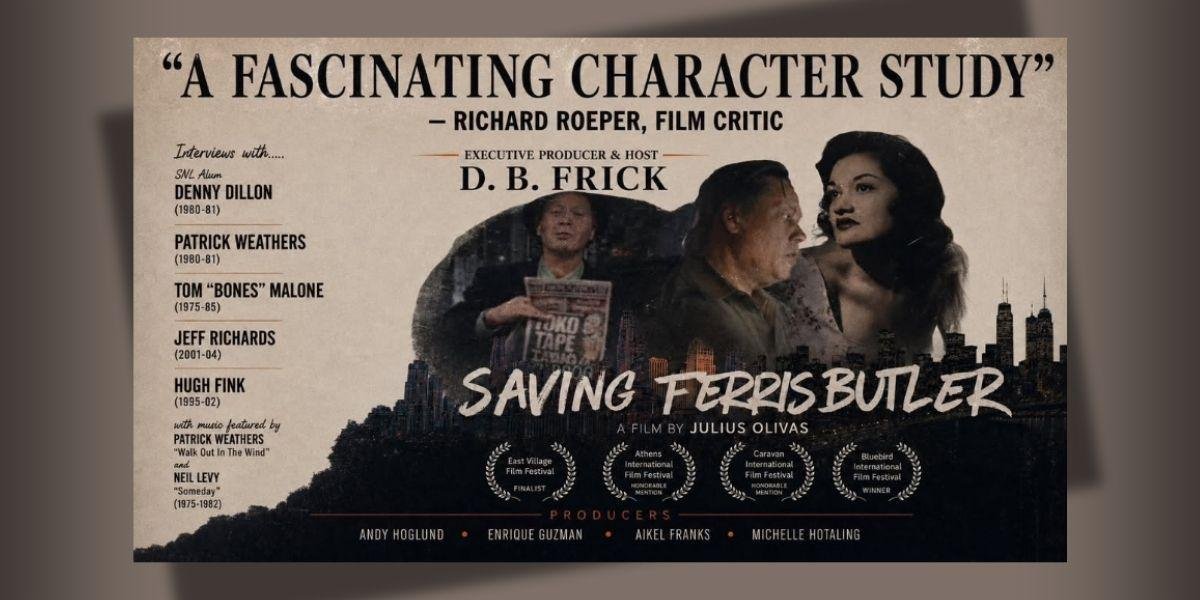
Directed by Julius Olivas, Saving Ferris Butler is hosted and executive-produced by D.B. Frick, who conducted its central interviews and largely financed the project. Producers include Enrique Guzman, Aikel Franks, Andy Hoglund and Michelle Hotaling.
The film gathers voices from several generations of comedy: Ferris Butler; Denny Dillon; Patrick Weathers; Hugh Fink; Jeff Richards; Tom “Bones” Malone; Neil Levy; Andy Hoglund; Jason Klamm; and Ferris’s family and creative circle.
Their memories sometimes align and sometimes collide, revealing how unstable cultural history can be. Music from SNL alumni Neil Levy and Patrick Weathers strengthens the connection to the community being documented. Weathers’s “Walk Out in the Wind” brings melancholy to the Las Vegas passages, while Levy’s “Someday” carries Ferris’s legacy toward the conclusion.
Made independently for less than $35,000, the film had no studio guaranteeing access, publicity or distribution. It was built through archival research, personal appeals and persistence. Frick brought decades of experience as a writer, performer, producer, radio personality and comedy teacher.
Olivas avoids turning Ferris into either a saint or a punchline. The result is funny, wounded, contradictory and human. Chicago film critic Richard Roeper captured it in four words: “A Fascinating Character Study.”
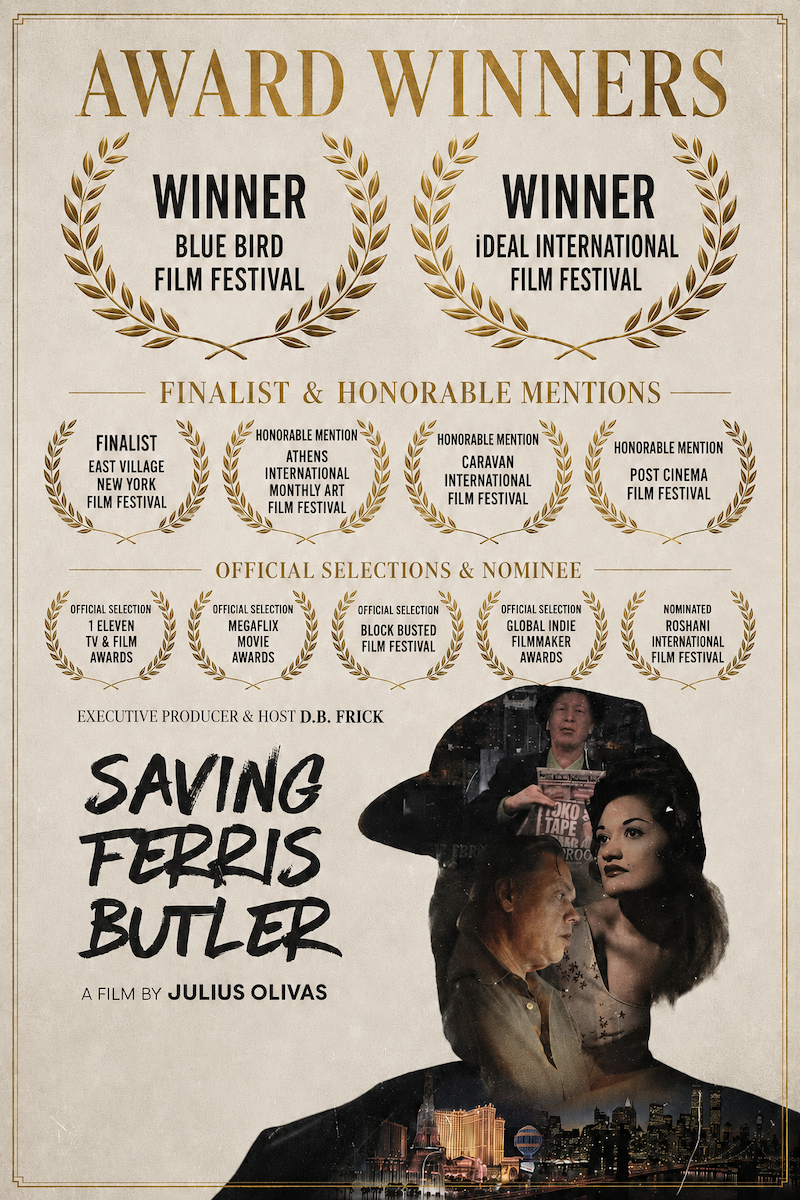
The film has also earned festival selections, honorable mentions and wins, Saving Ferris Butler is proud to be an award-winning documentary, earning victories at the Blue Bird Film Festival and the iDEAL International Film Festival. The film was also named a finalist at the East Village New York Film Festival, received honorable mentions from the Athens International Monthly Art Film Festival, Caravan International Film Festival and Post Cinema Film Festival, and earned additional selections and recognition from festivals around the world. Every laurel helps bring Ferris Butler’s extraordinary story, and the legacy of this overlooked comedy pioneer, to a wider audience.
The Sold-Out World Premiere
On June 11, 2026, exactly 40 years after the release of Ferris Bueller’s Day Off, Saving Ferris Butler held its sold-out world premiere at Manhattan’s historic Quad Cinema.
The 106-seat celebration included music, a costume contest, giveaways, a raffle and a live Q&A with D.B. Frick, Julius Olivas, Patrick Weathers, Andy Hoglund and Joshua Dudley, followed by an after-party at Society Cafe.
The film had already entered the national conversation through Entertainment Weekly. In his recap of the Saturday Night Live Season 51 finale, writer and film participant Andy Hoglund identified Butler as a potential inspiration for Ferris Bueller and recommended the documentary.
Press coverage continued through Mike Stephen’s Chicago-based Outside the Loop RADIO, a 38-minute Projection Booth special with Mike White and publisher Jeff Myhre’s extensive StageBiz interview. Each appearance promoted the film while adding to the oral history surrounding Butler.
Preserving Ferris at the Paley Center
The mission extends beyond exhibition. The production has been working to preserve the documentary alongside Ferris Butler’s existing materials at the Paley Center for Media, with an archival milestone planned for October 2026 in New York and Los Angeles.
Butler’s early career survives through fragile cable-access footage, scattered records and memories. Publicity lasts days; an archive can make the story discoverable to future scholars, journalists, comedians and audiences.
Chicago, the Pickwick and a Community of Partners
From September 18 through September 24, 2026, Saving Ferris Butler will play an Academy-qualifying engagement at the historic Pickwick Theatre in Park Ridge, Illinois. Screenings are scheduled daily at 2:00, 4:00, 6:00 and 8:00 p.m.
Chicago is not simply another market. John Hughes’s films are inseparable from Chicagoland, and Park Ridge sits within the landscape that inspired his fictional Shermer, Illinois. Bringing Butler’s story there is a homecoming for the mystery itself. Opening-weekend evenings will include appearances, comedy performances and Q&As with members of the film team and comedy community, including Patrick Weathers, Andy Hoglund and D.B. Frick.
The run has become a larger collaboration. Chicago comedy partners the Annoyance Theatre, the Den Theatre and Bughouse Theater are supporting the engagement through cross-promotion, ticket initiatives and planned live participation. Their involvement connects the improvisational history inside the documentary with the artists keeping that tradition alive today.
Also The Bughouse Theater will perform Improv at several screenings.
The production’s sponsors are equally essential. Hilton Garden Inn Chicago O’Hare is providing six complimentary nights for the opening weekends Raffle, giving the independent team a home base while echoing Ferris’s years of travel and fondness for hotels.
American Place Casino is contributing a gift basket and tickets to see comedian Dave Attell. That connection reflects the documentary’s difficult Las Vegas chapter and Ferris’s history with gambling. If gambling is causing a problem, call 1-800-GAMBLER.
Raising Cane’s Chicken Fingers® is providing 28 meal vouchers, one for every scheduled screening, along with keychains and audience giveaways. The partnership offers a playful connection to Ferris’s love of fast food and chicken fingers.
Publicity for the Chicago engagement is being handled by Garnier Public Relations. The firm is helping introduce Saving Ferris Butler to Chicago audiences and media ahead of its Academy Award–qualifying run. Its campaign highlights the documentary’s deep connections to Chicago’s film, television and comedy history.
Together, these theaters and sponsors are transforming a one-week booking into a community event. Their rooms, performances, promotion, prizes and vouchers demonstrate how independent cinema survives: many organizations deciding that an overlooked story deserves to be seen.
What Does It Mean to Save Someone?
A documentary cannot undo a firing, recover a lost fortune or force history to deliver a clean verdict. But it can preserve a voice. It can gather witnesses before they are gone, rescue footage from obscurity, put a forgotten name on a marquee and persuade an audience to spend 46 minutes with someone it might never otherwise have known.
Ferris Butler’s claim may bring viewers into the theater. His humanity is what remains when the lights come up.
Life moves pretty fast. Cultural memory moves faster. Saving Ferris Butler asks us to stop and look at someone history nearly left behind.
Pickwick Theatre: 5 South Prospect Avenue, Park Ridge, Illinois 60068
Dates: September 18–24, 2026
Screenings: 2:00, 4:00, 6:00 and 8:00 p.m. daily
Tickets: ● Pickwick Theatre tickets and showtimes
Official film links
● Fandango