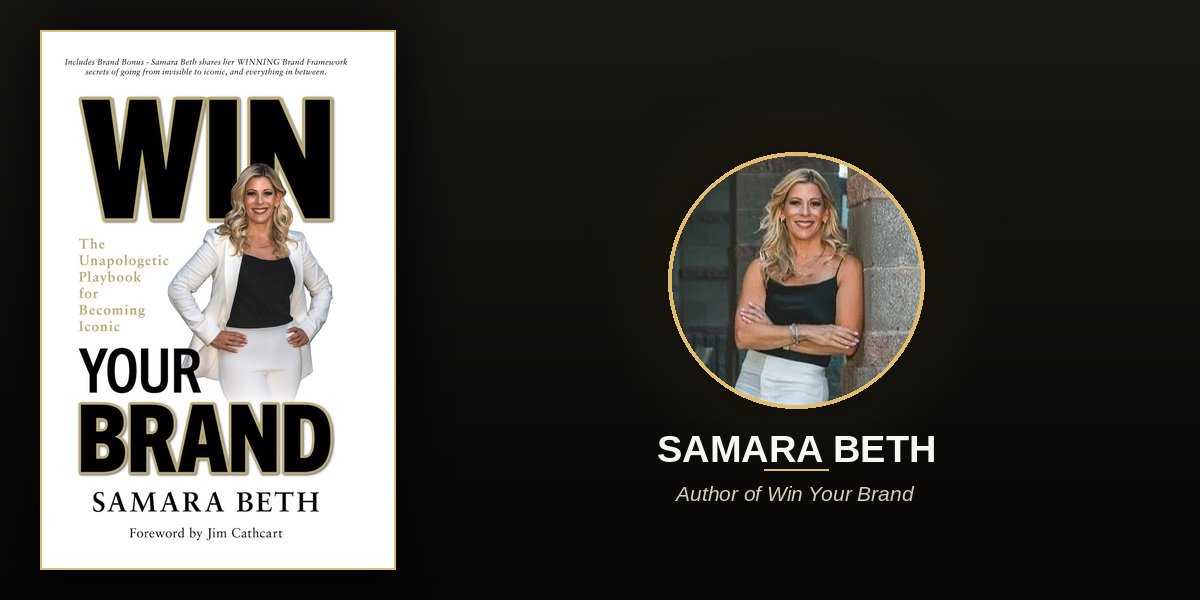
Branding advice often follows a similar pattern regardless of who is delivering it. Find your niche. Meet your audience where they are. Soften your edges so nobody is turned off. Sand down the parts of your personality or perspective that might make someone uncomfortable. Present the most agreeable and accessible version of yourself and watch the audience grow. The logic is sound enough on the surface, and the result, as Samara Beth has observed across three decades of working with entrepreneurs and brands, is a marketplace full of voices that sound almost exactly alike.
Win Your Brand: The Unapologetic Playbook for Becoming Iconic is a direct and specific argument against that approach. Samara makes it from a position of having paid the price of going the other way, of having built a brand rooted in honesty rather than palatability, and of having watched the difference between those two approaches play out in real business outcomes over time.
What Unapologetic Actually Means in Practice
Unapologetic, in Samara’s framework, does not mean aggressive or contrarian or deliberately polarizing for the sake of attracting attention. It means saying the truth even when it costs you some people in the short term. It means building your brand around what you actually believe rather than around what will make everyone comfortable. It means accepting that losing the audience that wanted the polished, agreeable version of you is not a failure but a necessary clarification of who you are actually building for.
Short-term, that is expensive and uncomfortable in ways that most entrepreneurs underestimate. Some people will not like you. Some will leave. Some will make their preference for the softened version of you explicitly known. For entrepreneurs who have spent years trying to be likable because likability felt necessary for survival, that experience is real and difficult. Samara does not soften it.
Long-term, it is the only approach that pays off at the level she is describing. The people who stay after the unapologetic version of you shows up are the ones who actually trust you. They are not there for a brand aesthetic or a pleasant vibe. They are there for you specifically, for your particular perspective and your particular way of being in the world. That is a fundamentally different and fundamentally stronger business than one built on being inoffensive to the widest possible audience, because inoffensive is infinitely replaceable and specific is not.
Why Story Is Strategy, Not Decoration
One of the more important distinctions Samara makes in the book is between what a framework does and what a story does, and why both are required for a brand that actually holds people through difficulty.
A framework tells you what to do. A story shows you that it is survivable. She could hand someone ten steps to build a brand, and they would nod along and feel equipped. But the moment they hit their own hard chapter, the moment the business stalls or the client disappears or the identity gets shaken by something unexpected, a list of steps doesn’t hold anyone up. A story does. When she shows readers exactly where she hit the bottom and how she got back up, she is giving them permission to do the same thing with their own version of that experience.
People do not trust polished advice from someone who has never been genuinely tested. They trust someone who has been in it, who has sat in the difficulty and come out the other side with something real to say about what happened. That is the entire difference between visibility and trust. Visibility gets attention for a moment. Trust gets loyalty across years. Story is how you build the second thing, and strategy without story produces the first thing at best.
In-Person Connection in an AI-Saturated World
Content is everywhere now and will only become more abundant as AI makes production easier and faster. That means content alone no longer makes anyone stand out from the noise. It just makes them louder in an already crowded room where everyone has roughly equal access to the same generation tools.
What cannot be automated is a room full of people who showed up for you specifically, who drove somewhere or made time or bought a ticket because they wanted to be in your presence. An intimate dinner, a live talk, a retreat, a gathering where people can see your face and shake your hand. That experience is becoming more valuable exactly because it is becoming more rare in a landscape dominated by digital interaction.
Samara pushes entrepreneurs to stop measuring their brand only in likes and impressions and start measuring it in real relationships built in real rooms. Her specific and practical advice: put something on the calendar this quarter that gets people in a room with you. That is where trust compounds fastest and most durably, and the trust built there is qualitatively different from anything a digital platform can produce.
If your brand sounds like everyone else’s, Win Your Brand by Samara Beth is available now on Amazon. The unapologetic version of you is the only one that builds lasting trust.