By: Marcus Callahan
Chicago has never required its music to be pretty. It requires it to be true.
That distinction has fueled generations of music made within the city, from blues and gospel to punk, house, hip-hop and alternative rock. Chicago artists have historically understood that a cracked voice can sometimes communicate more than a perfect one, that discomfort can make better art than reassurance, and that the distance between Saturday night’s mistakes and Sunday morning’s redemption can be surprisingly short.
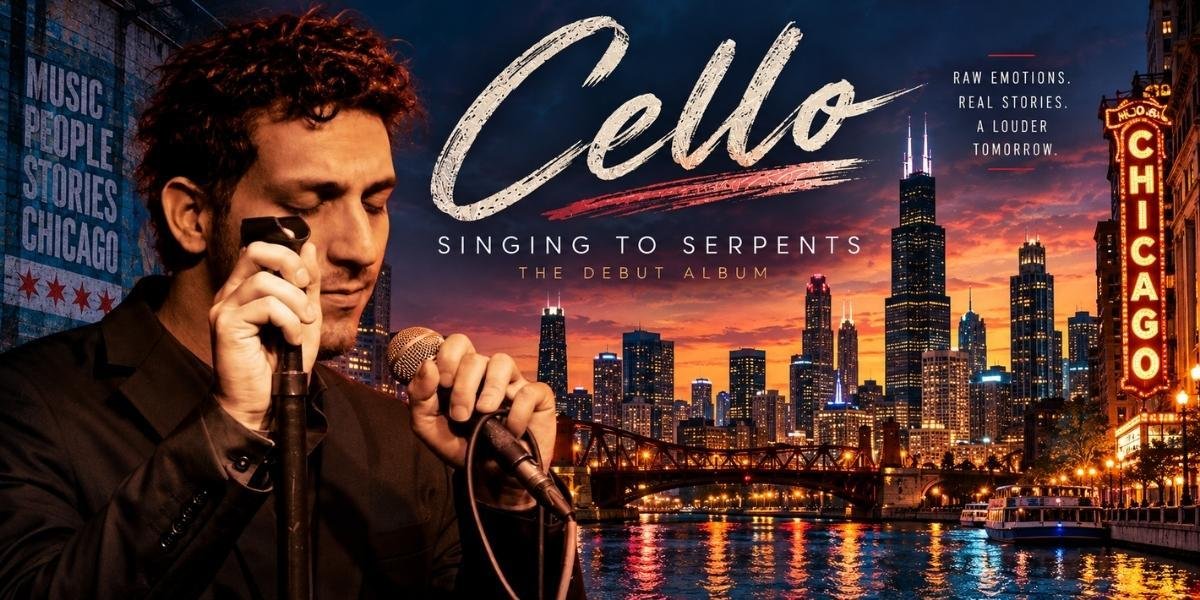
That makes Cello’s Singing to Serpents an intriguing record to hear through Chicago ears.
The Pittsburgh artist’s nine-song album isn’t geographically connected to the Windy City, but emotionally, it could spend a winter here. Singing to Serpents is restless, introspective and occasionally abrasive, dealing in the sorts of feelings people normally attempt to organize before allowing anyone else to see them.
Cello doesn’t bother organizing them.
He gives them songs.
Opening track “Stay Here” establishes that philosophy immediately. Its central plea sounds simple enough: don’t leave. But repetition changes its meaning. Affection becomes anxiety; anxiety inches toward fixation. Cello doesn’t write about romantic vulnerability after gaining perspective. He catches it while it’s still happening.
Picture the song playing on the Blue Line after midnight, windows reflecting faces back at themselves while neighborhoods flicker past outside. There is something distinctly urban about feeling completely alone while surrounded by strangers.
“Stay Here” lives inside that contradiction.
“Elevate” attempts to move upward, introducing ambition and confidence, but Cello never lets certainty remain unchallenged for long. His swagger has seams. You can hear the human being underneath the performance.
Chicago understands performers like that.
This isn’t a city historically impressed by somebody simply looking the part. From muddy South Side blues clubs to sweaty North Side rock rooms, credibility has generally required showing your work.
Cello shows plenty of it.
On “Sucks to Be Used,” hurt hardens into resentment. The temptation would be to make himself the sympathetic hero, but Cello’s songwriting is more interesting when he refuses that opportunity. His narrators aren’t necessarily reliable. They can be wounded and selfish, perceptive and irrational, vulnerable and defensive.
In other words, they behave like people.
The album grows increasingly nocturnal with “Full Moon,” “So Long” and “Cravings.” These are songs of attraction, separation and appetite, built for that strange hour when sensible decisions have gone home.
Chicago supplies plenty of appropriate scenery.
Lower Wacker at 2 a.m. The orange glow of streetlights against wet pavement. A nearly empty diner. Lake Michigan looking less like water than an enormous black absence beyond Lake Shore Drive.
Cello’s music belongs in those spaces because Singing to Serpents is fundamentally an after-hours record. It deals with the thoughts that become louder when everything else becomes quiet.
His neurodivergence adds meaningful context to that intensity. Cello is autistic and has ADHD, and he has become increasingly open about both as his music and advocacy have developed. The album’s repetitions, emotional fixations and abrupt movements between confidence and uncertainty can be understood partly through that perspective.
But Cello isn’t asking to be treated as a curiosity.
That’s important.
Autism and ADHD aren’t marketing concepts pasted onto Singing to Serpents. They’re aspects of the person making it. His larger goal of becoming a certified peer support professional in the autism field further separates his advocacy from empty branding. He hopes to eventually turn lived experience into practical support for other neurodivergent people.
That makes the album’s obsession with communication especially interesting.
Again and again, Cello seems to be asking the same fundamental question: How do I make you understand what’s happening inside me?
Sometimes he answers through repetition.
Sometimes anger.
Sometimes desire.
And eventually, faith.
“Pray” and “Faith” mark the album’s most compelling shift. After wrestling with lovers, cravings and himself, Cello looks toward something beyond himself.
For Chicago, that’s hardly an unfamiliar musical trajectory. This is a city where sacred and secular music have spent generations living within shouting distance of each other. Blues and gospel might have traveled different roads, but both understood that music becomes especially powerful when somebody needs something from it.
Cello needs something from “Faith.”
That’s why it works.
He doesn’t approach spirituality like someone who has collected all the answers. Belief remains difficult. Doubt remains present. Faith becomes valuable precisely because certainty isn’t guaranteed.
Finally, “Sleeping” arrives like the city around 4 a.m.
Everything slows.
After the emotional traffic of the preceding songs, the album doesn’t conclude with victory so much as exhaustion. Cello hasn’t solved himself. The relationships aren’t magically repaired. The anxiety hasn’t evaporated.
The serpents haven’t disappeared.
And maybe that’s the record’s central insight.
Singing to Serpents isn’t called Killing the Serpents.
Cello communicates with them.
They are desire, fear, resentment, loneliness, ego, doubt and whatever else waits inside us after the distractions stop. Instead of pretending those things can be conquered in three verses and a chorus, Cello allows them to remain complicated.
Chicago should understand.
This is a city built from contradictions: beautiful and brutal, sophisticated and blue-collar, sacred and profane, frozen half the year yet somehow permanently alive.
Cello’s record contains similar tensions.
Singing to Serpents isn’t perfect, pristine or emotionally convenient.
It’s something Chicago music has always valued more.
It sounds lived-in.