The Chicago Journal

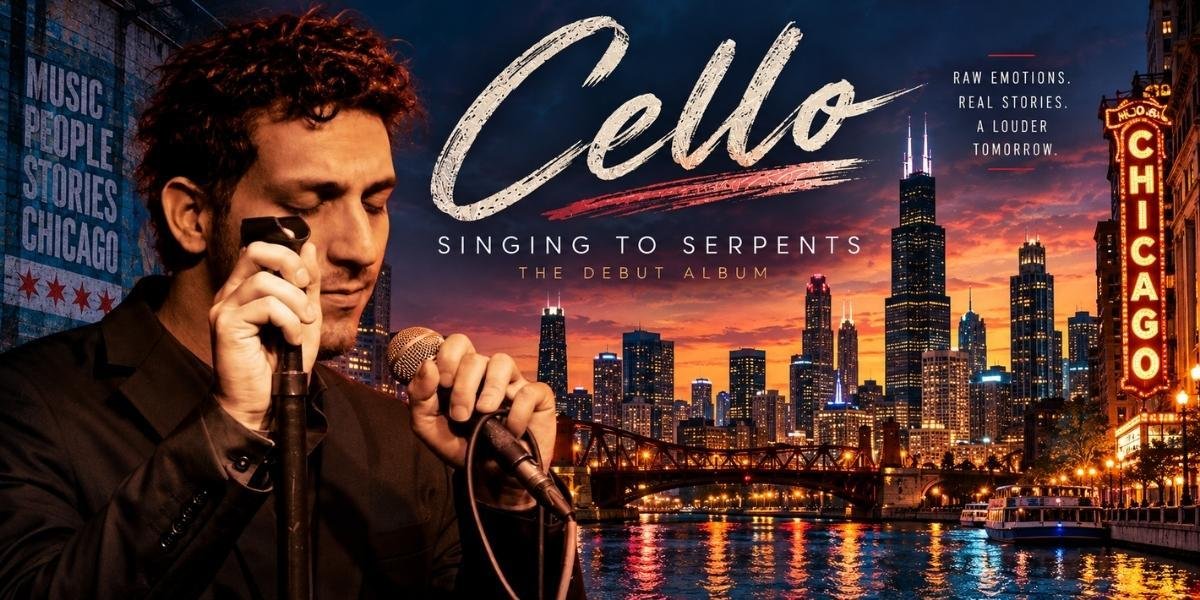
No Easy Answers and Cello’s Singing to Serpents Finds Beauty in the Bruises of the Windy City

By: Marcus Callahan

Chicago has never required its music to be pretty. It requires it to be true.

That distinction has fueled generations of music made within the city, from blues and gospel to punk, house, hip-hop and alternative rock. Chicago artists have historically understood that a cracked voice can sometimes communicate more than a perfect one, that discomfort can make better art than reassurance, and that the distance between Saturday night’s mistakes and Sunday morning’s redemption can be surprisingly short.

That makes Cello’s Singing to Serpents an intriguing record to hear through Chicago ears.

The Pittsburgh artist’s nine-song album isn’t geographically connected to the Windy City, but emotionally, it could spend a winter here. Singing to Serpents is restless, introspective and occasionally abrasive, dealing in the sorts of feelings people normally attempt to organize before allowing anyone else to see them.

Cello doesn’t bother organizing them.

He gives them songs.

Opening track “Stay Here” establishes that philosophy immediately. Its central plea sounds simple enough: don’t leave. But repetition changes its meaning. Affection becomes anxiety; anxiety inches toward fixation. Cello doesn’t write about romantic vulnerability after gaining perspective. He catches it while it’s still happening.

Picture the song playing on the Blue Line after midnight, windows reflecting faces back at themselves while neighborhoods flicker past outside. There is something distinctly urban about feeling completely alone while surrounded by strangers.

“Stay Here” lives inside that contradiction.

“Elevate” attempts to move upward, introducing ambition and confidence, but Cello never lets certainty remain unchallenged for long. His swagger has seams. You can hear the human being underneath the performance.

Chicago understands performers like that.

This isn’t a city historically impressed by somebody simply looking the part. From muddy South Side blues clubs to sweaty North Side rock rooms, credibility has generally required showing your work.

Cello shows plenty of it.

On “Sucks to Be Used,” hurt hardens into resentment. The temptation would be to make himself the sympathetic hero, but Cello’s songwriting is more interesting when he refuses that opportunity. His narrators aren’t necessarily reliable. They can be wounded and selfish, perceptive and irrational, vulnerable and defensive.

In other words, they behave like people.

The album grows increasingly nocturnal with “Full Moon,” “So Long” and “Cravings.” These are songs of attraction, separation and appetite, built for that strange hour when sensible decisions have gone home.

Chicago supplies plenty of appropriate scenery.

Lower Wacker at 2 a.m. The orange glow of streetlights against wet pavement. A nearly empty diner. Lake Michigan looking less like water than an enormous black absence beyond Lake Shore Drive.

Cello’s music belongs in those spaces because Singing to Serpents is fundamentally an after-hours record. It deals with the thoughts that become louder when everything else becomes quiet.

His neurodivergence adds meaningful context to that intensity. Cello is autistic and has ADHD, and he has become increasingly open about both as his music and advocacy have developed. The album’s repetitions, emotional fixations and abrupt movements between confidence and uncertainty can be understood partly through that perspective.

But Cello isn’t asking to be treated as a curiosity.

That’s important.

Autism and ADHD aren’t marketing concepts pasted onto Singing to Serpents. They’re aspects of the person making it. His larger goal of becoming a certified peer support professional in the autism field further separates his advocacy from empty branding. He hopes to eventually turn lived experience into practical support for other neurodivergent people.

That makes the album’s obsession with communication especially interesting.

Again and again, Cello seems to be asking the same fundamental question: How do I make you understand what’s happening inside me?

Sometimes he answers through repetition.

Sometimes anger.

Sometimes desire.

And eventually, faith.

“Pray” and “Faith” mark the album’s most compelling shift. After wrestling with lovers, cravings and himself, Cello looks toward something beyond himself.

For Chicago, that’s hardly an unfamiliar musical trajectory. This is a city where sacred and secular music have spent generations living within shouting distance of each other. Blues and gospel might have traveled different roads, but both understood that music becomes especially powerful when somebody needs something from it.

Cello needs something from “Faith.”

That’s why it works.

He doesn’t approach spirituality like someone who has collected all the answers. Belief remains difficult. Doubt remains present. Faith becomes valuable precisely because certainty isn’t guaranteed.

Finally, “Sleeping” arrives like the city around 4 a.m.

Everything slows.

After the emotional traffic of the preceding songs, the album doesn’t conclude with victory so much as exhaustion. Cello hasn’t solved himself. The relationships aren’t magically repaired. The anxiety hasn’t evaporated.

The serpents haven’t disappeared.

And maybe that’s the record’s central insight.

Singing to Serpents isn’t called Killing the Serpents.

Cello communicates with them.

They are desire, fear, resentment, loneliness, ego, doubt and whatever else waits inside us after the distractions stop. Instead of pretending those things can be conquered in three verses and a chorus, Cello allows them to remain complicated.

Chicago should understand.

This is a city built from contradictions: beautiful and brutal, sophisticated and blue-collar, sacred and profane, frozen half the year yet somehow permanently alive.

Cello’s record contains similar tensions.

Singing to Serpents isn’t perfect, pristine or emotionally convenient.

It’s something Chicago music has always valued more.

It sounds lived-in.
Miss Freddye Has Lived the Blues, So Don’t Ask Her to Pretend

By: Jack Bandy

The problem with the blues is that too many people want to make it respectable.

They want the tasteful guitar solo. The heritage festival. The expensive reissue on 180-gram vinyl. They want to talk about authenticity while drinking a twelve-dollar craft beer and applauding politely when the song ends.

Forget all that.

The blues was never supposed to be polite.

The blues is what happens when life kicks your door down, empties the refrigerator, breaks your heart, scares the hell out of you, and then discovers, much to its annoyance, that you’re still standing there the next morning.

Which brings us to Miss Freddye.

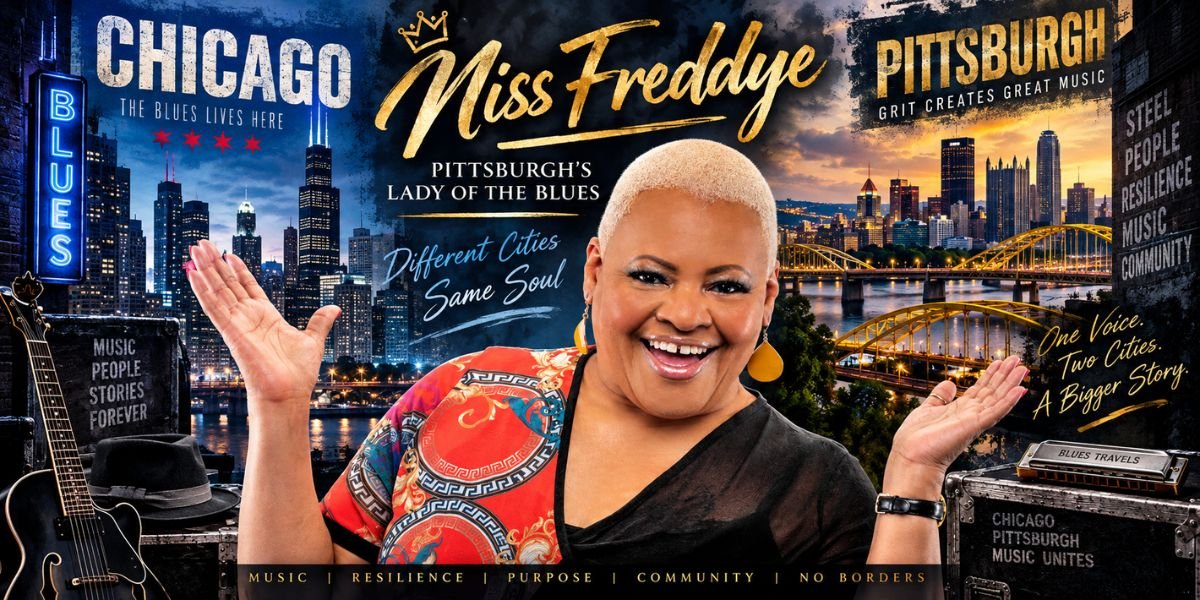
Pittsburgh calls her its “Lady of the Blues,” which sounds almost too dignified for somebody whose real qualification for the job is that she’s actually lived enough life to know what those words mean.

Miss Freddye didn’t arrive through some record-company laboratory. There wasn’t a stylist standing around saying, “You know what this woman needs? More authenticity.”

She already had it.

Before the charts, awards and applause, there was church. Gospel. That magnificent American contradiction where sorrow gets dressed up in its Sunday clothes and somehow turns into joy before lunchtime.

That’s where Freddye learned the first rule of singing: you better mean it.

Then came life.

For more than 30 years, Miss Freddye worked as a nurse. Think about that for a minute. While generations of musicians were desperately attempting to manufacture tortured-artist biographies, Freddye was walking into hospital rooms where actual human beings were afraid, sick, grieving, and hoping somebody might make things a little less terrible.

You want a blues education?

Try that.

Then she survived breast cancer.

Twice.

And COVID.

So when Miss Freddye sings about survival, there’s no need to consult the press release.

You can hear it.

Her voice doesn’t politely knock on the front door of a song. It walks in, sits down at the kitchen table and starts telling you what happened.

Sometimes there’s gospel in it. Sometimes there’s soul. Sometimes there’s the raw muscle of traditional blues. You can hear why names like Koko Taylor and Etta James come up whenever people try to describe her musical neighborhood.

But Miss Freddye doesn’t need to be anybody’s second coming.

She’s already the first Miss Freddye.

Her career began taking shape in Pittsburgh’s blues scene in the 1990s, and over the ensuing decades she did something increasingly revolutionary in the music business:

She kept going.

Gig after gig.

Song after song.

Year after year.

No viral dance required.

Eventually, the rest of the world started paying attention. Her music has reached international audiences, including charting on the UK iTunes Blues Chart. Her rendition of “Wade in the Water” also reached the iTunes gospel chart, which makes perfect sense because gospel and blues have always been arguing siblings living in the same American house.

One says, “Lord, save me.”

The other says, “Lord, you wouldn’t believe what happened last night.”

Miss Freddye understands both.

She’s also accumulated awards and recognition throughout her career, including honors from Pittsburgh’s Iron City Rocks Awards and acknowledgment from the wider blues community. Nice things to have, certainly. Put them on the shelf.

But trophies don’t sing.

Miss Freddye does.

And the most interesting thing about her isn’t where she charted. It’s what happened before she ever got there.

The cancer.

The nursing.

The family.

The church.

The disappointments nobody puts in biographies.

The ordinary Tuesdays when you get out of bed even though you’d rather not.

That’s where the blues actually lives.

And then there’s Pittsburgh.

Of course she’s from Pittsburgh.

Look at the place.

Three rivers colliding beneath bridges built by people who understood that your hands are supposed to get dirty occasionally. Hills stacked with houses. Old mills haunting the horizon. Neighborhood bars where somebody will explain exactly what’s wrong with your football team whether you asked or not.

Pittsburgh doesn’t specialize in delicate personalities.

Neither does Miss Freddye.

But toughness isn’t the same thing as hardness, and that’s where her music gets interesting.

Her work carries enormous warmth. She has devoted considerable energy to community causes, cancer awareness, veterans, young people and those who need somebody in their corner. The nurse never completely disappeared when the singer walked onto the stage.

Maybe that’s the secret.

Miss Freddye isn’t singing at people.

She’s taking care of them.

For three minutes, five minutes, an evening, however long the song lasts, she’s saying: I’ve been hurt too. I’ve been scared too. I’ve wondered what happens next.

And I’m still here.

That’s blues.

Not the costume.

Not the mythology.

Not the guitar somebody bought because Eric Clapton once played the same model.

Survival.

Miss Freddye has survived enough to understand something most of us spend our lives trying not to learn: joy means more after you’ve seriously considered losing it.

So call her Pittsburgh’s Lady of the Blues.

Give her the awards.

Put the chart numbers in the biography.

Just don’t mistake any of those things for the reason she matters.

The reason is simpler.

Miss Freddye lived.

Then she opened her mouth and told us about it.

Turn it up.

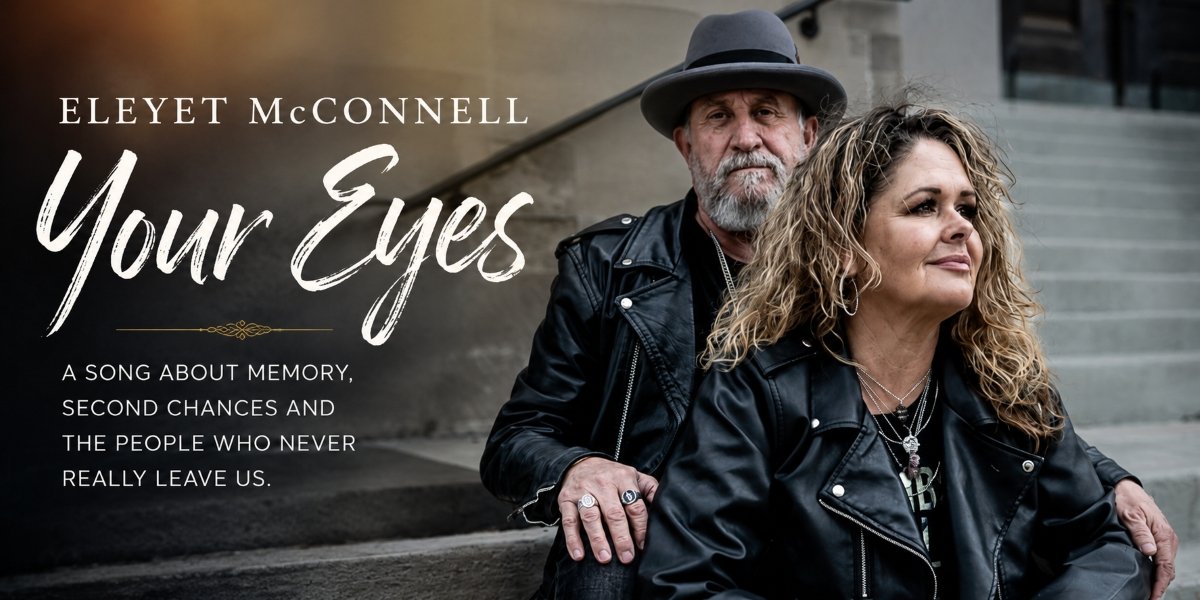
Eleyet McConnell’s “Your Eyes” and the Radical Business of Growing Old Together

By: Julian Blackwood

By the time rock and roll discovered the power ballad, it had already figured out sex, heartbreak, jealousy, cars, death, teenage rebellion, and at least fourteen different ways to describe Saturday night. What it never got particularly good at was adulthood. Not getting older as tragedy, mind you, but getting older as an achievement. Staying. Remembering. Looking at somebody after the years have done their damage and deciding the view is still pretty good.

Which brings us to Eleyet McConnell’s “Your Eyes,” a piano-driven ballad with strings, no apparent embarrassment about being one, and even less interest in convincing anybody under 25 that emotional maturity is cool.

Good for them.

The Ohio husband-and-wife duo have demonstrated considerably more muscle elsewhere on The Journey. “The Ledge” comes armed for confrontation, the sort of classic-rock bruiser that understands guitars are useful for more than decorating choruses. “Your Eyes” goes in the opposite direction. Instead of turning everything up, Angie and Chris McConnell strip everything back.

Piano. Strings. Voice. Song.

Turns out that’s plenty.

Chris McConnell has explained that the song began with an unexpected sighting of a high-school heartbreak in Walmart. Yes, Walmart. Forget Paris in the rain. Forget the last train out of Manhattan. This is American romance in the twenty-first century: fluorescent lights, shopping carts, and suddenly seeing somebody who can collapse several decades of your life into approximately three seconds.

Chris didn’t approach her. Instead, he wondered whether they could pick up a conversation where they had left it years before. By the time he exited the store, he had the bones of a song. He brought it to his wife. Angie, displaying either remarkable marital confidence or the superior instincts of a songwriter, added the bridge.

There’s your love story.

And it’s a better one than the song’s premise initially suggests, because “Your Eyes” isn’t really about wishing you’d ended up with somebody else. It’s about recognizing the strange persistence of human connection. People disappear. Years accumulate. Hair turns gray. But certain faces remain filed somewhere in the brain, waiting for an accidental encounter beside the household goods aisle to bring everything roaring back.

Angie McConnell understands this immediately.

Her vocal is the record.

Plenty of singers could attack a ballad like this with sufficient lung capacity to frighten nearby wildlife. McConnell doesn’t. She sings it like somebody remembering rather than auditioning. That distinction matters.

Her instrument has power, but what makes the performance work is the withholding of it. She lets phrases settle. She permits the piano to occupy emotional territory that lesser singers would immediately colonize with melisma. When the arrangement expands, she expands with it rather than attempting to outrun it.

Think less vocal Olympics, more Linda Ronstadt’s instinct for making plain language hurt. There’s some of Karen Carpenter’s conversational intimacy in the quieter passages, some Melissa Etheridge grit underneath the polish, and enough of Ann Wilson’s authority to remind you that restraint only works when the listener senses what the singer could unleash.

But comparisons get you only so far.

Angie sounds like Angie, which is the harder accomplishment.

Producer Patrick Himes wisely leaves the song alone. That sounds like faint praise until you consider how many ballads have been murdered by producers convinced that every emotional statement requires another layer. Here, piano establishes the architecture and Kimmi Samson’s strings provide dimension without turning the arrangement into orchestral wallpaper.

The strings are especially effective because they don’t announce: FEEL SOMETHING NOW.

They suggest.

That’s rarer than it should be.

The songwriting operates according to the same principle. “Your Eyes” doesn’t hide behind elaborate imagery. Its central idea is memory expressed through the physical detail that survives most vividly: another person’s eyes. The sentiment could become Hallmark material quickly, except the McConnells introduce something most love songs desperately avoid.

Age.

Gray hair enters the picture.

So does friendship.

That changes everything.

Suddenly this isn’t another song promising eternal passion from people who haven’t survived a mortgage together. It understands companionship as romance’s less glamorous but considerably tougher older sibling.

And because Angie and Chris are themselves married collaborators, there’s an amusing extra dimension to Chris writing about encountering an old flame and Angie becoming the person who completes the song. The past supplies the spark; the present finishes the composition.

Try getting that from an algorithm.

What Eleyet McConnell accomplishes with “Your Eyes” is neither revolutionary nor particularly fashionable. They’ve written a traditional ballad using traditional tools and traditional emotions. Anyone demanding formal innovation should look elsewhere.

But tradition isn’t the same thing as irrelevance.

A song this straightforward lives or dies on whether you believe the people performing it. There are no production tricks substantial enough to conceal dishonesty. No fashionable sonic abstraction to provide cover. Just melody, words, arrangement, and Angie McConnell standing in the middle of them.

You believe her.

That’s why the record works.

In a musical culture perpetually selling youth back to the young, “Your Eyes” makes a modest case for accumulated experience. Memory matters. Companionship matters. The people who knew us before we became whoever we think we are now matter.

And sometimes the old-fashioned power ballad still matters too.

Especially when somebody remembers how to sing one instead of merely performing it.

Harry Kappen’s “Distant Shore” Finds the Extraordinary in Ordinary Courage

By: David Marshall

Rock music has always done its best work when it tells the truth, not necessarily the truth, because that’s usually too complicated for any three-minute song, but a truth. One person’s truth. One family’s truth. One moment when the world shifts beneath your feet and suddenly nothing looks familiar anymore. That’s the territory Harry Kappen explores on “Distant Shore,” and he does it with the kind of quiet confidence that reminds you why songs still matter.

Taken from After the Crossing, Kappen’s first album recorded after relocating from the Netherlands to Mexico, “Distant Shore” begins with a personal realization but quickly reaches far beyond autobiography. His move was voluntary, made in pursuit of a new chapter in life. That experience led him to think about those whose journeys aren’t chosen, people fleeing war, poverty, persecution, and disaster with little more than hope to sustain them.

It’s a dangerous subject because songs about humanitarian crises often collapse under the weight of their own good intentions. Too many become editorials dressed up as music. Kappen understands that listeners don’t need another speech. They need a reason to care.

So he starts with a door.

“I kiss the door I can’t replace…”

That’s the moment the song earns your attention.

Before there are borders or oceans or political debates, there’s home. Not an abstract idea,a real home. A familiar doorway. A last look at a room you’ve lived in. A final breath before stepping into uncertainty. Kappen immediately understands something essential: history is experienced one person at a time.

As the song unfolds, the details accumulate naturally. Forty people crowded into a truck. Endless travel through darkness. Someone praying. Someone collapsing from exhaustion. Waves rising “like concrete walls.” None of it feels exaggerated because Kappen never reaches for drama. Reality is dramatic enough.

The remarkable thing about “Distant Shore” is how completely it trusts its audience. Kappen never insists upon what you’re supposed to think. He simply places you inside another person’s journey and lets the emotional consequences unfold.

Musically, the song occupies a fascinating space somewhere between atmospheric rock, progressive pop, and classic singer-songwriter craftsmanship. Kappen wrote, arranged, performed, and produced everything himself, yet the recording never feels like an exercise in studio perfectionism. Instead, every musical decision serves the emotional center of the song.

The most distinctive element is the mellotron, whose rich, haunting texture immediately recalls David Bowie’s “Space Oddity.” Kappen has openly acknowledged Bowie as one of the inspirations behind the recording, but the influence runs deeper than instrumentation. Bowie used space to explore alienation. Kappen uses the sea.

Both songs ask similar questions about isolation.

Both understand that physical distance often mirrors emotional distance.

But where Major Tom floated beyond Earth’s reach, Kappen’s narrator remains painfully grounded, trapped between the place he left and the place he desperately hopes exists.

The production reflects that uncertainty beautifully.

The keyboards drift across the stereo field like mist rolling over open water. Guitars appear and disappear without demanding attention. The rhythm section keeps moving forward with steady determination, suggesting that stopping simply isn’t an option. Nothing about the arrangement feels rushed. The song unfolds at the pace of reflection rather than urgency.

Kappen’s vocal performance deserves equal praise.

There isn’t an ounce of theatricality in his delivery. He doesn’t oversing the material or attempt to manufacture emotion through volume. Instead, he relies on phrasing, nuance, and sincerity. His voice carries compassion without sentimentality, concern without self-righteousness.

That’s harder than it sounds.

The chorus revolves around one deceptively simple question:

“Where is that distant shore?”

Like all great choruses, it works because it means more every time you hear it.

At first, the distant shore is literal.

Later, it becomes emotional.

Eventually, it becomes universal.

Everyone has a distant shore they’re trying to reach, whether it’s safety, peace, acceptance, forgiveness, or simply the belief that tomorrow might be better than today.

Kappen wisely leaves the answer unresolved.

There is no triumphant ending waiting in the final chorus. Hope remains uncertain because that’s how hope often exists in real life. The song refuses easy redemption, and it’s stronger for that decision.

You can’t help but hear Kappen’s decades as a music therapist echoing throughout the recording. People who spend years listening to others develop an unusual sensitivity to emotional truth. They understand that healing begins with being heard, not with having someone else explain your experience back to you.

“Distant Shore” embodies that philosophy.

It doesn’t speak over the people whose lives inspired it.

It listens.

In today’s musical landscape, dominated by instant gratification and disposable content, Harry Kappen has created something refreshingly durable. This is a song that asks for your attention rather than demanding it. It rewards repeated listening because every return reveals another lyrical image, another subtle production choice, another emotional layer beneath the surface.

Rock music has never been at its best when it’s merely loud.

It’s been at its best when it reminds us that ordinary people are capable of extraordinary courage.

“Distant Shore” does exactly that.

Harry Kappen has written a song that doesn’t pretend to solve the world’s problems. It accomplishes something smaller, and perhaps more important. It asks listeners to remember that every distant shore begins with someone taking one impossible step away from home.

That’s the kind of truth rock music has always been built to carry.

Music as Advocacy: How Dnash Tha Rapper Combines Art with Activism

Dnash Tha Rapper, Cincinnati’s rising hip-hop icon, is redefining what it means to be an artist in the modern age. While many musicians aim for fame and fortune, Dnash uses his platform to amplify voices, address critical social issues, and inspire change. Through his unique blend of artistry and activism, he’s proving that music can be more than entertainment—it can be a powerful force for justice and empowerment.

Dnash Tha Rapper

Photo Courtesy: Dnash Tha Rapper

In 2020, Dnash made history with Cincinnati’s first pro-Black album, a project that cemented his role as a socially conscious artist. The album went beyond beats and rhymes, highlighting systemic injustices while raising awareness for Carl Wesley, a man battling chronic kidney disease. The project’s focus on health disparities in the Black community brought attention to an often-overlooked issue, proving that Dnash’s music is as impactful as it is innovative.

This milestone album set the tone for Dnash’s career as a musician who intertwines art with advocacy. His “Timeless” movement—a philosophy centered on perseverance, authenticity, and unity—resonates deeply with fans. Through slogans like “Stay Timeless” and “Happy Timeless Day,” Dnash invites listeners to embrace their individuality while championing collective progress.

Dnash’s ability to merge activism with music is evident in his lyrics, which often tackle themes of fairness, resilience, and community. His viral hit “Universal Language” exemplifies this approach, blending cross-cultural collaboration with a message of unity. The UK/US rap tape, created alongside Oliver Bate, peaked at #35 on the iTunes charts, demonstrating that socially conscious music can achieve mainstream success.

Beyond the music, Dnash’s advocacy has earned him a reputation as a role model for aspiring artists. He has received endorsements from industry powerhouses like Druski, DJ Drama, and Dave East, along with recognition from British rapper Stormzy. Despite the accolades, Dnash remains grounded, using his growing influence to inspire others to dream big and take action.

In a world often divided by inequities, Dnash’s work bridges gaps, offering hope and empowerment to his listeners. His upcoming album, “Timeless 4,” is expected to delve deeper into his journey, providing fans with an unfiltered look at the man behind the movement.

What sets Dnash apart is his unwavering commitment to using his platform for good. From creating chart-topping music to advocating for justice and health equity, he proves that art and activism can coexist powerfully. His journey from adversity to success, immortalized in a Cincinnati community mural, is a testament to his resilience and dedication.

Dnash Tha Rapper’s story is more than a tale of musical success; it’s a blueprint for how artists can inspire change and give back to their communities. By combining his passion for music with a mission for justice, Dnash is not just changing the rap game—he’s changing lives.

Dnash Tha Rapper

Photo Courtesy: Dnash Tha Rapper

Dnash’s journey from humble beginnings to becoming a trailblazer in music is a testament to his grit and determination. Growing up in Cincinnati, he faced significant challenges, but he turned those hardships into fuel for his creative pursuits. His breakthrough came with the release of “Universal Language,” a UK/US collaborative rap tape with British artist Oliver Bate. The project not only marked a milestone as one of the first of its kind but also peaked at an impressive #35 on the iTunes charts, solidifying Dnash’s reputation as a global innovator.

What truly sets Dnash apart is his “Timeless” movement, a philosophy that emphasizes perseverance, authenticity, and staying true to one’s purpose. This ethos is more than a catchphrase—it’s a lifestyle that has resonated deeply with fans and fellow artists alike. The movement has given rise to popular slogans like “Stay Timeless,” “Happy Timeless Day,” and “Be Timeless,” alongside his signature ad-lib, “Timeless.”

The success of his “Timeless” series underscores his impact on the music world. With “Timeless 3” climbing to #74 on the charts in 2023 and “Universal Language” achieving international acclaim in 2024, Dnash has proven his ability to deliver back-to-back hits. His upcoming album, “Timeless 4,” promises to take his artistry to new heights, offering fans an even deeper look into his personal journey and creative process.

Dnash’s influence extends beyond music. In 2020, he released Cincinnati’s first pro-Black album, advocating for social justice and health awareness. The album spotlighted Carl Wesley’s fight against chronic kidney disease, merging art with activism and showcasing Dnash’s commitment to making a difference.

Earning endorsements from industry heavyweights like Druski, DJ Drama, and Benzino, as well as receiving praise from British rapper Stormzy, Dnash has accumulated over three million streams. His work has sparked comparisons to Nipsey Hussle—a nod to his dedication to community empowerment and resilience.

To learn more about Dnash Tha Rapper, follow him on Instagram or Twitter.

A Lifetime of Adventures: Lessons from Traveler from the Past

A Life Lived on the Edge

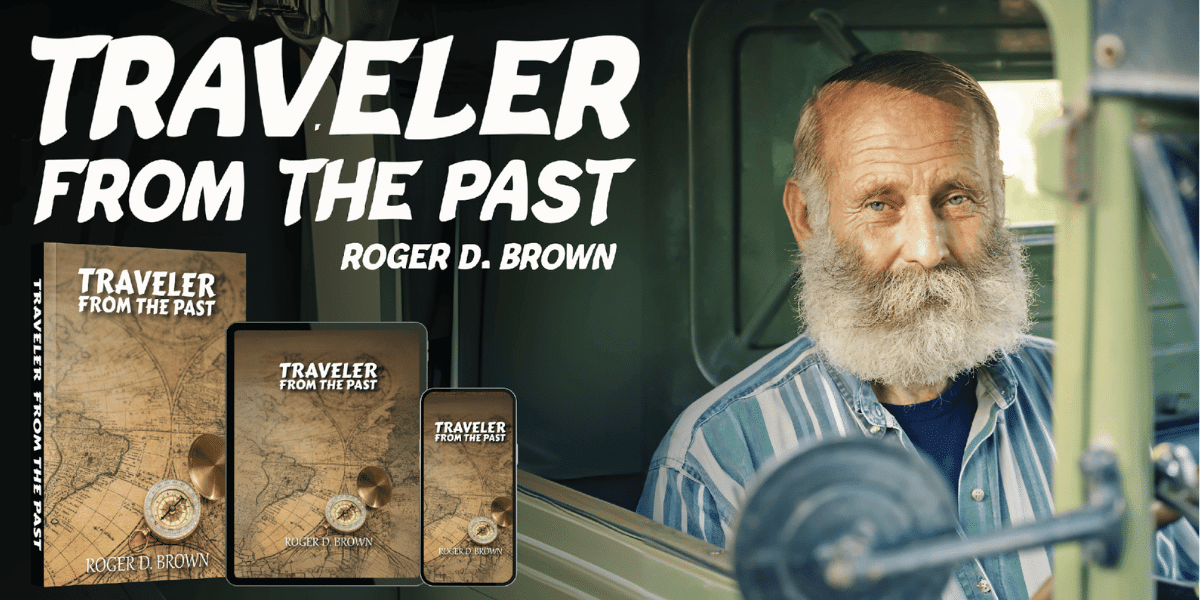
Roger Brown’s Traveler from the Past is a captivating memoir that transcends the boundaries of a traditional travelogue. Packed with tales of grit, exploration, and a relentless drive for discovery, this book is not just a recount of Brown’s journey across 70 countries—it’s a testament to the power of embracing life’s unpredictability. Through breathtaking voyages, grueling challenges, and transformative experiences, Brown offers readers more than just an adventure; he provides a manual for living courageously.

The Call of the Open Sea

One of the standout aspects of Brown’s narrative is his extraordinary journey aboard Tropic Tramp, a 53-foot gaff-rigged ketch. Sailing over 15,000 miles from British Columbia to South America and across the South Pacific, Brown immerses readers in the beauty and peril of life at sea. From diving in pristine waters to fishing in remote corners of the world, this chapter of his life underscores the importance of embracing nature’s raw power.

The key takeaway here is that taking risks often leads to the most rewarding experiences. For readers stuck in routine, Brown’s story serves as a nudge to step out of their comfort zones and embrace the unknown.

Walkabouts and Self-Discovery

Brown’s seven-month Walkabout through New Zealand, Indonesia, and Southeast Asia reveals the profound impact of slow travel. Trekking through the Himalayas, Tibet, and China, he discovers the essence of these cultures while finding pieces of himself along the way. His journey highlights the importance of immersing oneself in diverse environments to broaden horizons and challenge preconceived notions.

This portion of the memoir inspires readers to not just explore new places but to let those places transform them. Brown teaches us that travel is not just about destinations but about the growth and understanding that come with the journey.

A Life of Hands-On Work

Beyond his globetrotting adventures, Brown’s life as a diesel mechanic, forest firefighter, and heavy-equipment operator offers a glimpse into the value of hard work and perseverance. His vivid accounts of logging forests, hauling livestock, and even building homes in California and Mexico showcase a life deeply intertwined with labor and craftsmanship.

Brown’s relentless work ethic is a reminder of the dignity in labor, no matter how gritty or demanding it may be. His experiences underscore that passion and commitment can transform any task into a fulfilling endeavor.

Close Encounters with the Wild

Among Brown’s many adventures, his encounters with wildlife stand out. From a 12-foot boa constrictor in the jungle to a mountain lion perched just feet away, these moments are not just thrilling anecdotes—they reflect a deep respect for the natural world. Brown’s ability to remain calm in the face of danger and his appreciation for the wilderness teaches us the importance of harmony with nature.

For readers, these tales are both a source of awe and a gentle reminder to approach the world around them with curiosity and respect.

Building Dreams from the Ground Up

Brown’s stories of designing and constructing timber and straw bale homes are more than just tales of architecture—they’re lessons in creativity and determination. Whether restoring antique trucks or constructing roads in jungles, Brown’s hands-on approach to life reveals the rewards of turning vision into reality.

This aspect of his memoir is an inspiration for anyone hesitant to take on big projects or pursue bold dreams. Brown’s message is clear: with patience and persistence, even the most daunting tasks can be accomplished.

Lessons from a Traveler’s Soul

Traveler from the Past is more than a book; it’s an invitation to live life with passion, courage, and curiosity. Through his thrilling adventures and grounded work ethic, Roger Brown reminds readers that life’s richness lies in its diversity. From crossing oceans to building homes, every chapter of Brown’s life is a masterclass in resilience and exploration.

Readers are left with a powerful message: life is an adventure waiting to be lived, and it’s up to each of us to answer the call. Roger Brown’s story inspires us to embrace challenges, savor the journey, and find joy in every twist and turn. For those yearning to break free from the mundane, Traveler from the Past is the spark they need to embark on their own extraordinary journey.

Published by Stephanie M.

AI-Generated Music: Transforming Artist Collaborations

The music industry is witnessing a revolution as artificial intelligence (AI) becomes more frequently used in creative processes and artist collaborations. AI-generated music has evolved from experimental technology into a tool that can assist and amplify artistic expression. This fusion of human talent and machine capability offers artists new tools for creating music, opening new avenues for innovation and collaboration.

The Emergence of AI in Music Creation

AI’s presence in music is no longer confined to simple automated compositions. Today, advanced AI algorithms can analyze vast libraries of musical data, learning intricate patterns, styles, and structures. This allows AI to create music that aligns with or introduces new takes on existing genres, resulting in unique compositions that may expand upon traditional methods.

Artists and producers are increasingly experimenting with AI to enhance their creative workflow. Whether it’s generating melodies, harmonies, or even lyrics, AI provides a starting point or an inspirational boost, enabling artists to explore new soundscapes and experiment with different musical styles.

Collaborative Projects: Artists and AI

A growing number of musicians are testing AI as a collaborative partner. For instance, established artists have worked alongside AI tools to co-create songs, using machine learning models trained on their own musical catalog or influences. These collaborations allow artists to try new techniques without replacing the human touch that makes music personal and emotive.

One notable example of this collaborative effort is artists using AI to generate instrumental backdrops or beats as a basis for their songwriting. This approach allows musicians to quickly experiment with different musical directions, helping them find those that resonate with their artistic vision. Additionally, AI tools have been used to compose background scores for film and media, highlighting the adaptability and range of AI in music creation.

Benefits of AI-Driven Collaborations

The integration of AI into music creation may offer several benefits:

  • Enhanced Creativity: AI can suggest novel ideas and arrangements that artists might not have considered, sparking creativity and encouraging innovation. This can help musicians break out of repetitive patterns and explore new artistic directions.
  • Efficiency in Production: With AI’s ability to quickly generate and test musical ideas, artists can streamline the production process. This can lead to faster turnaround times and more dynamic workflows, allowing musicians to focus on refining their craft and improving their final product.
  • Accessibility for Emerging Artists: AI-powered music tools have made advanced music production more accessible to emerging artists and independent musicians who might not have the resources to work with professional producers or studios. These tools can act as virtual co-producers, potentially enhancing the quality of music without extensive financial resources.

Challenges and Ethical Considerations

Despite the potential of AI in music, its adoption comes with challenges and ethical questions. One concern is the risk of AI-generated music potentially impacting perceptions of human creativity. Critics argue that music’s emotive power comes from the personal experiences and emotions of the artist—elements that some claim AI cannot authentically replicate.

Additionally, copyright issues present a significant challenge. When AI models are trained on existing songs, questions arise regarding the ownership of the generated music and the rights of original artists whose work may have influenced the AI’s learning process.

Ensuring transparency in how AI tools are used and maintaining a healthy balance between machine contribution and human oversight are key to addressing these challenges. Musicians and developers are working together to create ethical guidelines that aim to protect creativity while fostering innovation.

The Future of Music with AI

The future of AI-generated music could involve a hybrid model where human and machine creativity coexist harmoniously. As technology advances, it is likely that AI will play a growing role in the music production process, moving from an experimental tool to a commonly used resource in how music is made and experienced.

Artists will continue to seek new ways to use AI to push artistic boundaries, while audiences might enjoy increasingly diverse and experimental music that blends human emotion and technological ingenuity. The collaborative spirit between AI and artists marks a new era in music, one that embraces change while celebrating the creative essence that defines the art form.

AI-generated music appears likely to remain a prominent influence in artist collaborations, enabling the music industry to explore realms of sound that were previously difficult to imagine. This innovation has the potential to enrich the art of music and expand the possibilities of how stories and emotions are conveyed through sound.


Published by: Annie P.

Spotify Expands Daylist Globally with 14 New Language Options

By: Elena Mart

Spotify, the global music streaming giant, has recently announced the expansion of its popular personalized playlist feature, Daylist, to audiences worldwide, now available in 14 new languages. This move reflects Spotify’s commitment to enhancing user experience by tailoring its offerings to a broader and more diverse listener base. Daylist, known for curating music that shifts throughout the day to match listeners’ moods and activities, has resonated with users who seek customized, time-specific soundtracks.

The Concept Behind Daylist

Daylist is designed to adapt to users’ changing preferences and routines throughout the day. Unlike traditional static playlists, Daylist evolves in real-time, considering factors such as time of day and listening history to deliver a dynamic and relevant music experience. For example, users might receive an upbeat playlist during their morning workout, a focus-driven selection for the workday, and a laid-back set of tunes for evening relaxation.

This innovative approach helps listeners discover new music that aligns with their mood and activities, fostering deeper engagement with the platform. Daylist’s personalized nature supports Spotify’s goal of creating an interactive, user-centered experience that sets it apart in the competitive streaming market.

The Global Expansion and Language Integration

The decision to make Daylist available in 14 additional languages is part of Spotify’s broader strategy to cater to its increasingly global audience. With music streaming being an international phenomenon, the expansion allows more users to enjoy a tailored listening experience in their native languages, making the feature more accessible and enjoyable.

The integration of new languages is a testament to Spotify’s adaptability and focus on user inclusivity. By expanding Daylist’s reach, Spotify not only strengthens its presence in key global markets but also reinforces its position as a leader in personalized music streaming.

Enhancing User Experience with Localization

Localization is crucial for global services aiming to resonate with diverse user bases. Spotify’s decision to offer Daylist in multiple languages helps ensure that users feel seen and valued, creating a more personal connection with the app. This move aligns with Spotify’s ongoing efforts to cater to varied cultural and linguistic preferences, which enhances user loyalty and satisfaction.

Offering Daylist in different languages also supports Spotify’s mission to bridge cultural gaps through music. By making personalized playlists available to a broader demographic, Spotify encourages cross-cultural appreciation and discovery, enriching the user experience.

Competitive Edge in the Streaming Industry

With this expansion, Spotify continues to differentiate itself from competitors by focusing on personalization and innovation. In an industry where listeners are offered myriad streaming options, features like Daylist that deliver unique, adaptive experiences help Spotify maintain its edge.

Other streaming platforms have also explored personalized playlist features, but Spotify’s ability to tailor its services across multiple languages and regions solidifies its position as a pioneer in the field. By combining localized content with cutting-edge personalization algorithms, Spotify aims that users are engaged, entertained, and invested in their listening journey.

User Reactions and Future Outlook

Initial feedback from users who have accessed Daylist in their native languages has been overwhelmingly positive. Many appreciate the effort Spotify has made to tailor content to their preferences, enhancing their connection to the platform. This expansion is expected to attract new subscribers from regions that may have previously felt underserved or overlooked by mainstream streaming services.

Looking ahead, Spotify’s strategic focus on personalization and inclusivity suggests that the platform will continue to roll out updates and features designed to cater to an even wider audience. The expansion of Daylist is just one example of how Spotify is leveraging technology to offer an adaptive and customized experience that aligns with modern listening habits.

Conclusion: A Step Forward in Personalized Streaming

Spotify’s global expansion of Daylist in 14 new languages marks a significant milestone in the company’s mission to provide an inclusive and personalized streaming experience. This move not only enhances accessibility for users around the world but also reinforces Spotify’s reputation as an industry leader in music personalization. By continuing to innovate and adapt to the needs of a diverse global audience, Spotify is setting the standard for the future of music streaming.

With its dedication to user experience and adaptability, Spotify’s Daylist is poised to become a staple feature for millions more users, bridging cultural divides and making music a more inclusive and personal experience than ever before.

Published by: Martin De Juan

Amornay Is Charging Up for Her Next Big Move

Get ready to be blown away because Amornay is a force in the music industry that is unlike anything you’ve seen before. Anaysha Robinson, this powerhouse R&B singer and songwriter who also happens to be a SAG-AFTRA Union actress, is making waves with her electrifying energy and boundless creativity. Growing up in Long Island, NY, Amornay discovered her love for music early, and ever since, she’s been on a mission to take over the industry in ways that have left fans craving more. This isn’t just another story of a rising star—this is the story of an unstoppable artist whose authenticity, talent, and vision are lighting up every stage she steps on.

Her journey into entertainment began at 17 when she first pursued acting. But acting was just the beginning for Amornay. Deep down, she knew she was destined for something more. In 2018, at just 21, she made the bold decision to dive headfirst into the music industry—and thank goodness she did. Her entry into music wasn’t just a career change but the start of a movement. Drawing inspiration from R&B legends like Aaliyah, Janet Jackson, Sade, and Drake, Amornay has fused old-school soul with contemporary beats, creating a sound that hits hard with today’s listeners while giving a nod to the timeless classics.

And her sound? It’s fire. The kind of music that makes you close your eyes, sway your body, and feel every beat in your chest. She isn’t just making music; she’s crafting an experience. Her voice has this incredible ability to wrap around your emotions, whether it’s the raw honesty in her lyrics or the smooth, rhythmic flow of her melodies. Fans are hooked, and it’s no wonder—there’s something about Amornay’s voice that pulls you in and keeps you there.

But what really sets Amornay apart? It’s not just her sound; it’s her authenticity. Her story is steeped in her upbringing, where she was surrounded by musical legends. Her family introduced her to a range of iconic artists—Mariah Carey, Chaka Khan, Michael Jackson, Beres Hammond, Buju Banton, Biggie Smalls—the kind of musical royalty that shapes greatness. And greatness is exactly what Amornay is delivering. Those influences taught her how to express herself, how to blend genres, and how to stay true to her roots while constantly evolving as an artist.

From a young age, music was everything to her. She didn’t just dabble in it—she lived it. Amornay was involved in chorus, mastered the flute, and picked up the trumpet as part of a private marching band, showcasing her versatility and love for instrumentation. She wasn’t just a student of music; she was a natural-born performer. Her talent was undeniable, which led her to compete in the prestigious “Nesma” program, where her voice wowed audiences. These formative experiences cemented her path, leading her to embrace singing, songwriting, production, and arrangement. She’s not just a singer—she’s an all-around music mastermind.

Her latest single, “You Want Me,” is proof of that. The song is an emotional deep dive into the complexities of past relationships and how they shape your ability to love again. It’s vulnerable, it’s raw, and it’s relatable—especially for women who’ve carried the scars of love lost. But Amornay doesn’t stop at sharing her pain; she uses it as a way to connect. Her fans don’t just hear the music—they feel it. With “You Want Me,” she’s created something that hits you right in the soul, and it’s only a glimpse of what’s to come in her debut album, which promises to be nothing short of a sonic and visual masterpiece.

And that’s just the beginning. Amornay’s ambitions are sky-high, and she’s ready to take her art to the world. She dreams of touring internationally, bringing her music to global audiences who are already waiting to hear her. But she’s not just focused on music. Amornay is a visionary who plans to launch her own trendy apparel line, collaborate with her favorite artists and actors, and—mark these words—become a Grammy and Oscar nominee. With her undeniable talent and laser-sharp focus, she can turn those dreams into reality.

But don’t get it twisted—Amornay’s vision extends far beyond personal success. She’s driven by a desire to give back and uplift others with her platform. Having faced her own personal battles, including overcoming childhood cancer and navigating toxic relationships, Amornay is passionate about using her story to inspire. She plans to write books and screenplays that share her journey, offering hope and strength to those facing similar struggles. And she’s not stopping there. Amornay wants to partner with organizations like the Make-A-Wish Foundation, using her voice and influence to create positive change in the world.

Her website, www.amornay.com, is a hub for everything Amornay. Fans can dive into her music, watch her latest videos, and keep up with her through press and mailing lists. It’s a gateway into her world, and if you haven’t stepped in yet—what are you waiting for?

With her unstoppable drive, her magnetic talent, and a vision that’s bigger than the stars, Amornay is poised to make an impact on the music industry that’s unforgettable. She’s not just here to play the game—she’s here to change it. So get ready because Amornay is coming for everything, and she’s bringing her fans along for the ride.

Published by: Josh Tatunay

Sarantos Captivates with Heartfelt Song on Regret and Love

By: MTS Management Group

On September 9th, 2024, Sarantos unveiled his latest musical creation, “I’m Sorry This Is the Life I Gave You,” a track that delves deep into the themes of regret and emotional vulnerability. Sarantos, an artist renowned for his ability to express profound emotional truths, has once again captured the hearts of his listeners with a rock ballad that is as stirring as it is soulful.

The single begins with a gentle, reflective melody that instantly sets a somber mood. This musical introduction perfectly preludes the heartfelt vocals that Sarantos is known for. As the song progresses, his voice, laden with emotional nuances, brings to life the poignant lyrics. From the very first lines, “Time whispers / I avoid ghosts / And the waves swallow me whole,” listeners are drawn into a deeply personal journey, navigating through shadows of doubt and introspection.

The lyrical content of “I’m Sorry This Is the Life I Gave You” speaks volumes about regret and a profound longing to have provided more to a loved one. The lyrics resonate with anyone who has experienced similar sentiments of remorse, making the song universally appealing while intensely personal. The chorus, “I’m sorry this is the life I gave you / You’re a rare gem in a sea of stones / And you deserve so much more than me,” is a powerful admission of guilt and unworthiness, repeated throughout the track and gaining emotional depth with each iteration.

Musically, the track is masterfully crafted with a minimalist approach, allowing the lyrics and vocals to shine. The instrumentation slowly builds in complexity, mirroring the escalating emotional narrative. Subtle guitar strums and the poignant tones of a resonant piano create a backdrop that is both simple and profound, focusing the listener’s attention on the lyrical narrative.

The accompanying music video is a visual extension of the song’s themes, enhancing the overall impact through its storytelling. The video portrays the deep-seated regret and the ripple effect of one’s choices on the lives of others, using powerful imagery to parallel and amplify the lyrical content. This visual representation adds a deeper layer of understanding and empathy, making the song’s message even more compelling.

At just under three minutes, the song’s concise nature is one of its strengths. Each line is laden with meaning, and every musical note is imbued with Sarantos’ heartfelt apologies. The track’s brevity underscores the intensity of the emotions it conveys, leaving a profound impact that lingers long after the final note has faded.

“I’m Sorry This Is the Life I Gave You” is more than a mere musical piece; it is a heartfelt confession and an emotional plea that connects with listeners on a fundamental level. Sarantos’ candidness and raw emotion serve to remind us of his unmatched ability to reach into the depths of his own experiences to touch the lives of his audience.


As a significant addition to his diverse catalog, this track stands out not only for its emotional depth but also for its artistic integrity. Sarantos continues to wear his heart on his sleeve, a quality that has defined his career and earned him the admiration of fans worldwide.

In conclusion, with “I’m Sorry This Is the Life I Gave You,” Sarantos delivers a powerful performance that taps into universal themes of love, regret, and redemption. The song is a touching testament to his skill as an artist committed to exploring the complexities of the human condition. It not only highlights his career but also offers a poignant reflection that will resonate with many, urging them to contemplate their own relationships and the emotional footprints they leave behind.

Published by: Holy Minoza