By: Jack Bandy
The problem with the blues is that too many people want to make it respectable.
They want the tasteful guitar solo. The heritage festival. The expensive reissue on 180-gram vinyl. They want to talk about authenticity while drinking a twelve-dollar craft beer and applauding politely when the song ends.
Forget all that.
The blues was never supposed to be polite.
The blues is what happens when life kicks your door down, empties the refrigerator, breaks your heart, scares the hell out of you, and then discovers, much to its annoyance, that you’re still standing there the next morning.
Which brings us to Miss Freddye.
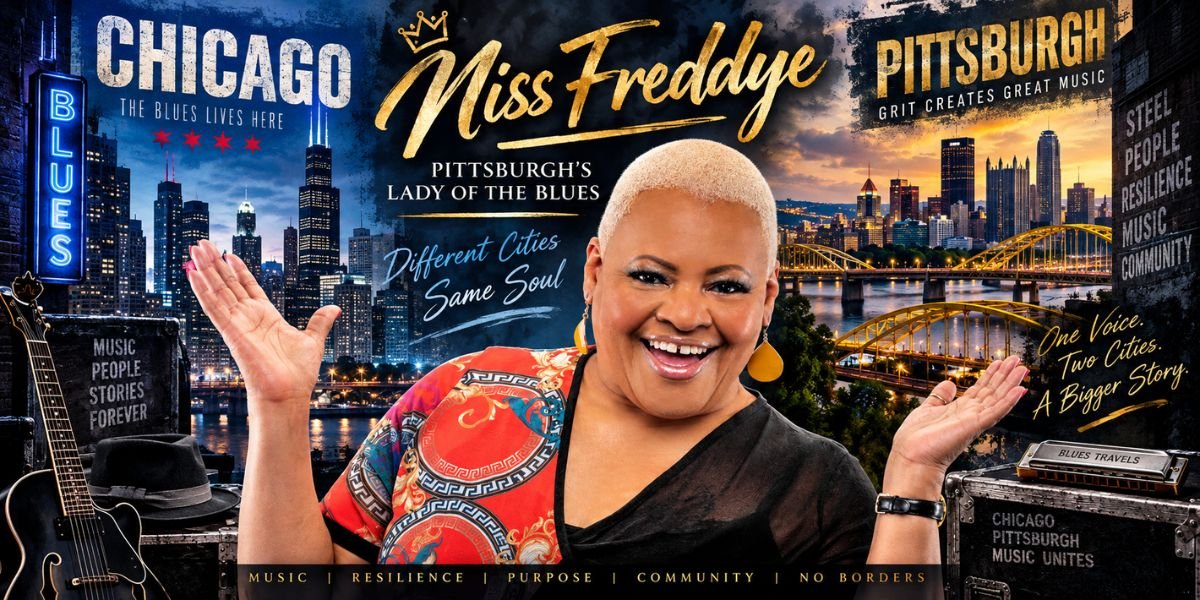
Pittsburgh calls her its “Lady of the Blues,” which sounds almost too dignified for somebody whose real qualification for the job is that she’s actually lived enough life to know what those words mean.
Miss Freddye didn’t arrive through some record-company laboratory. There wasn’t a stylist standing around saying, “You know what this woman needs? More authenticity.”
She already had it.
Before the charts, awards and applause, there was church. Gospel. That magnificent American contradiction where sorrow gets dressed up in its Sunday clothes and somehow turns into joy before lunchtime.
That’s where Freddye learned the first rule of singing: you better mean it.
Then came life.
For more than 30 years, Miss Freddye worked as a nurse. Think about that for a minute. While generations of musicians were desperately attempting to manufacture tortured-artist biographies, Freddye was walking into hospital rooms where actual human beings were afraid, sick, grieving, and hoping somebody might make things a little less terrible.
You want a blues education?
Try that.
Then she survived breast cancer.
Twice.
And COVID.
So when Miss Freddye sings about survival, there’s no need to consult the press release.
You can hear it.
Her voice doesn’t politely knock on the front door of a song. It walks in, sits down at the kitchen table and starts telling you what happened.
Sometimes there’s gospel in it. Sometimes there’s soul. Sometimes there’s the raw muscle of traditional blues. You can hear why names like Koko Taylor and Etta James come up whenever people try to describe her musical neighborhood.
But Miss Freddye doesn’t need to be anybody’s second coming.
She’s already the first Miss Freddye.
Her career began taking shape in Pittsburgh’s blues scene in the 1990s, and over the ensuing decades she did something increasingly revolutionary in the music business:
She kept going.
Gig after gig.
Song after song.
Year after year.
No viral dance required.
Eventually, the rest of the world started paying attention. Her music has reached international audiences, including charting on the UK iTunes Blues Chart. Her rendition of “Wade in the Water” also reached the iTunes gospel chart, which makes perfect sense because gospel and blues have always been arguing siblings living in the same American house.
One says, “Lord, save me.”
The other says, “Lord, you wouldn’t believe what happened last night.”
Miss Freddye understands both.
She’s also accumulated awards and recognition throughout her career, including honors from Pittsburgh’s Iron City Rocks Awards and acknowledgment from the wider blues community. Nice things to have, certainly. Put them on the shelf.
But trophies don’t sing.
Miss Freddye does.
And the most interesting thing about her isn’t where she charted. It’s what happened before she ever got there.
The cancer.
The nursing.
The family.
The church.
The disappointments nobody puts in biographies.
The ordinary Tuesdays when you get out of bed even though you’d rather not.
That’s where the blues actually lives.
And then there’s Pittsburgh.
Of course she’s from Pittsburgh.
Look at the place.
Three rivers colliding beneath bridges built by people who understood that your hands are supposed to get dirty occasionally. Hills stacked with houses. Old mills haunting the horizon. Neighborhood bars where somebody will explain exactly what’s wrong with your football team whether you asked or not.
Pittsburgh doesn’t specialize in delicate personalities.
Neither does Miss Freddye.
But toughness isn’t the same thing as hardness, and that’s where her music gets interesting.
Her work carries enormous warmth. She has devoted considerable energy to community causes, cancer awareness, veterans, young people and those who need somebody in their corner. The nurse never completely disappeared when the singer walked onto the stage.
Maybe that’s the secret.
Miss Freddye isn’t singing at people.
She’s taking care of them.
For three minutes, five minutes, an evening, however long the song lasts, she’s saying: I’ve been hurt too. I’ve been scared too. I’ve wondered what happens next.
And I’m still here.
That’s blues.
Not the costume.
Not the mythology.
Not the guitar somebody bought because Eric Clapton once played the same model.
Survival.
Miss Freddye has survived enough to understand something most of us spend our lives trying not to learn: joy means more after you’ve seriously considered losing it.
So call her Pittsburgh’s Lady of the Blues.
Give her the awards.
Put the chart numbers in the biography.
Just don’t mistake any of those things for the reason she matters.
The reason is simpler.
Miss Freddye lived.
Then she opened her mouth and told us about it.
Turn it up.