
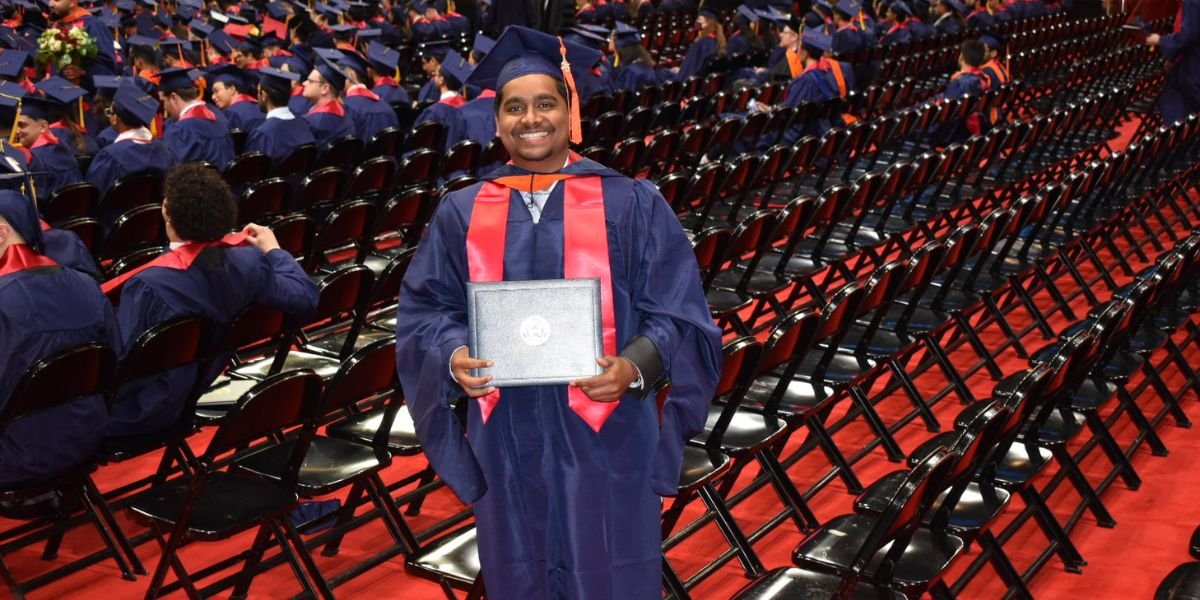
For Yogesh Rethinapandian, Chicago was not just where he earned a graduate degree. It became the city that taught him how to build.
A 22-year-old arriving in Chicago for the first time does not fully understand the city at once.
At first, it is the noise. The trains cutting through neighborhoods. The wind moving between glass towers. The lake appearing suddenly at the end of a long street. The rush of students, workers, founders, researchers, and immigrants all trying to make something of themselves in a city that does not slow down for anyone.
For many graduate students, Chicago is a place to study, earn a degree, and move on. For Yogesh Rethinapandian, it became something deeper. It became the place where ambition stopped being an idea and became a daily discipline.
Rethinapandian came to the University of Illinois Chicago with the goal of building a serious technical foundation in computer engineering. Like many students who arrive with big plans, he carried more than one dream. He wanted to grow as a researcher. He wanted to publish meaningful work. He wanted to contribute to advanced semiconductor systems and secure computing. But he also felt the pull of entrepreneurship, the urge to solve real problems outside the classroom.
Chicago forced him to confront both sides at once.
Graduate school required patience. Research required depth. Startup life required speed. The city required endurance.
During his time at UIC, Rethinapandian developed scholarly work in semiconductor systems, hardware security, and advanced computing. His research has explored chiplet security and die-to-die communication in AI accelerators, a field becoming increasingly important as modern computing systems move toward modular chip architectures. In simple terms, his work looks at how sensitive data moves inside advanced chips and how future AI hardware can be made more secure at the hardware layer itself.
At the same time, he was also beginning to build beyond the lab.
Rethinapandian later co-founded Kamuit, an angel-backed transportation technology startup focused on structured shared mobility. The company grew from an observation familiar to many students and immigrants: traveling between university towns, airports, and major cities can be expensive, fragmented, and unreliable, even when other people are already driving the same routes.
The idea was simple, but the execution was not. Kamuit set out to bring structure to long-distance shared rides through verified users, scheduled routes, and community-based coordination. What began as a problem he personally understood started turning into a company that drew early investor and advisor interest.
To Rethinapandian, the connection between semiconductor research and mobility technology is not as strange as it may seem. Both are about trust. In one case, trust between chiplets inside an AI accelerator. In the other, trust between people moving across cities. Both require systems that can coordinate safely, reliably, and at scale.
Chicago helped him see that pattern.
“Whenever I felt like I was falling behind or missing out, I would take a run from Harrison toward the lake,” Rethinapandian said. “You see the trains moving, students walking, people working late, the skyline on one side and the lake on the other. Chicago has a way of reminding you that everyone is carrying something, but everyone is still moving.”
That movement became part of his own rhythm.
There were days when research deadlines felt heavier than expected. There were nights when startup decisions carried more uncertainty than confidence. There were moments when the fear of missing out became real: fear of choosing the wrong path, fear of moving too slowly, fear of trying to be both a scholar and a founder when the world often asks people to pick one identity.
But Chicago did not teach him to choose only one side of himself. It taught him to build bridges between them.
“Chicago feels like two sides of the river,” he said. “On one side, there is the pressure to prove yourself. On the other, there is the reminder to breathe and keep going. The bridges are what matter. You have to build your own bridges between fear and ambition, between research and execution, between who you are and who you are trying to become.”
That lesson became central to how he approached his work.
His semiconductor research gave him a way to think deeply about invisible infrastructure: the internal systems that make modern AI computing possible. His startup work gave him a way to think about visible infrastructure: roads, cities, airports, university towns, and the people moving between them. In both cases, he was drawn to problems that many people experience but few systems are designed to handle well.
For Rethinapandian, UIC was more than a university on a résumé. It was where he learned to operate under pressure, to connect academic rigor with practical execution, and to understand that ambition is not built in one clean direction. It is built through competing demands, late nights, difficult choices, and the willingness to keep going when the outcome is not guaranteed.
That experience reflects a broader shift among young STEM graduates. Many are no longer treating research and entrepreneurship as separate tracks. They are publishing, presenting, building, testing, and applying technical ideas to public problems. They are learning that scholarly work can shape industry thinking, while startup work can expose new research questions.
Rethinapandian’s path sits within that shift.
His work in semiconductor security points toward the future of AI hardware, where trust may need to be designed into the physical architecture of computing. His work with Kamuit points toward another kind of trust system, one focused on people, routes, and shared transportation.
Both paths are still being built. But Chicago gave him the environment to begin carrying both.
“Chicago showed me that you do not have to wait until everything is perfect to start,” he said. “You can be tired, uncertain, and still take the next step. That is what the city taught me.”
For a young graduate student who arrived with a fresh mind and more ambition than certainty, Chicago became more than a backdrop. It became a training ground.
The skyline, the lakefront runs, the bridges, the classrooms, the research papers, and the long nights all became part of the same story.
Not a story about avoiding fear.
A story about learning how to move with it.