
By: Claire Donovan
Chicago knows something about standing through difficult seasons.
This is a city where summer arrives like a celebration, and winter tests everybody’s commitment. Trees that spend July forming green canopies over neighborhood streets can appear skeletal by January, battered by lakefront winds and buried beneath snow. Then spring comes, and somehow they begin again.
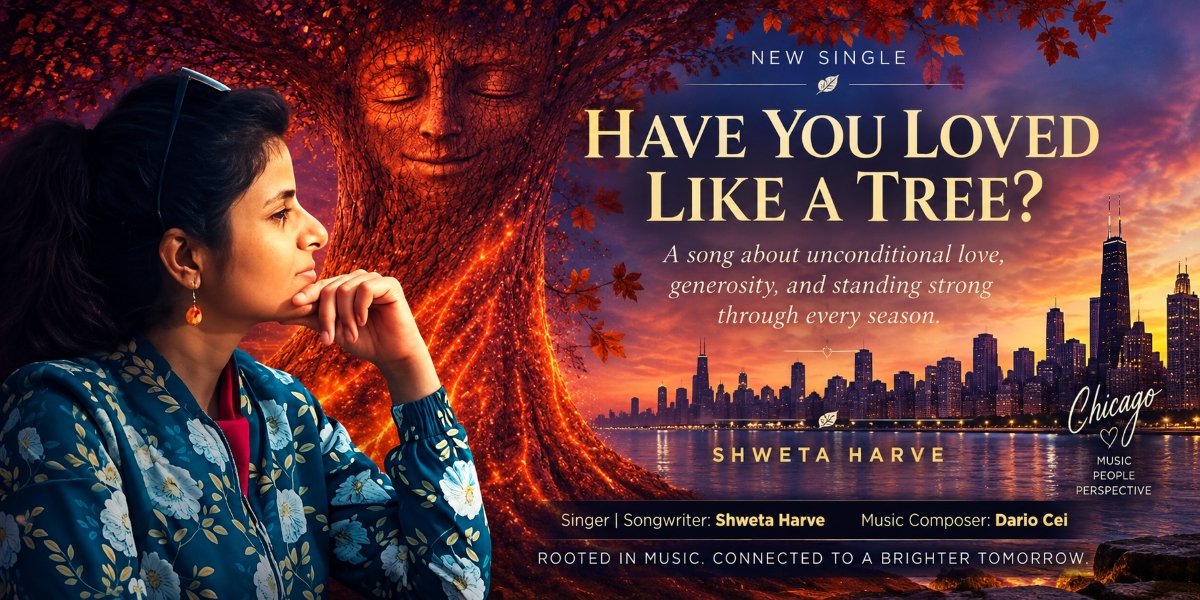
That cycle makes Shweta Harve’s “Have You Loved Like a Tree?” feel particularly meaningful when heard from a Chicago perspective. The Dallas-based singer-songwriter builds the single around a deceptively simple question: What would it mean to love another person the way a tree exists in the world?
Harve isn’t really singing about trees, of course.
She’s singing about endurance.
About giving.
About remaining present when the season changes.
Those ideas fit Chicago remarkably well.
Chicago has always been a city of neighborhoods, where identity can change within a few train stops but community remains essential. From Bronzeville and Pilsen to Hyde Park, Uptown and Rogers Park, generations of people have created lives through relationships that endure because somebody decided to remain standing when things became difficult.
Harve turns that kind of steadfastness into the emotional center of her song.
The tree becomes an uncomplicated but surprisingly effective symbol. It provides shade without demanding payment. Its branches offer shelter. Its roots keep it grounded. It gives something to the world simply by being there.
The longer Harve develops the idea, the less sentimental it becomes.
Because loving like a tree sounds easy until you consider what she’s actually asking.
Can you give without calculating what you’ll receive?
Can you offer someone shelter during their worst season?
Can you stay rooted while everything around you changes?
Musically, “Have You Loved Like a Tree?” approaches those questions with restraint. The production leaves plenty of space around Harve’s vocal, favoring warmth and reflection instead of chasing the oversized sonic impact common to contemporary pop.
That makes sense for the material.
Chicago listeners come from a city with an extraordinary musical inheritance: blues, gospel, house, jazz, soul, rock and hip-hop have all flourished here. Those traditions may sound radically different, but the best examples share one quality: emotional truth matters more than decoration.
Harve understands that principle.
Her performance isn’t designed as a showcase for vocal acrobatics. Instead, she delivers the song with sincerity and control, allowing the words to remain the focal point. There is conviction in her voice without the feeling that she’s trying to convince you.
That difference matters.
The song becomes even more interesting alongside Harve’s earlier “What the Troll?”, which reached No. 26 on the Mediabase Adult Contemporary chart. That single confronted online trolling, cyberbullying, and the strange cruelty that can emerge when human interaction is filtered through anonymity and screens.
Put the two songs together, and they almost behave like a question and response.
“What the Troll?” examines disconnection.
“Have You Loved Like a Tree?” searches for connection.
One looks at what happens when people forget the humanity of strangers. The other asks whether generosity, patience, and unconditional support might help us remember it.
For an independent artist, that’s the beginning of a compelling creative identity. Harve isn’t simply releasing songs around whatever topic happens to be commercially convenient. She appears increasingly interested in using accessible music to examine how people treat one another.
Chicago is an appropriate city for that conversation because community here isn’t an abstraction. It’s embedded in the city’s culture. Neighborhood festivals, corner bars, churches, block clubs, independent venues, and family businesses survive because people continually invest in the places and people around them.
In other words, they put down roots.
There is room for Harve to push the musical side of her concept further. “Have You Loved Like a Tree?” maintains a consistently reflective atmosphere, but greater dynamic contrast could deepen its emotional impact. Chicago’s gospel tradition understands this instinctively: begin intimately, build patiently, and eventually let the music rise until contemplation becomes release.
A more dramatic final passage could give Harve’s message additional force without compromising the song’s tenderness.
Still, its restraint has purpose.
The recording doesn’t shout because the tree doesn’t need to.
That’s ultimately what makes the metaphor stick.
Think about a Chicago tree in February. There are no leaves. No evidence of growth. Nothing outwardly spectacular is happening. Yet beneath the surface, life remains. The roots haven’t abandoned their work simply because nobody can see the results.
There is something beautiful in that image, and something distinctly relevant to Harve’s definition of love.
Real devotion isn’t always dramatic.
Sometimes it’s showing up.
Sometimes it’s surviving winter together.
Sometimes it’s standing quietly beside someone until their spring returns.
That is where “Have You Loved Like a Tree?” moves beyond its unusual title and becomes something genuinely affecting. Harve takes an everyday object and asks listeners to reconsider it as a model for human behavior.
In a culture dominated by speed, visibility and instant reaction, she’s advocating something slower: patience without recognition, strength without performance and generosity without expectation.
Chicago understands all three.
Harve’s memorable central metaphor, sincere vocal delivery, and understated production give the single emotional staying power. Greater dynamic development could make the musical journey even stronger, but the song accomplishes the most important task: it leaves listeners thinking after it ends.
In the Windy City, where every year brings another test of what can survive the season, Shweta Harve’s question lands with particular force.
When the cold comes, will your love still have roots?