
Chicago is famous for its towering skyline, deep-dish pizza, and vibrant neighborhoods. But beneath the modern city lies a shadowy history shaped by warfare, organized crime, violence, and death. For travelers who want to see the dark side of the Windy City, these locations offer fascinating glimpses into the events and legends that helped shape Chicago.
SMC Cartage Company Garage: The Site of the St. Valentine’s Day Massacre
Few events are as closely associated with Chicago’s gangster era as the St. Valentine’s Day Massacre. On February 14, 1929, seven men connected to Chicago’s North Side Gang were murdered inside a garage at 2122 North Clark Street.
The killings were part of the violent struggle between rival criminal organizations led by Al Capone and Bugs Moran. Men dressed as police officers entered the garage and lined the victims against a wall before opening fire. Although the exact identities of the perpetrators remain uncertain, the massacre became one of the most infamous episodes of Prohibition-era Chicago.
The original garage was eventually demolished, but its location remains a point of interest for visitors fascinated by the city’s gangster history. Exploring such sites offers unique opportunities to learn about Chicago’s gangs and mobsters. Go beyond the romanticized image of Prohibition-era gangsters and consider the brutality that accompanied organized crime.
Fort Dearborn: Chicago Before Chicago
Long before Al Capone and Prohibition, Chicago was shaped by conflict between Native peoples, settlers, and military forces. Fort Dearborn was established by the United States Army in 1803 near the mouth of the Chicago River. The fort became an important military outpost, but its history took a tragic turn during the War of 1812.
In August 1812, American soldiers and civilians evacuated the fort under orders from the army command at Detroit. Potawatomi warriors attacked the column as it moved south along the lakeshore, and the resulting conflict became known as the Battle of Fort Dearborn. A number of soldiers and civilians were killed or captured during the fighting.
The fort itself eventually disappeared, and modern Chicago grew around the location. Today, markers and monuments help visitors understand where this early military installation once stood.
Exploring Fort Dearborn’s history provides a fascinating reminder that the enormous city surrounding you was once a contested frontier settlement. Chicago’s dark history didn’t begin with gangsters but actually stretches back to the city’s earliest years.
Red Lion Pub: Raising a Glass to Chicago’s Ghosts
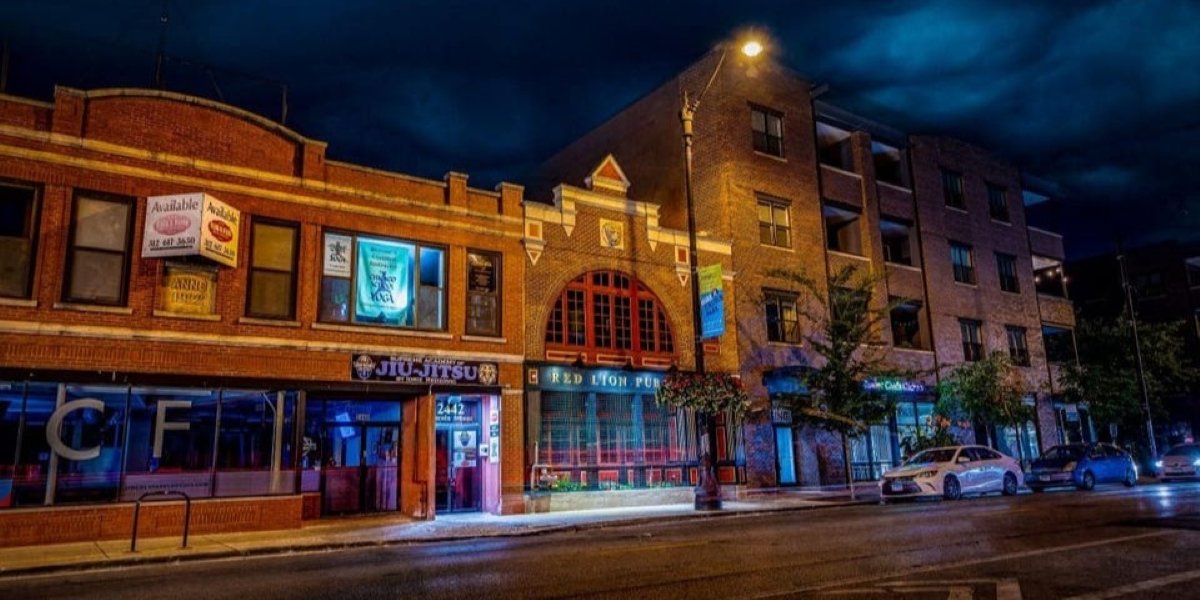
History doesn’t always stay confined to museums and monuments. Sometimes it can be found in the city’s pubs. There’s a reason the Red Lion Pub is a regular stop on a Chicago ghost tour. It’s a fascinating stop for travelers who enjoy combining historical storytelling with paranormal lore.
Like many historic establishments, the pub has accumulated stories of unusual activity and unexplained encounters. That combination is part of what makes exploring haunted locations so entertaining. A historic pub isn’t merely a place to have a drink; it can also become a window into the lives and stories of the people who came before.
For visitors interested in Chicago’s darker side, a haunted pub offers a chance to experience history after sunset. Add a ghost tour to the evening, and you can turn a simple night out into an exploration of Chicago’s legends, tragedies, and lingering spirits.
Death Alley: A Dark Corner of the Theater District
The bright lights of Chicago’s theater district might seem like an unlikely place to encounter a grim story. But near the Nederlander Theatre is a narrow passage popularly known as “Death Alley.”
The name is connected to a tragic theater fire that devastated Chicago at the turn of the twentieth century. The Iroquois Theatre fire of 1903 remains one of the deadliest disasters in Chicago’s history. Hundreds of people died when a fire broke out during a performance, turning a place of entertainment into a scene of unimaginable chaos.
Just behind the theater, the alley was used as a makeshift morgue. There, the bodies were piled up until they could be transported to the proper facilities. This gruesome event gave the back alley its morbid nickname.
Walking through the area today can be a striking experience because of the contrast between its modern surroundings and its tragic history. What appears to be an ordinary downtown passageway becomes much more meaningful when you understand what happened nearby.
Graceland Cemetery: History Among the Tombstones
No list of dark history and haunted places in Chicago is complete without a trip to Graceland Cemetery. Founded in 1860, this historic cemetery is the final resting place of many prominent Chicagoans, including architects, industrialists, politicians, and cultural figures. Its elaborate monuments and mausoleums make it as much an outdoor architectural museum as a cemetery.
But cemeteries naturally invite visitors to think about the darker side of history: disease, death, tragedy, and the passage of time. Walking among the elaborate graves provides a different perspective on the people who built Chicago.
Graceland is also an excellent place to explore Chicago’s architectural history. Many of the monuments reflect the wealth and ambitions of the city’s Gilded Age elite, while the cemetery’s mature trees and winding paths provide a peaceful contrast to the busy streets outside.
For those interested in the supernatural, cemeteries also naturally inspire ghost stories and local legends. Even without encountering anything paranormal, however, Graceland offers something valuable: a tangible connection to Chicagoans of past generations.
Experience Chicago’s History Differently
Exploring Chicago’s dark history sites offers more than a collection of scary stories. They reveal the conflicts, tragedies, ambitions, and ordinary lives that helped transform Chicago from a frontier settlement into one of America’s greatest cities. If you want to experience the Windy City from a different perspective, follow its darker stories. You may discover that the past is never very far away.