
By: Roxanne Jeffrey
She still remembers the office. The fancy car visible through the window. The air of confidence that filled the room before she’d even asked a single question. The business owner across from her generating over ten million dollars in revenue, surrounded by every visible sign of success.
And then she started asking about margins. About product mix. About customer concentration. And the answers didn’t come.
By the end of the meeting, he had told her he didn’t need her help. His brother-in-law was his CPA. He had a staff of bookkeepers keeping the lights on. As she walked out, she had already seen enough. One major customer. Two products. Margins below ten percent.
A few years later, she found out through a mutual friend that his company no longer existed. He had filed for bankruptcy.
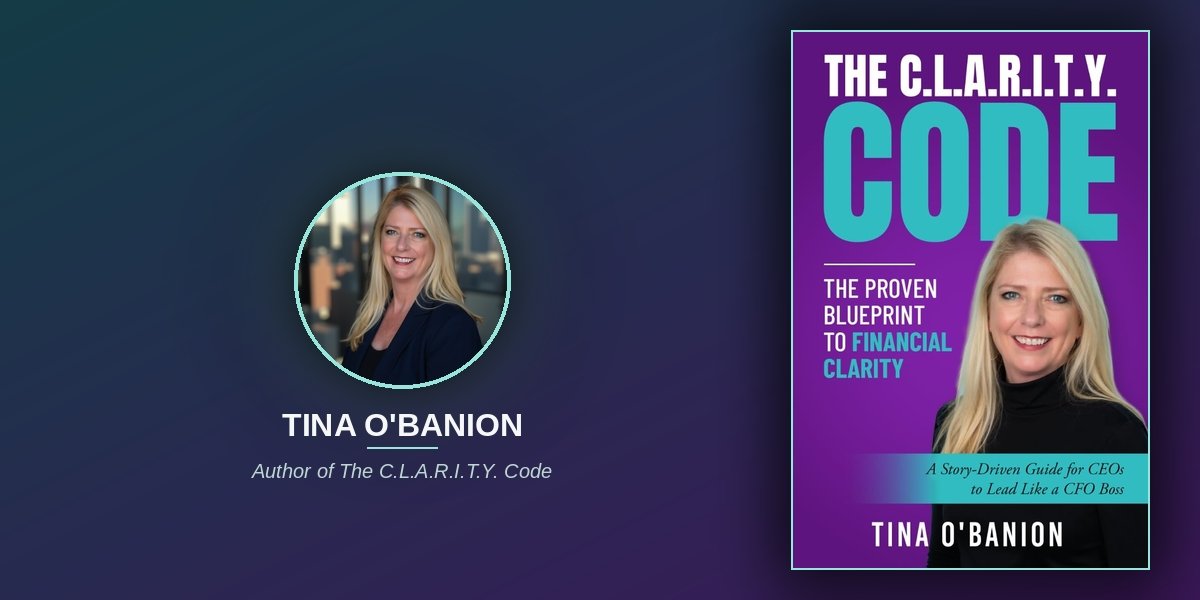
He wasn’t unusual, Tina says. He was the norm. And that’s exactly why she wrote The C.L.A.R.I.T.Y. Code.
Busy Isn’t the Same as Profitable
One of the most useful distinctions in Tina’s framework is the difference between being busy working and simply being busy. Entrepreneurs look around at a full calendar, a busy team, and a growing client list and assume that activity equals progress. It doesn’t.
Busy and profitable are not the same thing. And far too many business owners never stop to ask the most important question: are we busy doing the right things?
A strong financial strategy would show an entrepreneur exactly what to focus on. What activities, what clients, what revenue streams actually move the needle and build real value in the business. Without that visibility, growth for growth’s sake becomes the goal. And if you’re scaling without understanding your profit margins, your cash position, and your true financial health, you can be completely booked out and still be living, as Tina puts it directly, in Brokeville.
The Warning Signs Show Up Before the Statements Do
When businesses are scaling without a solid financial foundation, Tina says the warning signs are usually not subtle. They show up in daily operations long before they show up on a financial statement.
Vendors that can’t get paid on time. Payroll that feels like a monthly miracle. Loans being taken out, credit cards being maxed, personal relationships being strained to keep the lights on. These are all the business telling you clearly and loudly that something is broken underneath all that growth.
What makes this especially dangerous is that the growth itself can mask the problem. Revenue is coming in, the team is busy, new clients are signing, and from the outside everything looks like momentum. But underneath, the foundation is cracking.
A building can only rise as high as its foundation can support. The same is true for a business. Sustainable scale is the goal, and you cannot get there without the foundation.
What the Right Person at the Table Actually Does
Tina draws a sharp distinction between the different financial professionals an entrepreneur might have access to. A bookkeeper records what already happened. A CPA shows up at tax time. Both are looking in the rearview mirror.
A fractional CFO sits at the table and looks out the windshield with you. What’s ahead. What decisions need to be made. What the numbers are telling you about where your business is going.
And if your business is generating at least one million dollars in revenue, she says without hesitation, you cannot afford not to have that perspective at your side.
She tells the story of a woman she met at a networking luncheon who owned a medspa. Her bookkeeper had advised her to purchase an entire year’s worth of supplies and inventory all at once. Something felt off. Tina told her it wasn’t just off; it was awful advice. A few weeks later, the woman became a client, fired her bookkeeper, and fired her CPA firm too, because yes, the CPA firm had also been doing her bookkeeping.
The wrong person at your table is sometimes worse than no one at all.
If your business looks great from the outside but something feels off underneath, The C.L.A.R.I.T.Y. Code by Tina O’Banion is available now on Amazon. The warning signs are already there. The question is whether you’re ready to see them.
Disclaimer: This article is intended for general informational and editorial purposes only. It does not provide financial, accounting, tax, legal, business, or professional advisory advice, and it should not be relied upon as a substitute for guidance from qualified professionals. Business performance, profitability, cash flow, financial strategy, and operational outcomes can vary based on industry, market conditions, management decisions, accounting practices, and individual circumstances. Readers should consult a licensed CPA, financial advisor, fractional CFO, attorney, or other qualified professional before making business or financial decisions.