
By: Andrew Vespa
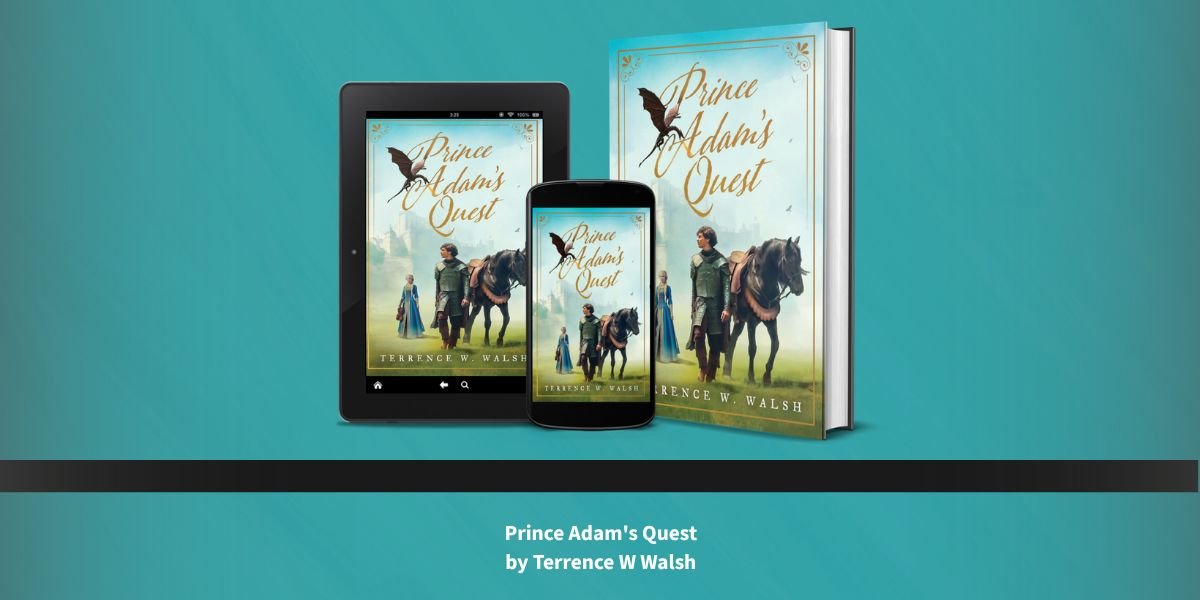
There is a particular kind of storytelling confidence that allows a writer to hand the ending of a story back to the character and say, here, you decide how this goes. Terrence W. Walsh shows that confidence in Prince Adam’s Quest, a playful and witty result of a writer who spent three decades in the U.S. Coast Guard writing mostly nonfiction and then retired to Cape Cod and decided to write the kind of fiction he wanted to read. The result is a book that wears its playfulness openly while giving readers more to consider underneath the surface charm.
The setup is straightforward. Prince Adam sets forth from the kingdom of Leftovria to slay a dragon that has been reported causing destruction, accompanied by Minnow, an apprentice bard whose talent for composing songs on the road turns out to be more useful than anyone, including Minnow, anticipated. The journey takes them across bridges managed by trolls who love tolls with the particular devotion of creatures who have organized their civilization around the concept, and Adam’s ongoing struggle to pay those tolls gives the narrative a grounding comedy that can keep even the more fantastical elements connected to consequence.
What Walsh does with that setup is where the book becomes more layered. The story can work as an allegory, but the instruction does not arrive in the form of a lesson delivered from above. It arrives through the specific texture of Adam’s choices, through the way Minnow’s songs change the atmosphere of every room they enter, and through the three possible endings the book holds open simultaneously until Adam chooses his fate. That structural choice, unusual and carefully handled, gives the book another layer beyond its surface entertainment.
Walsh writes with dry, affectionate wit and a sense of connection between reading, experience, and storytelling. The prose has a rhythm that suggests a storyteller comfortable in his own skin, unhurried and precise and amused by the world he has built. The kingdom of Leftovria feels inhabited rather than merely described, and the supporting characters, particularly the troll king, whose susceptibility to Minnow’s music is one of the book’s recurring threads, have specific personalities that help the fantasy world feel lived in.
Prince Adam’s Quest is the kind of book that can remind readers what inventive and human fantasy can do. It may entertain readers while leaving them thinking about the ending they would have chosen and why, which can become a question worth sitting with longer than expected.
Readers interested in a fantasy quest that hands them the ending and asks them to decide what winning actually means can find Prince Adam’s Quest by Terrence W. Walsh on Amazon. The book gives readers a chance to consider which fate they would choose for Prince Adam, and what that choice might say about them.