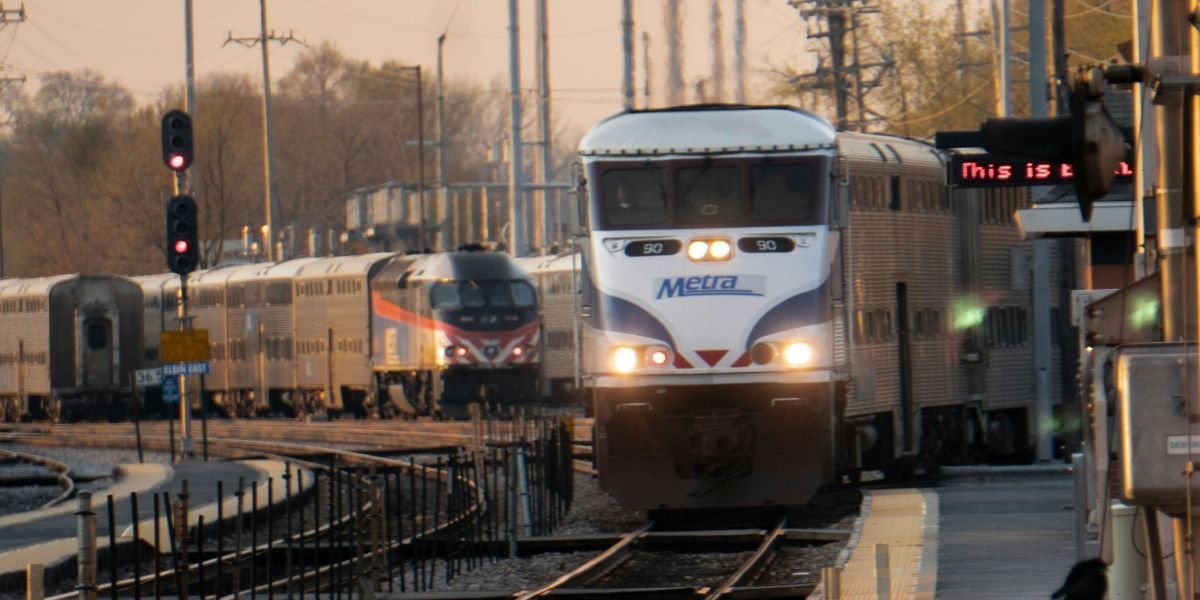
Metra will put its first battery-electric train on public display at LaSalle Street Station on October 14 and 15, giving riders an early look at the four-car trainset set to begin service on the Rock Island District’s Beverly Branch in 2028. It is the first of eight battery-electric trains Metra has ordered.
Key Takeaways
- The battery-electric train will be on display at LaSalle Street Station, 414 S. LaSalle St., on October 14 and 15, with viewing from 10 a.m. to 6 p.m. on October 14.
- Service on the 16.4-mile Beverly Branch between LaSalle Street and Blue Island is planned to begin in 2028.
- The four-car trainset seats about 200 passengers and has a listed top speed of 79 mph.
- Batteries recharge at fast-charging stations at each end of the line, with a plug-in option that takes about 2.5 hours.
- Before entering service, the train will go through further testing in Pueblo, Colorado.
- Metra changed its battery specifications three times during production as battery technology improved.
Metra Introduces the Battery-Electric Train at McCormick Place
Metra first showed the battery-electric train on October 5 at the American Public Transportation Association’s TRANSform & Expo at McCormick Place. It was the association’s first convention in Chicago since 1981. The trainset was built by Stadler, a manufacturer based in Switzerland, and was finished about two and a half years after Metra’s board approved the purchase in February 2024.
The train has been shown only to Metra employees since then. Metra CEO Jim Derwinski said the agency planned to invite mechanics, engineers, and other staff to inspect the train in the rail yard before taking it downtown, so the people who will maintain and operate it can see it first.
The public showcase at LaSalle Street Station is the first chance for Rock Island District riders to step aboard. Metra said that after the viewing, the battery-electric train will undergo further testing before entering service.
Why Metra Chose the Beverly Branch
Metra picked the Beverly Branch for its first battery-electric service for practical reasons. The branch runs 16.4 miles from LaSalle Street Station through Beverly, Mount Greenwood, and Morgan Park to Blue Island, with closely spaced stops through residential neighborhoods.
That stop-and-go pattern suits the train’s design. Battery-electric trains accelerate faster than diesel equipment and recover energy through regenerative braking each time they slow down. Derwinski also pointed to how close homes along the Beverly Branch sit to the tracks. A quieter train without diesel exhaust makes a noticeable difference for residents whose backyards border the line.
The route is also well within the train’s range. Metra has projected a range of 45 to 65 miles on a full charge, which covers a round trip on the branch with room to spare.
How the Battery-Electric Train Charges and Runs
The charging setup avoids the cost of electrifying the whole line. Fast-charging stations at each end of the Beverly Branch will recharge the batteries through pantographs on the train’s central power unit, which draw power from a short overhead rail. Derwinski said plug-in charging will also be available and takes about two and a half hours.
The train runs on lithium-titanate battery packs. The manufacturer lists charging capacity of up to 2 megawatts and a top speed of 79 mph. Inside, the two seating areas are connected by a narrow passageway through the battery section in the middle of the train.
Battery technology improved quickly during production. Derwinski said Metra changed the order three times in the short time since the contract was signed as better batteries became available. He described the first train as a starting point, not the final version of what battery rail could do in Chicago.
Federal Funding Helped Cover the Order
Metra received a $169.3 million federal Congestion Mitigation and Air Quality Improvement grant to help pay for the battery-electric trains. The new trainsets will let Metra retire some of its oldest diesel locomotives and railcars.
The project fits into a larger discussion about the future of rail in Chicago. Other proposals, such as a $2.25 billion express rail plan linking O’Hare to downtown, are competing for attention and funding. Metra’s battery-electric trains stand out as a project already built and paid for, with a confirmed route and a planned service date.
What Riders Can Expect Before 2028
The Beverly Branch will keep running its current diesel service until the battery-electric trains are cleared for passengers. Testing in Pueblo, Colorado, comes first. Derwinski said the train needs to be tested in real-world conditions to see how it performs.
The LaSalle Street showcase lets South Side riders see what is coming to their line. Questions about charging, comfort, and accessibility can be answered in person rather than through renderings.
FAQs
When Can the Public See Metra’s Battery-Electric Train?
The train will be on display at LaSalle Street Station, 414 S. LaSalle St., on October 14 and 15, 2026. Viewing runs from 10 a.m. to 6 p.m. on October 14.
When Will Metra’s Battery-Electric Train Start Carrying Passengers?
Metra plans to begin service on the Rock Island District’s Beverly Branch in 2028. The train will first undergo further testing in Pueblo, Colorado.
Which Metra Line Will Use the Battery-Electric Train?
The train will run on the Beverly Branch of the Rock Island District. The branch covers 16.4 miles between LaSalle Street Station and Blue Island.
How Does Metra’s Battery-Electric Train Recharge?
The train recharges at fast-charging stations at each end of the line, drawing power from an overhead rail. Plug-in charging is also available and takes about 2.5 hours.
How Many Battery-Electric Trains Did Metra Order?
Metra ordered eight battery-electric trainsets. The one on display is the first, and it seats about 200 passengers across four cars.