The Chicago Journal

Alison Storry Reflects on Fifty Years of Grief After Her Father’s Murder in Fatherless


By: Jax Smith

There is a specific quality of courage in memoir writing that has nothing to do with the willingness to share difficult information and everything to do with the willingness to examine that information without the organizational logic that makes it manageable. Most memoir writers impose a narrative shape on their material that protects both the writer and the reader from the full disorganization of grief, the way it actually moves through a life without the courtesy of following a comprehensible arc toward a comprehensible resolution. Alison Storry has written Fatherless without that protection, and the result is a memoir that feels genuinely lived rather than retrospectively ordered, genuinely examined rather than retrospectively explained.

She was seven years old when her father was murdered in Northern Ireland, a casualty of the IRA and of the Troubles that generated casualties across generations in ways that political history captures poorly and personal history captures not at all until someone like Storry sits down without armor and begins to trace the actual shape of the damage. She spent the year after his death being sent to boarding school in the British countryside, a displacement that followed the first and established the pattern that would organize the next five decades, movement and reinvention and the continuous creation of a self capable of functioning in the present without being overtaken by the past.

That self, what Storry calls the useful self, she learned to construct around the grief she could not afford to feel, served her well enough across a career as an international model and a life that took her from England to Hong Kong to Japan to the United States. It served her well enough through a marriage and into the divorce trial that finally made the distance between the constructed self and the actual self impossible to maintain. What the memoir traces is the cost of that construction and the specific nature of the liberation that comes from finally setting it down.

Storry writes about her father, about the boarding school years, about the Asia chapters of her life, about her marriage and its ending, with the honesty of someone who has decided that accuracy matters more than comfort and that the reader she is trusting with this material deserves the truth rather than the managed version. The memoir does not flinch from the ways that childhood survival strategies become adult self-sabotage. It does not pretend that the answer she eventually finds resolves everything that the loss created. It offers instead the specific and durable satisfaction of a life examined honestly, which is the only satisfaction that genuinely difficult memoirs have to offer and the only one worth having.

If you want a memoir that traces the full and honest cost of losing a parent to political violence in childhood and the fifty-year journey to examine that loss without the armor that made the journey survivable in the first place, Fatherless by Alison Storry is the book that does it without flinching. Head over to Amazon and get your copy today, and let one woman’s courageous accounting of her own life give you something you can carry forward in yours.

N.E. Carlisle Explores Books, Memory and Legacy in a Cozy Mystery

By: Victoria Smith

The best cozy mysteries have always understood something that the genre’s detractors miss when they dismiss it as lightweight entertainment: that the pleasures of warmth and community and the satisfaction of a well-solved puzzle are not trivial pleasures but genuine ones, and that a story which delivers all of them with skill and care is doing something genuinely valuable for the reader who needs exactly that combination at exactly that moment. N.E. Carlisle has understood this from the beginning of the Bonne Année Mysteries, and Books, Bunnies, and a Body is the installment that most fully articulates the emotional intelligence underlying that understanding.

The thematic material at the book’s heart, organized around what happens to books after the people who loved them are gone, gives the novel a tenderness and a depth that sit alongside the mystery mechanics without competing with them. Année’s work buying whole lots from shuttered shops and estate sales is rendered with the specific detail of someone who has thought carefully about what it means to be the inheritor of other people’s libraries, the particular intimacy of handling objects that were loved before you arrived and that carry that love in their marginalia and their inscriptions and the way their spines have been broken by the hands that read them most. This is not a heavy theme in Carlisle’s treatment. It is a gentle one, present in the texture of the narrative rather than foregrounded at the expense of everything else.

The mystery itself is constructed around the community rhythms of spring in Hazelton, with the egg hunt and the approaching wedding giving the investigative timeline both its urgency and its emotional stakes. Carlisle builds her puzzle with the respect for the reader’s intelligence that characterizes the best work in the genre, assembling clues that are genuinely discoverable without being obvious and suspects who are specific enough to be genuinely suspicious without being reduced to their suspiciousness.

Oscar the Bernedoodle earns his considerable page time through specific comic behavior rather than vague adorableness. The recipes are gluten and nut-free and warmly presented. The Basque cheesecake note, serves eight or two after a bad day, is the line that will stay with readers longest because it captures the entire emotional register of the series in a single breath.

If you love cozy mysteries that combine genuine warmth with genuine puzzle-craft and that understand the specific comfort that a well-told small-town story provides to the readers who need it, Books, Bunnies, and a Body by N.E. Carlisle is the book that delivers all of it with a beating heart and a beautiful setting. Head over to Amazon and get your copy today.

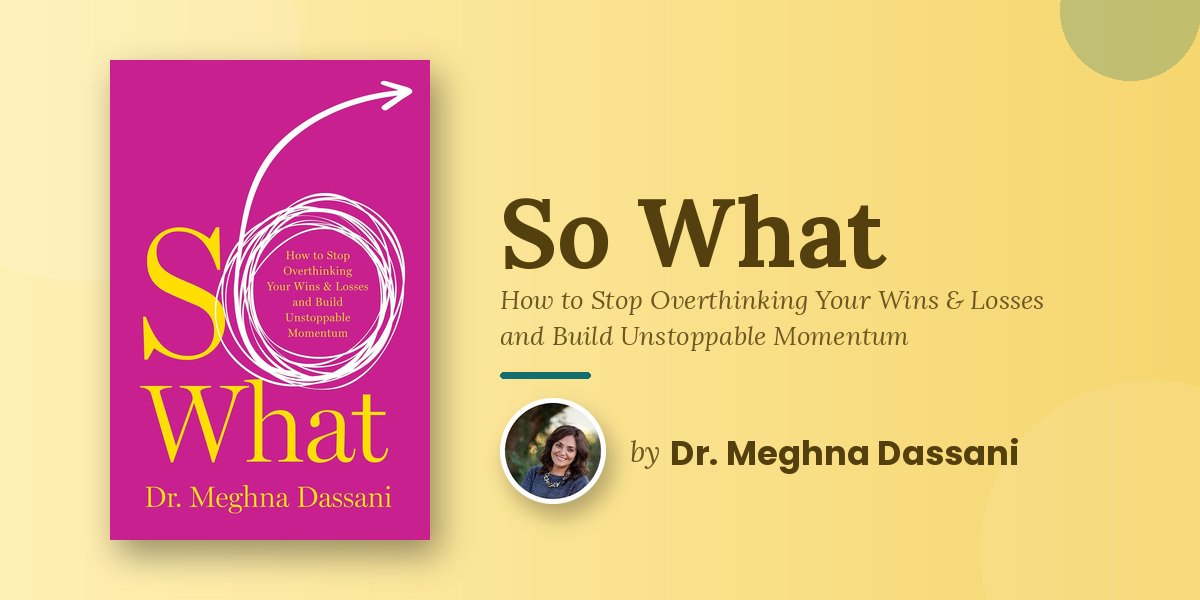
So What Is Not a Philosophy Book About Overthinking; It Is a Momentum-Building Practice Manual, and Dr. Meghna Dassani Knows the Difference

By: Tony Collins

The personal development landscape is full of books that correctly diagnose overthinking as a significant obstacle to success and then offer solutions organized around reducing or eliminating the overthinking itself, as if the problem were the thoughts rather than what the thoughts prevent. Dr. Meghna Dassani takes a different approach in So What, and the difference matters practically. She is not primarily interested in helping readers think less or think better. She is interested in helping them move more, specifically in building the habit of forward momentum that makes both wins and losses into fuel rather than anchors. That reframe from the quality of thinking to the fact of movement is what gives the book its particular and practical authority.

The So What Sequence she introduces is the concrete expression of that reframe. Acknowledge. So what. What’s next. The sequence is not asking for the analysis to stop. It is asking for the analysis to be bounded, to have a specific endpoint after which forward movement is the required response rather than continued examination. That boundary is what makes momentum possible in the aftermath of both wins, which can become as paralyzing as losses when they invite excessive analysis of what they mean and what to do to replicate them, and losses, which can become anchor points of self-examination that delay the next attempt indefinitely.

Dassani’s credibility comes from a specific and relevant source. She built a thriving dental practice and a career that produced multiple books on sleep health and airway science while watching her highest-performing peers stay frozen at exactly the kind of decision and reflection points that the So What Sequence is designed to move through quickly. She knows the pattern from the outside, from watching it cost people she respected in real time, and she knows the alternative from the inside, from the specific habit she developed of redirecting energy from analysis to action with a discipline that produced consistent forward movement where the overthinking pause would have produced stagnation.

The application of the framework across relationships, parenting, health, leadership, career, and personal growth reflects an understanding of overthinking as a domain-agnostic mental habit rather than a domain-specific strategic problem. The 30-Day So What Challenge companion gives the framework a structured implementation path that most productivity books propose without providing.

So What is explicitly the opposite of manifestation culture, and that positioning is honest and important. This is not a book about aligning your energy or visualizing your outcomes. It is a book about moving, specifically and repeatedly, which is the only mechanism through which momentum is actually built.

If you are ready for a momentum-building practice manual that is organized around the fact of forward movement rather than the quality of your thinking about what to do next, So What by Dr. Meghna Dassani is the most practical and the most immediately actionable resource currently available for the specific problem it addresses. Head over to Amazon and get your copy today and start building the momentum that over-analysis has been costing you.

Metra’s First Battery-Electric Train Goes on Public Display at LaSalle Street Station October 14 and 15

Metra will put its first battery-electric train on public display at LaSalle Street Station on October 14 and 15, giving riders an early look at the four-car trainset set to begin service on the Rock Island District’s Beverly Branch in 2028. It is the first of eight battery-electric trains Metra has ordered.

Key Takeaways

  • The battery-electric train will be on display at LaSalle Street Station, 414 S. LaSalle St., on October 14 and 15, with viewing from 10 a.m. to 6 p.m. on October 14.
  • Service on the 16.4-mile Beverly Branch between LaSalle Street and Blue Island is planned to begin in 2028.
  • The four-car trainset seats about 200 passengers and has a listed top speed of 79 mph.
  • Batteries recharge at fast-charging stations at each end of the line, with a plug-in option that takes about 2.5 hours.
  • Before entering service, the train will go through further testing in Pueblo, Colorado.
  • Metra changed its battery specifications three times during production as battery technology improved.

Metra Introduces the Battery-Electric Train at McCormick Place

Metra first showed the battery-electric train on October 5 at the American Public Transportation Association’s TRANSform & Expo at McCormick Place. It was the association’s first convention in Chicago since 1981. The trainset was built by Stadler, a manufacturer based in Switzerland, and was finished about two and a half years after Metra’s board approved the purchase in February 2024.

The train has been shown only to Metra employees since then. Metra CEO Jim Derwinski said the agency planned to invite mechanics, engineers, and other staff to inspect the train in the rail yard before taking it downtown, so the people who will maintain and operate it can see it first.

The public showcase at LaSalle Street Station is the first chance for Rock Island District riders to step aboard. Metra said that after the viewing, the battery-electric train will undergo further testing before entering service.

Why Metra Chose the Beverly Branch

Metra picked the Beverly Branch for its first battery-electric service for practical reasons. The branch runs 16.4 miles from LaSalle Street Station through Beverly, Mount Greenwood, and Morgan Park to Blue Island, with closely spaced stops through residential neighborhoods.

That stop-and-go pattern suits the train’s design. Battery-electric trains accelerate faster than diesel equipment and recover energy through regenerative braking each time they slow down. Derwinski also pointed to how close homes along the Beverly Branch sit to the tracks. A quieter train without diesel exhaust makes a noticeable difference for residents whose backyards border the line.

The route is also well within the train’s range. Metra has projected a range of 45 to 65 miles on a full charge, which covers a round trip on the branch with room to spare.

How the Battery-Electric Train Charges and Runs

The charging setup avoids the cost of electrifying the whole line. Fast-charging stations at each end of the Beverly Branch will recharge the batteries through pantographs on the train’s central power unit, which draw power from a short overhead rail. Derwinski said plug-in charging will also be available and takes about two and a half hours.

The train runs on lithium-titanate battery packs. The manufacturer lists charging capacity of up to 2 megawatts and a top speed of 79 mph. Inside, the two seating areas are connected by a narrow passageway through the battery section in the middle of the train.

Battery technology improved quickly during production. Derwinski said Metra changed the order three times in the short time since the contract was signed as better batteries became available. He described the first train as a starting point, not the final version of what battery rail could do in Chicago.

Federal Funding Helped Cover the Order

Metra received a $169.3 million federal Congestion Mitigation and Air Quality Improvement grant to help pay for the battery-electric trains. The new trainsets will let Metra retire some of its oldest diesel locomotives and railcars.

The project fits into a larger discussion about the future of rail in Chicago. Other proposals, such as a $2.25 billion express rail plan linking O’Hare to downtown, are competing for attention and funding. Metra’s battery-electric trains stand out as a project already built and paid for, with a confirmed route and a planned service date.

What Riders Can Expect Before 2028

The Beverly Branch will keep running its current diesel service until the battery-electric trains are cleared for passengers. Testing in Pueblo, Colorado, comes first. Derwinski said the train needs to be tested in real-world conditions to see how it performs.

The LaSalle Street showcase lets South Side riders see what is coming to their line. Questions about charging, comfort, and accessibility can be answered in person rather than through renderings.

FAQs

When Can the Public See Metra’s Battery-Electric Train?

The train will be on display at LaSalle Street Station, 414 S. LaSalle St., on October 14 and 15, 2026. Viewing runs from 10 a.m. to 6 p.m. on October 14.

When Will Metra’s Battery-Electric Train Start Carrying Passengers?

Metra plans to begin service on the Rock Island District’s Beverly Branch in 2028. The train will first undergo further testing in Pueblo, Colorado.

Which Metra Line Will Use the Battery-Electric Train?

The train will run on the Beverly Branch of the Rock Island District. The branch covers 16.4 miles between LaSalle Street Station and Blue Island.

How Does Metra’s Battery-Electric Train Recharge?

The train recharges at fast-charging stations at each end of the line, drawing power from an overhead rail. Plug-in charging is also available and takes about 2.5 hours.

How Many Battery-Electric Trains Did Metra Order?

Metra ordered eight battery-electric trainsets. The one on display is the first, and it seats about 200 passengers across four cars.