

Chicago’s housing stock skews old, even by Rust Belt standards. City parcel records are tracked by the Cook County Assessor’s Office and analyzed by the Institute for Housing Studies at DePaul University; the median age of the city’s two-flats and three-flats is over a century.
That gap between building age and building code keeps a narrow but steady lane open for licensed handyman repairs in Chicago, work too small for a general contractor’s crew and too frequent to disappear.
Why Chicago’s Building Age Matters For Maintenance Demand
Chicago’s residential landscape is dominated by masonry buildings that predate modern construction standards.
The median age of the city’s 2-to-4 unit buildings, the backbone of Chicago’s rental stock, is 108 years, with only modest variation from one neighborhood to the next, according to the Institute for Housing Studies at DePaul University.
A few figures put the pattern in context.
- More than two-thirds of Chicago’s occupied housing units predate 1970, based on Census data compiled through the American Community Survey.
- The typical 2-to-4 unit building in the city is around 108 years old, per Cook County Assessor parcel data cited by DePaul’s Institute for Housing Studies.
- Chicago’s bungalow belt alone accounts for more than 80,000 homes, most of them built between 1910 and 1940.
The Gap Between Large Contractors And Small Jobs
General contractors size their overhead around bigger jobs, with permits and subcontractors, and crews that need weeks of steady work to stay profitable. A sticking door or a broken latch rarely clears that bar.
The city’s own permitting system reflects the split: the Department of Buildings runs an Express Permit Program, launched in November 2023 and expanded further in September 2024, built specifically to fast-track small repair and replacement work that doesn’t require architectural drawings.
A program like that only gets built when the volume of minor repair work is too large, and too low-margin, for the standard review process most large contractors are set up around.
A short list explains why bigger firms tend to pass:
- A few-hundred-dollar repair call rarely covers a general contractor’s minimum job cost once scheduling and overhead are factored in.
- Multi-unit buildings generate repair requests that are too small and too frequent for a standard bidding process.
- Insurance and staffing structures built for large-scale construction add overhead that doesn’t scale down well.
What Do Property Managers And Landlords Deal With Most
Anyone managing a multi-unit building in Chicago sees the same short list on repeat.
- Door closers and hinges wear out faster in buildings with heavy foot traffic.
- Weatherproofing around older window frames needs attention every heating season.
- Furniture and fixture assembly comes up constantly in buildings with regular tenant turnover.
- Cabinet and closet hardware fails more often in units that haven’t been updated in decades.
What Does This Mean For Building Owners
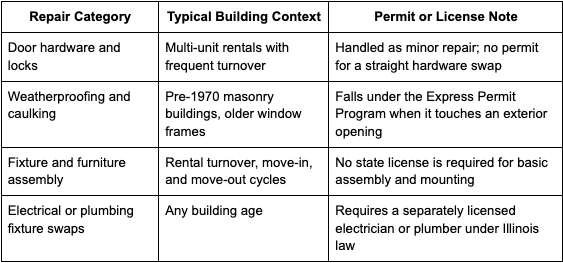
Illinois does not issue a statewide handyman license. The Illinois Department of Financial and Professional Regulation licenses only certain trades, including roofing, under the Illinois Roofing Industry Licensing Act.
Chicago handles the remaining requirements locally. Routine repairs generally fall outside state licensing, while structural, electrical, plumbing, and roofing work may require licensed tradespeople.
Owners can stay ahead of repairs by:
- Using providers who understand Chicago permit rules for routine jobs.
- Treating maintenance as an ongoing expense, not a one-time renovation cost.
Chicago’s aging brick two-flats, courtyard buildings, and bungalows need steady upkeep to maintain long-term demand.