By: Dar Dowling
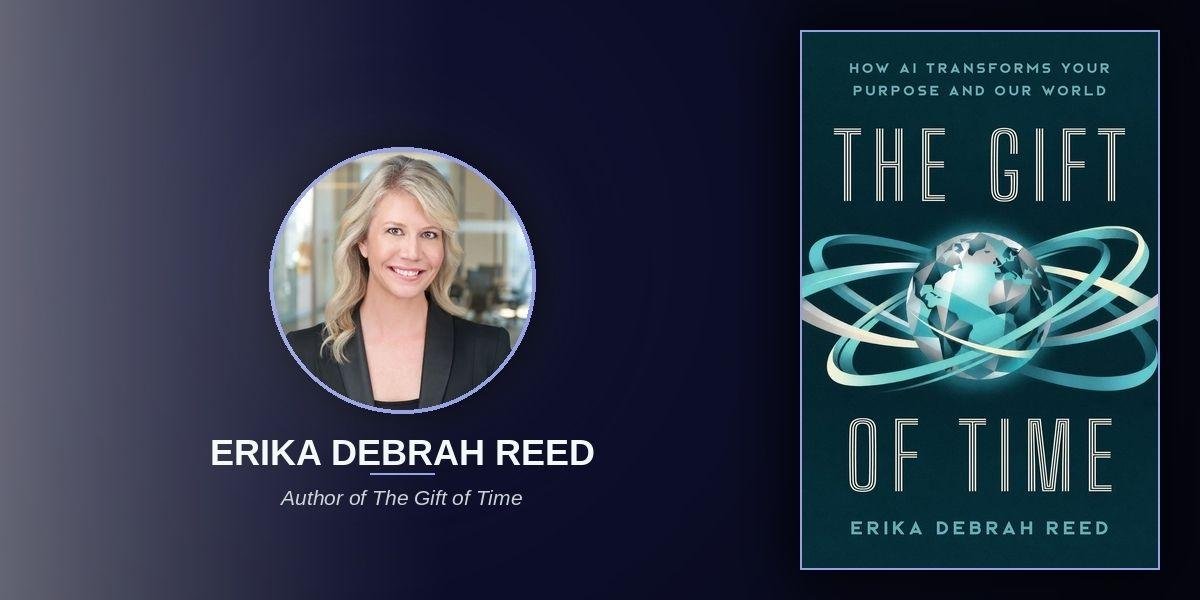
Most books about artificial intelligence begin with the technology. Erika Debrah Reed begins with time itself, with Aristotle’s observation that time is composed of parts that do not fully exist, with Augustine’s insight that the past lives only in memory and the future only in expectation and the present only in immediate attention, with Einstein’s revelation that time is elastic and relational and inseparable from the observer’s position in space. That opening philosophical arc is not preamble. It is the argument. If we do not understand what time actually is, we cannot understand what it means to have more of it returned to us, or what it would take to live that time well.
Reed is a strategist for one of the world’s largest retail organizations, an advisor to venture capital firms, and someone whose professional life is spent at the intersection of commerce, real estate, and transportation. She brings to this book the specific kind of intelligence that knows how to hold a very large complicated system in view while also understanding the human behavior operating within it, and that combination gives The Gift of Time a quality of grounded insight that purely technological treatments of AI often leave aside.
The book moves outward from the philosophy of time through the history of timekeeping through the transformation of the work week through the era of autonomous vehicles through the emergence of humanoid robotics through the automated future of aviation through the autonomous divide that separates those who will benefit most from these transitions from those who risk being left behind through the education renaissance that AI is making both necessary and possible and finally into what Reed calls the philosophy of curiosity, the quality of engaged, open-ended attention that she identifies as the deepest human response to a world increasingly shaped by machines.
What makes the reading experience so genuinely engaging is the quality of the specific cases Reed deploys throughout. The story of KITT and the 1982 Pontiac Trans Am alongside the contemporary Tesla neural network is not a nostalgic detour. It is a precise illustration of how cultural imagination shapes technological adoption, and how the fantasy of a trusted machine companion that frees human attention for more important things has been with us far longer than the technology required to realize it. The elevator operator strike of 1945 is not a historical footnote. It is a case study in the specific psychology of automation trust and how the combination of economic necessity and deliberate psychological reassurance made the driverless elevator ordinary in a generation.
The Gift of Time turns its attention to the ordinary places where time disappears, the commutes and the administrative loops and the fragments of attention scattered across obligations. Reed pairs a philosophical framework with a practical question, which is what a person might actually do if those fragments came back whole. She leaves the answer to the reader.
If you want to understand what artificial intelligence actually means for the texture of your daily life, your relationship with time, and the question of what you are here to do with the finite hours you have been given, The Gift of Time by Erika Debrah Reed is the book that addresses all three with more depth and more warmth than anything else currently available on the subject. Pick up your copy on Amazon today and start thinking about the most important question the AI era has raised so far.