By: Fabiana Simmons
There is a particular kind of professional education that no MBA program is likely to offer and that much of the business book industry has overlooked: the education that accumulates when someone spends a decade watching how people behave in the specific pressure cooker of commercial air travel.
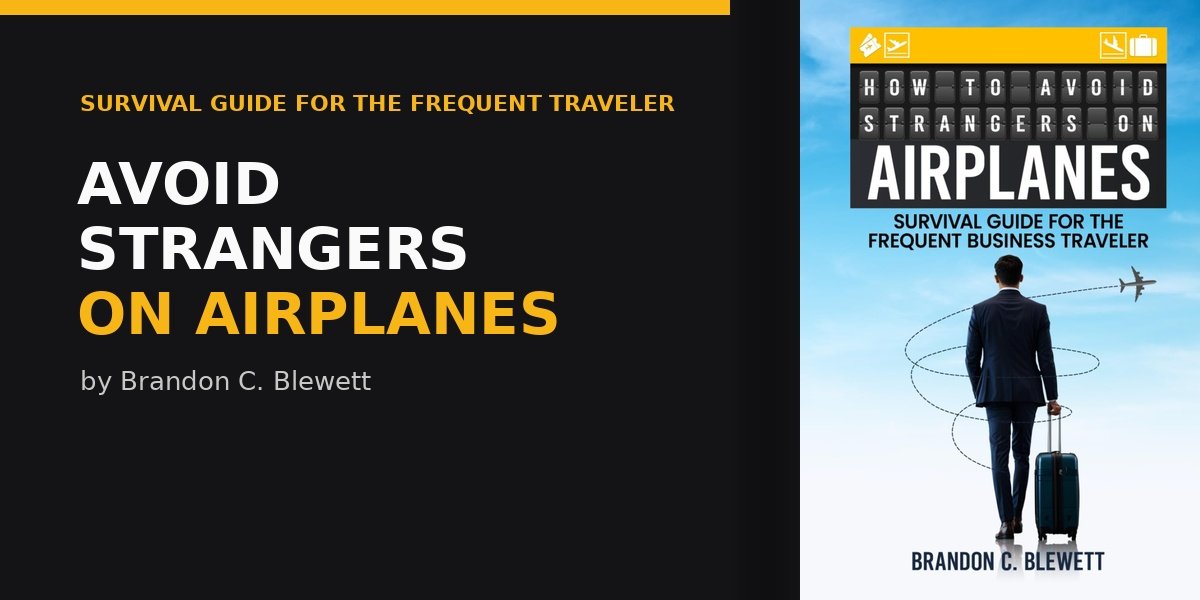
Brandon C. Blewett received that education the hard way, departing on Monday mornings and returning on Thursdays with the reliability of someone for whom the airport was often more familiar than his own kitchen. How to Avoid Strangers on Airplanes is his account of what that education produced.
What stands out immediately about reading this book is how efficiently Blewett makes his comedy work. There is no long warm-up, no unnecessary preamble, and no gentle easing into the material. He opens with the specific and recognizable world of the frequent business traveler and begins making observations that are both funny and thoughtful before readers have had time to fully settle into the book.
That economy of prose, the ability to deliver insight with few wasted words, is not only a stylistic quality of the book. It is also a product of the professional environment Blewett inhabited for more than a decade, where the ability to communicate with precision and impact under time pressure often mattered.
The Six Habits of Highly Annoying Travelers are the book’s central contribution, and many readers may recognize their own airport experiences in the comic detail. But Blewett’s broader insight, the one that gives the book depth beneath its entertainment value, is that these habits are not only airport-specific phenomena.
They are human behaviors that can show up wherever people share limited resources under pressure, including many professional environments. The Gate Lice resemble people in an organization who jump queues and ignore shared norms. The overhead bin abusers resemble colleagues who take more than their fair share of organizational resources and seem surprised when this creates friction.
By naming these behaviors in their most comic form, Blewett makes them easier to identify in more serious organizational settings.
The career guidance he builds from those observations reflects the perspective of someone who has navigated both the literal turbulence of constant travel and the figurative turbulence of a demanding career in professional services and corporate development. His insights on leadership, resilience, and knowing when to pivot are concise, direct, and grounded in real-world experience.
How to Avoid Strangers on Airplanes is a business book that can be useful partly because it is also enjoyable to read. Blewett has written something frequent business travelers may appreciate immediately, while career-focused professionals may find practical long after the humor lands.
If you are a frequent business traveler who has been accumulating observations about human behavior in airports for years and suspected there was something useful in all of it, How to Avoid Strangers on Airplanes by Brandon C. Blewett is the book that confirms your suspicion and delivers it with more wit and more practical insight than you were probably expecting. Grab your copy on Amazon and find out what a decade of weekly travel, Million Miler status, and a sharp eye for human nature actually produces when someone finally sits down to write it all out.