
By: David Marshall
Rock music has always done its best work when it tells the truth, not necessarily the truth, because that’s usually too complicated for any three-minute song, but a truth. One person’s truth. One family’s truth. One moment when the world shifts beneath your feet and suddenly nothing looks familiar anymore. That’s the territory Harry Kappen explores on “Distant Shore,” and he does it with the kind of quiet confidence that reminds you why songs still matter.
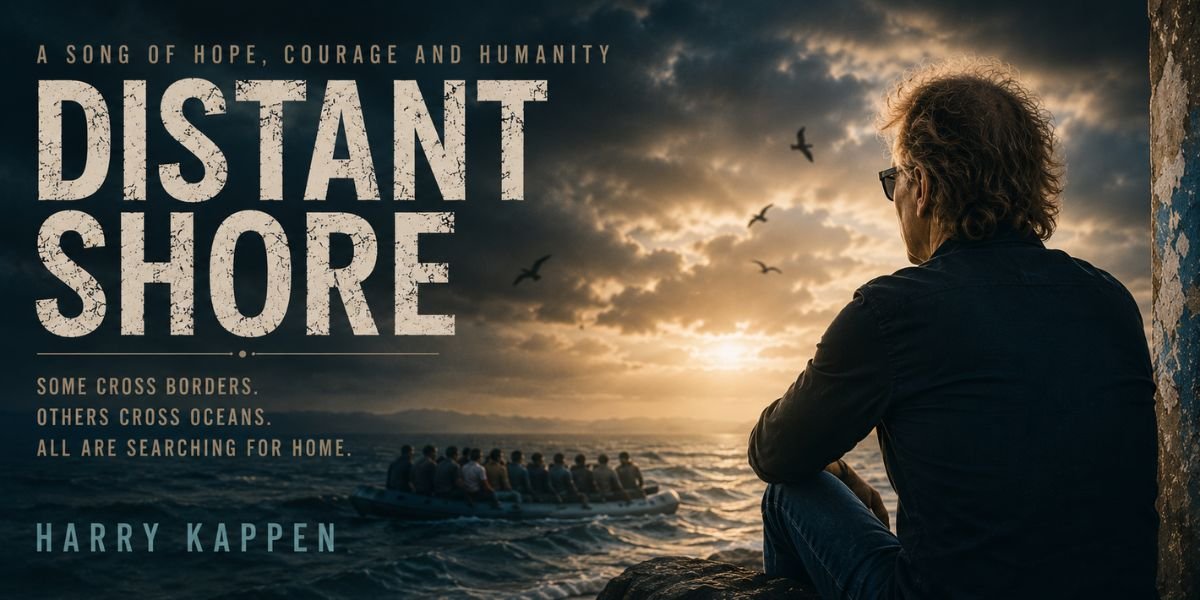
Taken from After the Crossing, Kappen’s first album recorded after relocating from the Netherlands to Mexico, “Distant Shore” begins with a personal realization but quickly reaches far beyond autobiography. His move was voluntary, made in pursuit of a new chapter in life. That experience led him to think about those whose journeys aren’t chosen, people fleeing war, poverty, persecution, and disaster with little more than hope to sustain them.
It’s a dangerous subject because songs about humanitarian crises often collapse under the weight of their own good intentions. Too many become editorials dressed up as music. Kappen understands that listeners don’t need another speech. They need a reason to care.
So he starts with a door.
“I kiss the door I can’t replace…”
That’s the moment the song earns your attention.
Before there are borders or oceans or political debates, there’s home. Not an abstract idea,a real home. A familiar doorway. A last look at a room you’ve lived in. A final breath before stepping into uncertainty. Kappen immediately understands something essential: history is experienced one person at a time.
As the song unfolds, the details accumulate naturally. Forty people crowded into a truck. Endless travel through darkness. Someone praying. Someone collapsing from exhaustion. Waves rising “like concrete walls.” None of it feels exaggerated because Kappen never reaches for drama. Reality is dramatic enough.
The remarkable thing about “Distant Shore” is how completely it trusts its audience. Kappen never insists upon what you’re supposed to think. He simply places you inside another person’s journey and lets the emotional consequences unfold.
Musically, the song occupies a fascinating space somewhere between atmospheric rock, progressive pop, and classic singer-songwriter craftsmanship. Kappen wrote, arranged, performed, and produced everything himself, yet the recording never feels like an exercise in studio perfectionism. Instead, every musical decision serves the emotional center of the song.
The most distinctive element is the mellotron, whose rich, haunting texture immediately recalls David Bowie’s “Space Oddity.” Kappen has openly acknowledged Bowie as one of the inspirations behind the recording, but the influence runs deeper than instrumentation. Bowie used space to explore alienation. Kappen uses the sea.
Both songs ask similar questions about isolation.
Both understand that physical distance often mirrors emotional distance.
But where Major Tom floated beyond Earth’s reach, Kappen’s narrator remains painfully grounded, trapped between the place he left and the place he desperately hopes exists.
The production reflects that uncertainty beautifully.
The keyboards drift across the stereo field like mist rolling over open water. Guitars appear and disappear without demanding attention. The rhythm section keeps moving forward with steady determination, suggesting that stopping simply isn’t an option. Nothing about the arrangement feels rushed. The song unfolds at the pace of reflection rather than urgency.
Kappen’s vocal performance deserves equal praise.
There isn’t an ounce of theatricality in his delivery. He doesn’t oversing the material or attempt to manufacture emotion through volume. Instead, he relies on phrasing, nuance, and sincerity. His voice carries compassion without sentimentality, concern without self-righteousness.
That’s harder than it sounds.
The chorus revolves around one deceptively simple question:
“Where is that distant shore?”
Like all great choruses, it works because it means more every time you hear it.
At first, the distant shore is literal.
Later, it becomes emotional.
Eventually, it becomes universal.
Everyone has a distant shore they’re trying to reach, whether it’s safety, peace, acceptance, forgiveness, or simply the belief that tomorrow might be better than today.
Kappen wisely leaves the answer unresolved.
There is no triumphant ending waiting in the final chorus. Hope remains uncertain because that’s how hope often exists in real life. The song refuses easy redemption, and it’s stronger for that decision.
You can’t help but hear Kappen’s decades as a music therapist echoing throughout the recording. People who spend years listening to others develop an unusual sensitivity to emotional truth. They understand that healing begins with being heard, not with having someone else explain your experience back to you.
“Distant Shore” embodies that philosophy.
It doesn’t speak over the people whose lives inspired it.
It listens.
In today’s musical landscape, dominated by instant gratification and disposable content, Harry Kappen has created something refreshingly durable. This is a song that asks for your attention rather than demanding it. It rewards repeated listening because every return reveals another lyrical image, another subtle production choice, another emotional layer beneath the surface.
Rock music has never been at its best when it’s merely loud.
It’s been at its best when it reminds us that ordinary people are capable of extraordinary courage.
“Distant Shore” does exactly that.
Harry Kappen has written a song that doesn’t pretend to solve the world’s problems. It accomplishes something smaller, and perhaps more important. It asks listeners to remember that every distant shore begins with someone taking one impossible step away from home.
That’s the kind of truth rock music has always been built to carry.