
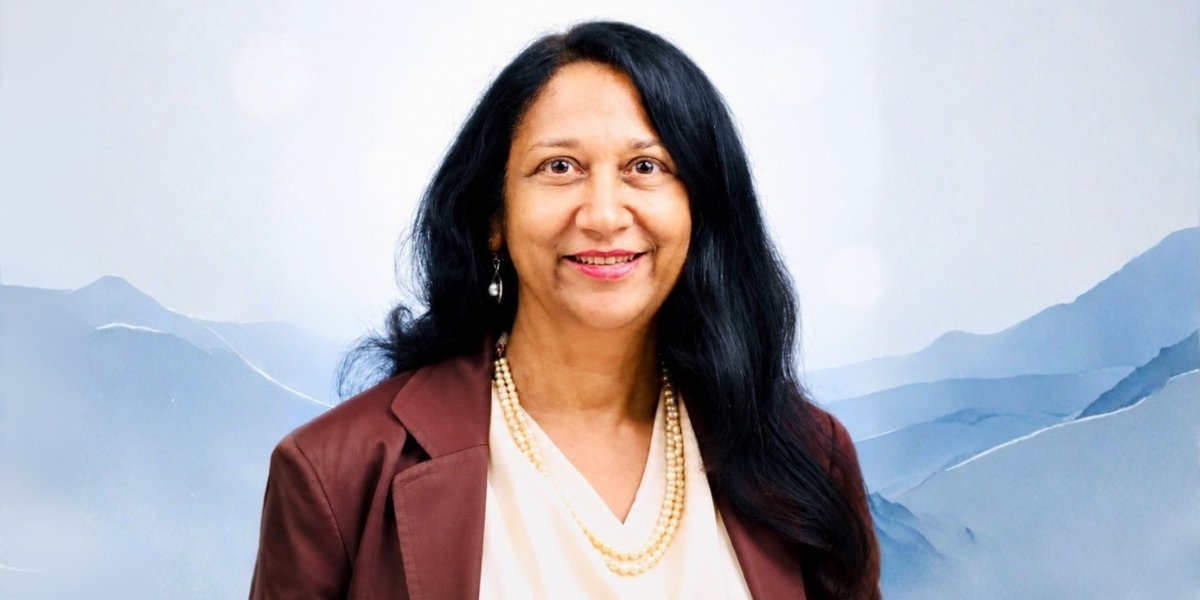
There is a phone call that Dr. Kalyani Gopal, PhD, has never been able to forget. A young girl was being treated, calling late one night from a payphone in Chicago, asking to be picked up. Dr. Gopal told her to go home to her foster parents, assuming it was a teenage dispute. She never heard from the girl again. That silence changed everything.
That moment redirected the career of one of the most decorated clinical psychologists working in human rights today. Dr. Kalyani Gopal, PhD, went from treating foster children in a clinical setting to building an internationally recognized coalition against human trafficking, founding a therapeutic shelter in Indiana, and eventually becoming the first Asian American President of the Psychology Coalition at the United Nations. The path was shaped by grief, urgency, and an unshakable sense of responsibility.
Roots That Ran Deep: Growing Up in a Family Built on Service
Dr. Kalyani Gopal, PhD, grew up in a military family where moving between cities was a way of life. Each new school brought a different culture, a different social ecosystem, and a new set of unspoken rules. Rather than struggling with the instability, she developed a sharp ability to observe, listen, and adapt. Those skills, she has said, made a career in psychology feel like a natural fit.
Altruism ran through her family for generations. Her most formative example was her mother, an Army officer’s wife who returned to college at 35 while raising three young children, then went back again at 50 to become a naturopath. Her mother built a thriving business around organic products, expanded it across an entire state with no formal marketing background, and hired women escaping domestic violence, offering them dignified work and fair wages. For Dr. Gopal, that example set a standard: professional achievement means nothing if it isn’t connected to something larger.
She began her doctoral studies at Vanderbilt University in Tennessee and completed her doctorate in clinical psychology at Alliant University in San Diego. From the start, her focus was on the populations that systems most often fail: children in foster care, survivors of abuse, and individuals carrying trauma that no one had ever named or treated.
Naming What Others Hadn’t: The Science Behind the Practice
One of the most significant contributions of Dr. Kalyani Gopal, PhD, to the clinical field is a term she coined herself: “Displacement Trauma.” The concept describes the complex psychological damage caused by repeated disruptions to childhood attachment bonds, a pattern common in children who cycle through foster placements, institutional care, or unstable family environments.
The term gave clinicians, case managers, and courts a framework for understanding behaviors that had previously been misread as defiance or pathology. It also gave parents and caregivers language to describe what they were witnessing in the children they cared for.
Her books have extended that work into practical tools. She is the author of The Supportive Foster Parent, Foster Parenting Step-by-Step, and the grief and loss workbook In My Heart. Her most recent book, Strong Roots, Safe Wings, published on Amazon, focuses on helping parents recognize and interrupt generational trauma patterns before they pass to the next child. She is also co-editor of the Springer publication Sex Trafficking: Feminist and Transnational Perspectives, which places the crisis in both a psychological and global policy context.
From Clinic to Coalition: Building SAFECHR and the Work That Followed
In 2014, Dr. Kalyani Gopal, PhD, founded the SAFECHR Coalition for Human Rights with a specific goal: to confront human trafficking through psychology, not just law enforcement. That distinction mattered. Most anti-trafficking frameworks at the time centered on prosecution. SAFECHR centered on the survivor.
Under her leadership, SAFECHR developed an internationally accredited, psychologically grounded training program in human trafficking for advocates, clinicians, and law enforcement professionals. She has since trained a wide range of institutions and individuals, including:
• FBI agents
• Police officers, sheriffs, and firefighters
• Judges, attorneys, and case managers
• Foster and adoptive parents
• Government agencies and nonprofit organizations
She has also developed a training manual for clinicians in Mongolia and victim-identification tools for use in Ukraine and Myanmar, working directly with survivors of rape and war. The reach of that work is hard to overstate. Dr. Gopal has moved the conversation about trafficking from awareness into an operational, clinically grounded response.
Since 2020, SAFECHR has operated a therapeutic shelter in Indiana specifically for women who have been trafficked. The shelter is currently scaling to 10 beds with a target of 40-bed operations. Dr. Gopal is building a restorative therapy healing center in India, paired with a commitment to adopt 16 villages in remote areas where girls face the highest risk of being recruited into trafficking networks.
Conference Rooms and Courtrooms: The Scope of Her Leadership
Dr. Kalyani Gopal, PhD, has chaired the Global SAFECHR Conferences since the first one in Chicago in 2014. Subsequent conferences ran in Washington, D.C., and Virginia in 2016, and Chicago again in 2018 and 2019. The next SAFECHR Conference is planned for India in 2027 at safechrindia.com.
Her institutional leadership runs equally wide. She served as President of the Society of Clinical Psychology, Division 12 of the American Psychological Association, in 2022. She chaired the Illinois Psychological Association’s Working Committee on Hate and Harassment. She serves on two Indiana Lake County boards: the Child Protection Team and the Child Fatality Team. In January 2025, she began her tenure on the APA Council of Representatives for Division 56, which covers trauma psychology.
She also serves as President of Mid-America Psychological and Counseling Services, PC, overseeing operations across six mental health clinics in Indiana and Illinois.
The awards she has received reflect the breadth of that work:
• Indiana Lake County Award for Excellence, 2004
• Indiana Attorney General’s Voices for Victims Award, 2015
• US Congressional Award for Top 20 Global Women
• Indiana Commission for Women Torchbearer Award, 2024
The United Nations and a New Chapter of Global Leadership
In August 2024, Dr. Kalyani Gopal, PhD, became President of the Psychology Coalition at the United Nations. She has since been re-elected to a second two-year term, a signal of the confidence the coalition places in her vision for psychology’s role in international human rights work.
It’s a platform that connects directly to the on-the-ground work she has been doing for decades. The tools she created for Ukraine and Myanmar, the training curricula deployed across multiple countries, the survivor-centered shelter model she is scaling in Indiana, all of it positions Dr. Gopal as someone who treats global policy as a complement to direct service, not a replacement for it.
She has described success not in titles or accolades, but in a feeling: a peaceful, calming sense of personal fulfillment and meaning. Watching women and children move from victimhood to survival to purpose-driven lives is, in her own words, the most powerful driver behind her determination to build that 40-bed shelter and to keep going.
What Her Patients Taught Her
For all the institutions she has built and the policies she has shaped, Dr. Kalyani Gopal, PhD, is quick to credit her patients as her most important teachers. Decades of clinical work, listening carefully and helping people rewire the stories they carry, have given her a ground-level understanding of what trauma actually costs and what healing actually requires.
That respect for the people she serves shows up everywhere in her work. It shows up in the language she chooses, in the shelter model she built, in the way she talks about defining success. It is also visible in the way she has raised her own children: one now a Director of Digital Neuropsychology and Brain Health at Harvard Medical School and an Associate Professor in Psychology at Harvard, the other a Harvard Law School graduate working in private equity in California.
Dr. Gopal’s story is not a straight line from graduate school to recognition. It is a series of commitments, each one following from the last, built on the belief that every person can overcome past trauma with the right help, and that the right help is something she can spend a lifetime building.