By: Zach Miller
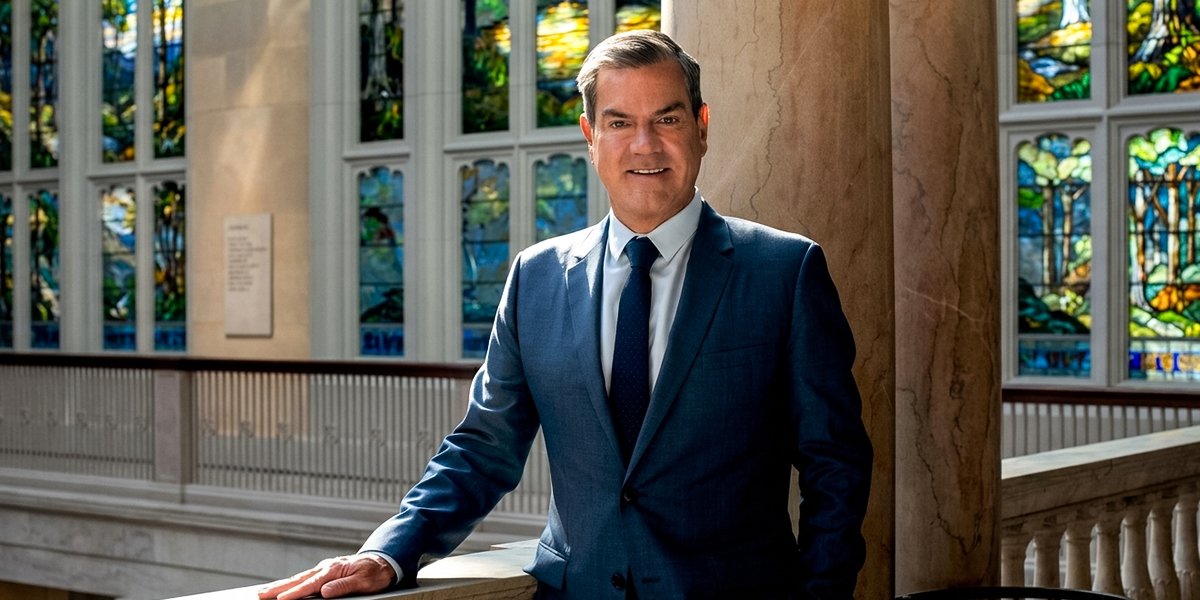
When James Rondeau took the helm of the Art Institute of Chicago in January 2016, he had spent nearly two decades learning the museum from the inside out: first as an associate curator of contemporary art, then as chair of the modern and contemporary art department, a post he held for more than a decade.
He knew the collection intimately, understood the rhythms of the curatorial staff, and had spent years pursuing acquisitions that would stretch the museum’s idea of what it was. The promotion was, in that sense, a natural progression. What he didn’t entirely anticipate was how different the job would feel. “This job is very, very different,” he told WBEZ recently, “from the narrowest construct to the broadest.”
A decade in, the breadth of Rondeau’s leadership is visible in galleries that have been reconfigured, in storerooms holding thousands of new acquisitions, and in building plans that he hopes will reshape the institution for the next generation of visitors.
The Curator-to-Director Transition
James Rondeau grew up in South Hadley, Massachusetts, within reach of five art museums, and made his first trip to the Art Institute as a student at Middlebury College. He earned a master’s degree in art history from Williams College and began his professional life as an associate curator at the Wadsworth Atheneum in Hartford, Connecticut, before joining the Art Institute in 1998.
Over 18 years as a curator, he organized more than 30 solo exhibitions with artists including Shirin Neshat, Thomas Hirschhorn, Olafur Eliasson, Marlene Dumas, and Charles Ray. He co-organized “Jasper Johns: Gray” in 2007, which was named best monographic museum show nationally by the American section of the International Art Critics Association. He led the Institute’s Roy Lichtenstein retrospective in 2012 and the Christopher Wool survey in 2014. In 2009, he oversaw the installation of the modern and contemporary collection in the newly opened Modern Wing, designed by Renzo Piano at a cost of $294 million, the largest single addition to the campus until this decade’s projects broke ground.
The year before he became director, he helped broker what remains the largest gift of art in the museum’s history. Collectors Stefan Edlis and Gael Neeson pledged 44 works, including paintings and sculptures by Andy Warhol, Jeff Koons, Cy Twombly, Jasper Johns, Gerhard Richter, and Cindy Sherman, valued at approximately $500 million. The donation came with an unusual condition: the works would remain on public view for 50 years.
Rondeau addressed the stipulation directly in a statement to The Art Newspaper: “For the Art Institute of Chicago, the commitment… to display the [Edlis-Neeson] collection for 50 years is by no means a burden. We made our selections precisely because they are works we will want, and we believe future stewards of the collection will want, always on view.”
Despite the achievements, when he sat down with WBEZ and the Chicago Sun Times for a wide-ranging discussion of his first decade in January 2026, Rondeau offered a measured assessment.
“It’s a forever learning curve, and acknowledging that with clarity, confidence and some humility on the occasion of looking back on 10 years has been really productive,” he said. “I’ve done a lot of reflecting on what leadership means and what I expect of myself and what I expect I can offer the institution.”
One Collection, 11 Departments
One of the defining challenges Rondeau described when he took over was moving from a curatorial world defined by a single department to the directorial responsibility of overseeing 11. The Art Institute holds approximately 300,000 works spanning 5,000 years and every major continent. That breadth carries its own demands, and its own possibilities.
There was an easy assumption when he was appointed, given his background, that the museum might tilt heavily toward contemporary work. It hasn’t.
“I’m being given the privilege to sit in this office in order to support the ancient Mediterranean, to support Indian textiles and Japanese screen painting in the 17th century,” he said. “That’s the job. It’s not discretionary on my part to say, ‘I’m going to ignore the finances and just love contemporary art.’ That would be a recipe for failure.”
Acquisitions across departments number roughly 1,000 per year, according to Rondeau. The most recent headline-making addition came in early 2025, when collectors Jeffrey and Carol Horvitz donated nearly 2,000 drawings, 200 paintings, and 50 sculptures of French art spanning the 16th through 19th centuries. Works by Jacques-Louis David, Jean-Honoré Fragonard, François Boucher, and Théodore Géricault arrived in a single transfer.
Rondeau later called the gift “generational, transformative,” and it was hailed as one of the largest financial gifts in the museum’s history by the Association of Registrars and Collections Specialists.
Rondeau also pointed to more under-the-radar acquisitions as significant, including “Still Life Reviving” (1963) by Remedios Varo, a 2024 purchase. It came a year after the museum presented its first-ever solo exhibition devoted to a female surrealist painter and the first show dedicated to a woman artist from Mexico. Photography holdings have also expanded. In 2025, the museum acquired 30 works by Francesca Woodman from the Woodman Family Foundation. The Stenn family’s gifts, a promised 97 post-1960 works on paper in 2022 followed by 100 additional drawings and prints in 2023 and a $3 million endowment, strengthened holdings in Minimalist and Conceptual art, with work by Josef Albers, Eva Hesse, Lee Bontecou, Judy Chicago, Donald Judd, and Sol LeWitt. The Bucksbaum family’s $25 million gift in 2024, the largest ever directed at the photography department, laid the groundwork for a dedicated Bucksbaum Photography Center.
The museum has also made deliberate efforts to acquire work by artists historically underrepresented in its galleries, including Kerry James Marshall, Theaster Gates, Jaune Quick-to-See Smith, Norman Lewis, Betye Saar, Bisa Butler, Tschabalala Self, and Amanda Williams, among others.
The Financial Picture
The museum’s endowment stood at $1.12 billion at the time of Rondeau’s January 2026 WBEZ interview, a 70% increase over the course of his tenure. The endowment now funds more than 40% of the institution’s annual $122 million operating budget, roughly 15 percentage points above the industry average of 25 percent for American art museums, as reported by the Association of Art Museum Directors.
The Institute’s free-admission program drew 300,000 visitors in 2025. Although standard adult admission runs $32 (Chicago residents pay $20), the free-access program has expanded reach into neighborhoods the museum had historically underserved, a trend Rondeau pointed to as one of the more meaningful gains of the decade.
Building for the Next Decade
The recent donations and endowments are set to help fund the museum’s physical development for a generation.
In 2017, Rondeau engaged the Spanish firm Barozzi Veiga to develop an architectural master plan. The first completed project under that partnership was a redesign of the Michigan Avenue lobby, which Rondeau described as now “much more open, much more welcoming and much brighter.” More recently, the firm redesigned the museum’s 17th-, 18th- and 19th-century European design galleries with a minimalist sensibility intended as a model for other spaces in the building.
In November 2025, the museum announced the Grainger Center for Conservation and Science, a $50 million project that will occupy the former Regenstein Hall, which had served as the museum’s principal temporary-exhibition gallery since the Rice Building opened in 1988. The 25,000-square-foot facility will bring the museum’s 40-person conservation team together for the first time. He called it the largest single modification to the campus since the 2009 Modern Wing. “We’re making something that has been quintessentially behind the scenes and putting it in a facility that’s visible and central,” he told the Chicago Tribune.
The Grainger Center will include floor-to-ceiling windows designed to maximize natural light for conservation work, updated digital imaging equipment, and an anteroom gallery where visitors can watch conservators at work. Its 20-foot ceilings will allow staff to treat large paintings without the workarounds currently required: when El Greco’s “The Assumption of the Virgin” (1577-79) needed treatment in 2018, the painting had to be worked on its side.
The center is expected to open in fall 2027 and is fully funded.
The Aaron I. Fleischman and Lin Lougheed Building, made possible by a $75 million gift announced in September 2024, will add gallery space for art from the late 19th century to the present. Only about 15% of the museum’s modern and contemporary collection is currently on view, Rondeau told the Sun Times.
The new building is intended to change that ratio. Aaron Fleischman described his reasoning when the gift was announced: “Touring the collections on view and in storage I came to believe that more of the museum’s extraordinary collection needed to be available to visitors and presented in world-class architecture.” He added that he was eager “for the museum to tell a more complete story of modern and contemporary art.”
A Museum Reshaped
The Art Institute Rondeau leads today is bigger, better funded, and more broadly collected than the one he inherited. Its endowment has grown by 70 percent. Its galleries have been physically remade. Its conservation department, long scattered across three floors in improvised quarters, is about to get a purpose-built home. Holdings in French Old Masters, Korean art, Conceptual drawings, surrealism, photography, and works by artists of color have all deepened substantially.
Whether as curator or director, Rondeau has now been at the Art Institute for nearly 30 years. The projects he has set in motion will take him well into the 2030s.
“When you visit this museum, you’re at one of the great museums of the world,” he said. “And if we spent a decade letting our peers refine their facilities and visitor experience and improve access to their collections and we didn’t do that, we would fall behind.”