The Chicago Journal

Why Reddit Belongs In Your Marketing Strategy

By: Jonny Waite, Co-Founder and CEO of RECHO

You can pay to get someone to your website and still lose them when they go to Reddit to ask whether your product is worth buying.

That’s the part of Reddit I want marketing leaders to think about. The customer has already noticed you. They may like what they’ve seen. Now they’re looking for someone who has actually used the product and will tell them what the website doesn’t.

On calls with brands, I spend a lot of time explaining how Reddit works. Many teams are still getting familiar with the platform. Once we look at the conversations happening in their category, the opportunity becomes much easier to understand.

The Details Can Decide The Purchase

Think about someone comparing two expensive pieces of equipment. Both websites look great. Both promise strong performance. What the buyer wants to know is which one will be easier to maintain after a few years.

In a relevant community, an owner can explain what needed replacing. Someone else can disagree, name the model they bought and describe a different experience. The buyer can ask a follow-up question.

That’s information a campaign may never give them.

It matters in business buying, too. A 2026 Reddit and SurveyMonkey study of 1,202 U.S. business decision-makers found that 83% researched independently before speaking with sales. The same study found that 23% had used Reddit for research.

Those are findings from a platform-sponsored study, not proof that every prospect uses Reddit. They do give marketing teams a reason to investigate what buyers are discussing before a sales conversation begins.

When we assess a subreddit, member count is only part of the picture. I want to see the questions, the products being compared and whether the brand has something useful to contribute. A smaller community working through relevant buying decisions can be more valuable than a huge audience with little interest in the category.

Give People Something They Care About

One of my favorite examples from our work is All-Clad. Its cookware factory in Canonsburg, near Pittsburgh, gave us something interesting to share with a regional community: a look behind the scenes at how a familiar product is made.

We used a clearly branded account. The connection was local manufacturing and curiosity about the region. That gave people a reason to engage beyond being asked to consider another product.

I like asking whether a post would still be interesting without the logo. A factory tour can be. An expert explaining a technical problem can be. A product announcement copied from another channel may need more work.

The community has a say in that, too. Read its rules and understand what people already discuss. Where participation requires moderator approval, get it. If the community doesn’t welcome the contribution, respect that.

Be clear about who you work for. Product expertise is a reason for someone to listen; you don’t need to pretend you’re an independent customer to share it.

Stay For The Follow-up

Posting is the beginning of the work. People may ask difficult questions, challenge an explanation or bring up an unresolved problem. Someone needs to be there with enough product knowledge to respond.

Before launching, decide who can answer routine questions and who needs to handle technical or service issues. A promise to follow up only helps if somebody follows through.

A brand’s own subreddit can also give customers a place to exchange advice and hear from experts. It needs a reason for people to return. A feed of announcements usually isn’t enough.

Measure whether relevant people are engaging, whether contributions are accepted and whether the discussions produce useful questions or qualified traffic. Track commercial outcomes where you can. Upvotes can tell you a post landed; they can’t tell you how many people bought.

Reddit belongs in the strategy because customers can use those conversations to decide what deserves their money. Start by reading the discussions around your category. You may find that people are already asking questions your team is well placed to answer.

Business Line of Credit Requirements for Fast Approval

Picture a hallway with three doors. Behind the first is a bank. Behind the second is a credit union or community lender. Behind the third is an online provider. Each one offers a business line of credit, and each has its own requirements, timeline, and price. Knocking on the wrong one wastes time and may cost you a hard credit inquiry.

Here’s what you’ll find behind each door, so that you can choose before you knock.

Door Number One: The Bank

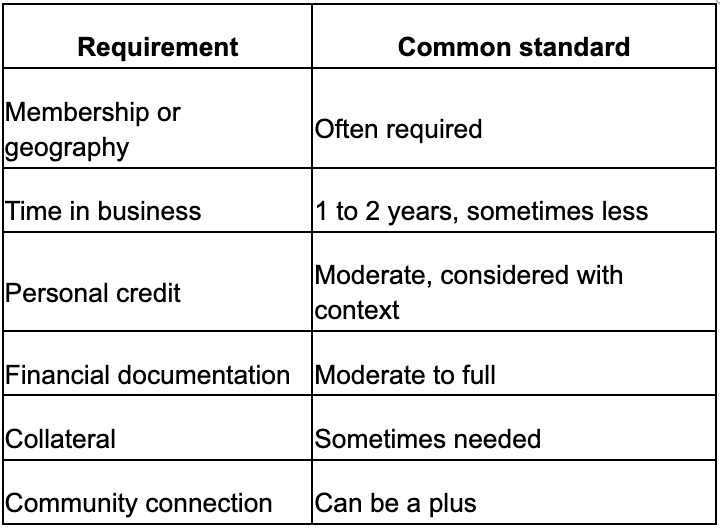
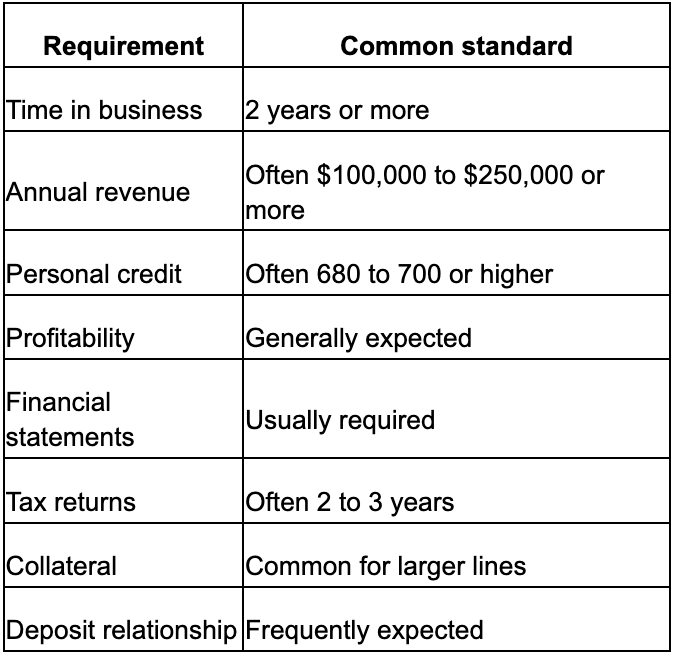
Typical requirements:

Photo Courtesy: Unsplash.com

Likely timeline: One to several weeks. An established customer with a small unsecured line can sometimes move considerably faster.

Why it’s worth knocking: Banks usually offer the lowest pricing and the fewest fees, along with larger limits.

How to prepare:

  • Move your operating account to the bank before you need credit
  • Meet a business banker in person
  • Bring clean financial statements prepared by an accountant
  • Be able to explain your cash conversion cycle
  • Expect a covenant or an annual clean-up requirement

Fast approval at this door: Unlikely unless you’re already a strong customer. Merchants turned away here might read this San Diego article about merchant loan programs about a card-based alternative.

Door Number Two: The Credit Union or Community Lender

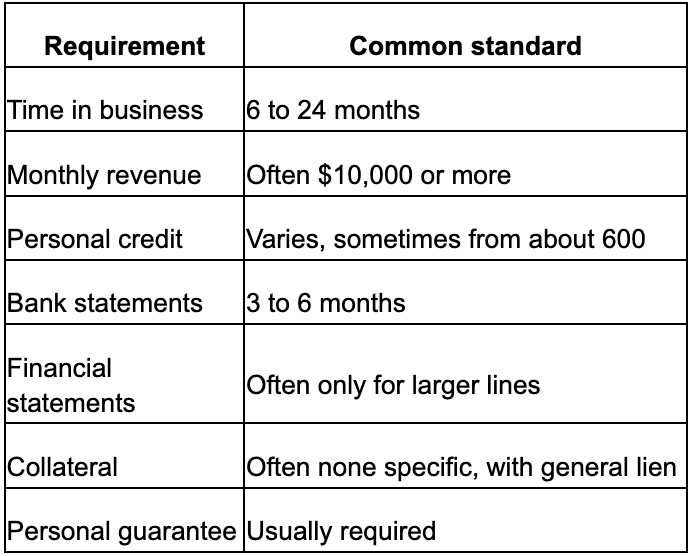
Typical requirements:

Photo Courtesy: Unsplash.com

Likely timeline: Days to several weeks.

Why it’s worth knocking: These institutions may take a more personal look at your story. Community development financial institutions, in particular, often exist to serve businesses banks overlook.

How to prepare:

  • Confirm your membership eligibility
  • Prepare a brief business summary
  • Explain any credit issues candidly
  • Ask about technical assistance or coaching

Fast approval at this door: Possible for small lines and existing members, but not typical.

Door Number Three: The Online Provider

Typical requirements:

Photo Courtesy: Unsplash.com

Likely timeline: Hours to a few days.

Why it’s worth knocking: Quick decisions and light paperwork. It’s the only one of the three doors commonly associated with near-immediate access.

How to prepare: Have statements and IDs ready, and apply early in the business day. Before committing, look at a page like Fundivi on-demand credit lines for an idea of what’s typically requested and offered. Ask about fees, repayment schedules, and whether draws replenish.

Fast approval at this door: Realistic for qualified applicants.

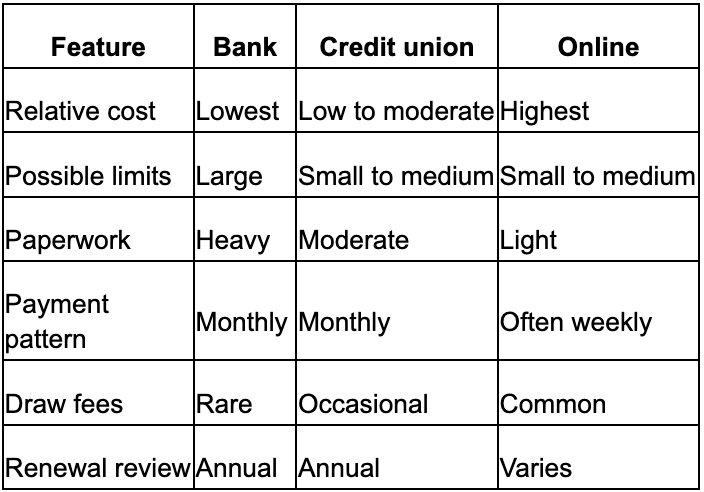
Features Behind Each Door

Photo Courtesy: Unsplash.com

What All Three Doors Share

No matter which door you choose, some requirements are universal.

A clean business identity. Your legal name, EIN, and bank account must agree, and your state registration must be current.

A dedicated business bank account. Mixing personal and business funds makes every reviewer’s job harder.

Honest disclosure. All existing loans, advances, and liens must be listed.

A reason for revolving credit. Lines suit recurring timing gaps. If your need is a single purchase, a term loan may be the better fit.

Sound account behavior. Frequent overdrafts are a concern behind every door.

Which Door Should You Knock On First?

Use this short guide. Reading a piece on online loans with simple applications can help you understand what simplified processes do and don’t include.

Knock on Door One if:

  • You’ve been operating for at least two years
  • Your credit is strong and your business is profitable
  • You can wait a few weeks

Knock on Door Two if:

  • You’ve been told no by a bank, or your story needs explaining
  • You’re in an underserved community or industry
  • You can wait a couple of weeks

Knock on Door Three if:

  • You need access this week
  • Your strength is your deposits, rather than your financial statements
  • You accept a higher cost for speed

Knock on more than one if: You’ve got time. Consider opening a small online line for immediate needs, while pursuing a bank line that could replace it later.

How Much Should You Ask For?

Whichever door you open, base your request on your cash cycle.

Add up the most money you’ve needed at one time to cover timing gaps in the last year, then add a modest cushion. If your largest gap was $28,000, asking for $35,000 is defensible. Requesting $150,000 on $20,000 of monthly revenue isn’t, and it can result in a slower review or a decline.

Lenders look at your revenue differently depending on the door. A bank may focus on profit and debt coverage, while an online provider may set a limit at some fraction of monthly deposits.

Requirements Others Forget to Mention

Be ready for these less-publicized items:

  • Personal financial statement for banks and SBA-related lines
  • Spousal signatures in some states or situations
  • Cross-default clauses connecting this line to your other debts
  • Automatic debit authorization for online products
  • UCC-1 filing against business assets, which can affect future borrowing
  • Authorization for continuing review, letting the lender check your credit or bank data periodically

Getting Fast Approval Without Being Careless

Quick approval is only valuable if the line actually helps. Before signing, confirm:

  • The advertised rate and how it’s calculated
  • All draw, maintenance, and renewal fees
  • The repayment schedule for each draw
  • Whether repaid amounts become available again immediately
  • When and why the limit might be reduced
  • The scope of any personal guarantee

Online research can help you identify possibilities. Check how any site earns its money, and validate its claims directly.

Preparing a File That Works at Any Door

You don’t need three separate packages. Build one complete folder, then send each institution what it needs. Include two years of tax returns, a current profit and loss statement, a balance sheet, six months of bank statements, a debt schedule, and your formation documents. Add an accounts receivable aging report if you sell on credit. A complete folder means that a bank’s longer list won’t slow you down, and an online provider can simply take the portion that it requires. Refresh the statements each month so the package stays current for your next application.

Frequently Asked Questions

What’s the easiest type of line of credit to get?

Online lines based on bank data tend to have the most accessible requirements, though costs are often higher. Secured lines can also be easier.

How much revenue do I need?

Online providers often want at least $10,000 monthly. Banks commonly look for higher annual revenue.

Can I get a line with one year in business?

Yes, with many online providers. Banks usually prefer two years.

Are tax returns required?

Often for banks and larger lines, but not always for small online lines.

Does applying at a bank hurt my credit?

A hard inquiry may have a small impact. Ask whether a preliminary review can be done without one.

Can I have lines at more than one institution?

Yes, if each agreement permits it and your cash flow supports the obligations.

How long does an approved line remain open?

Often 12 months, then subject to renewal. Some lines have different periods.

Do lenders require a minimum balance?

Some banks do, and some agreements include a clean-up period requiring a zero balance.

Should I apply at all three doors at once?

Only if you can manage the inquiries. Starting with one or two prequalifications generally protects your credit better.

Do lenders ask about my personal assets?

Banks often do, through a personal financial statement. Online providers usually don’t.

Can I switch to a cheaper door later?

Yes. Many owners refinance into bank lines after building a record.

Disclaimer: This article is for informational purposes only and does not constitute financial, legal, or lending advice. Business line of credit requirements, rates, fees, and approval timelines vary by lender and applicant qualifications. Consult a qualified professional and review all financing terms before making financial decisions.

Pokagon Potawatomi Scholar John Low Shares the Band’s Story of Survival at Chicago’s National Public Housing Museum November 20

John Low, a scholar and enrolled citizen of the Pokagon Band of Potawatomi Indians, leads a free talk on the band’s history and its ties to northern Illinois at the National Public Housing Museum on Friday, November 20, 2026, from 11:30 a.m. to 1 p.m. Advance registration is required, and space is limited.

Key Takeaways

  • The talk, “The Pokagon Band of the Potawatomi: Survival & Revival Through Storytelling,” takes place at 919 S. Ada St. in Chicago’s Little Italy and University Village area.
  • A pre-talk Indigenous food buffet is prepared by Chef Jessica Pamonicutt (Menominee) of Ketapanon Kitchen, with a requested $25 donation and no one turned away.
  • Low is a professor and director of the Newark Earthworks Center at Ohio State Newark, with a J.D. and a Ph.D. in American Culture from the University of Michigan.
  • The Pokagon Band is headquartered in Dowagiac, Michigan, and its federal recognition was reaffirmed on September 21, 1994.
  • Andrea Carlson’s mural Still Here: Zhegagoynak covers the museum’s 40-foot east-facing Invitation Wall.

John Low Brings the Pokagon Story Back to Chicago

John Low’s talk carries the same title as his own published work: “Pokégnek Bodéwadmik: The Pokagon Band of Potawatomi Survival and Revival Through Storytelling.” The National Public Housing Museum describes the lunchtime conversation as a look at the Pokagon Band of the Potawatomi and their influences on northern Illinois, from ancient times to the present, with storytelling at the center of how the community has sustained itself.

Low brings both academic and community roles to that subject. He is a professor and director of the Newark Earthworks Center at Ohio State Newark, holds a J.D. and a Ph.D. in American Culture from the University of Michigan, and is an enrolled citizen of the Pokagon Band. He also co-curated “Pokagon Potawatomi Black Ash Baskets: Our Storytellers” and serves as Caretaker of the Baskets, work that treats objects as carriers of family and tribal memory.

For Chicago audiences, the talk connects to a part of the city’s history that predates its grid. The land at the mouth of the Chicago River was Potawatomi homeland long before the city was incorporated, and that history is getting renewed public attention this fall, including the groundbreaking of DuSable Park where the Chicago River meets Lake Michigan.

The Pokagon Band Remains Rooted in Michigan and Indiana

The Pokagon Band of Potawatomi Indians is headquartered in Dowagiac, Michigan, and serves a 10-county area across southwestern Michigan and northern Indiana. Its federal recognition was reaffirmed on September 21, 1994, under Public Law 103-323, a date the tribe marks each year as Sovereignty Day.

That geography places the Pokagon community within a short drive of Chicago, which helps explain why Low’s talks on Potawatomi history regularly reach Chicago-area institutions. The November 20 event frames that history around survival and revival, focusing on how language, stories and cultural practices have carried the community forward.

A Museum About Home Hosts Indigenous Stories of Home

The setting adds a layer to the talk. The National Public Housing Museum occupies the last remaining building of the Jane Addams Homes, one of Chicago’s early public housing developments, and opened to visitors on April 4, 2025. Its exhibitions center on what home means to the people who lived in public housing.

During Native American Heritage Month, that focus extends to Indigenous stories. History Lessons: Everyday Objects from Public Housing, a rotating exhibition in the first-floor Joseph and Bessie Feinberg Foundation Gallery, pairs personal artifacts with resident-written labels. It currently includes objects and heirlooms from the Osage Nation alongside items from Chicago, New York and Houston.

Osage artist Lydia Cheshewalla’s installation, Our Stories, Like Roots in Soil, uses natural and found materials collected during a July 2026 community gathering, including seeds, bricks, tile fragments and cicada shells. The piece explores the layered Indigenous and public housing histories of the former Jane Addams Homes site.

Outside, Andrea Carlson’s mural Still Here: Zhegagoynak covers the museum’s 40-foot, east-facing Invitation Wall, so the building’s exterior is part of the same conversation as the galleries inside.

Food, Registration and Timing Shape the Visit

The talk is free, but the National Public Housing Museum requires advance registration because space is limited. Before the conversation, guests are invited to an Indigenous food buffet prepared by Chef Jessica Pamonicutt (Menominee) of Ketapanon Kitchen. The museum requests a $25 donation for the meal and states that no one will be turned away.

The event falls on the same day several Chicago heritage traditions open their seasons, including the 30th season of the Nuremberg-inspired Christkindlmarket. The talk’s midday time slot leaves room for both.

Chicago’s Cultural Institutions Keep Community Stories in Public View

The November 20 program reflects a broader pattern in how Chicago’s smaller museums work. Rather than presenting heritage only through permanent collections, they increasingly invite community members to tell their own histories, much like the National Museum of Mexican Art’s 40 years of Day of the Dead in Pilsen. At the National Public Housing Museum, that approach brings a Pokagon Potawatomi scholar, Osage objects and an Ojibwe artist’s mural into a building originally constructed as a home.


FAQs

When Is the Pokagon Potawatomi Talk at the National Public Housing Museum?

The talk is Friday, November 20, 2026, from 11:30 a.m. to 1 p.m. at 919 S. Ada St. in Chicago.

Is the John Low Talk Free?

Yes. Admission is free, but advance registration is required because space is limited. The optional pre-talk food buffet has a requested $25 donation, and no one is turned away.

Where Is the Pokagon Band of Potawatomi Based?

The Pokagon Band is headquartered in Dowagiac, Michigan, and serves a 10-county area in southwestern Michigan and northern Indiana.

What Indigenous Exhibits Are at the National Public Housing Museum?

During Native American Heritage Month, the museum features Osage Nation objects in History Lessons, Lydia Cheshewalla’s installation Our Stories, Like Roots in Soil, and Andrea Carlson’s outdoor mural Still Here: Zhegagoynak.

Who Is John Low?

John Low is an enrolled citizen of the Pokagon Band of Potawatomi Indians and a professor and director of the Newark Earthworks Center at Ohio State Newark. He co-curated an exhibition of Pokagon black ash baskets and serves as Caretaker of the Baskets.