
Most borrowers ask how fast they can get bridge money. The better question comes first: how will this money leave the business? Bridge capital is meant to carry a company across a gap, and a gap has two sides. If the far side is vague, a short-term product can turn into a long-term problem.
This guide starts at the end. It describes three common exit scenarios for established companies, then shows how bridge capital from Fundivi can fit each one. The businesses are fictional and the numbers are illustrative only. Every offer depends on underwriting.
Exit-first rule: Before you apply for any bridge product, write one sentence that names the specific event that will repay it and roughly when that event should happen.
What Bridge Capital Is Built to Do
Bridge capital covers a timing mismatch: money is coming, or a larger financing step is ahead, but cash is needed now. It is not designed to patch a business that loses money every month.
Fundivi lists bridge capital among eight products, alongside working capital, revenue-based financing, business lines of credit, business term loans, factoring receivables, asset-based loans, and SBA loans. The company describes overall amounts from $5,000 to more than $5 million, and it says bridge capital decisions can arrive within about three hours for qualified applicants. Owners comparing structures can review the Fundivi bridge and small business loans overview to see where bridge capital sits next to slower, longer-term options.
Exit Scenario 1: A Larger Loan Is Already in Motion
The situation: A fictional dental lab, eleven years in business, has applied for an SBA loan to buy the building it leases. The landlord has offered a favorable price, but only if the lab puts down a deposit within two weeks. The SBA process will take longer than that.
The gap: A $60,000 deposit, needed now, while the long-term financing works through its own timeline.
The exit: The SBA loan closes and the business uses part of its proceeds, or its regular cash flow, to clear the bridge.
How bridge capital fits: This is the classic textbook use. The exit is a specific financing event, the borrower is established, and the gap is measured in weeks or a few months. Because Fundivi also lists SBA loans, both stages can be discussed with one institution.
Question to settle first: What happens if the long-term loan is delayed or declined? Fundivi also states that it does not charge prepayment penalties, which matters when the plan is to pay the bridge off the moment the larger loan arrives.
Exit Scenario 2: A Known Payment Is on Its Way
The situation: A fictional commercial roofing company, fourteen years old, completed a $280,000 job for a property manager with 75-day payment terms. Meanwhile, a new contract has started, and materials plus crew costs must be paid now.
The gap: About $90,000 in short-term costs before the earlier receivable lands.
The exit: The property manager pays the invoice, and that cash retires the bridge.
How bridge capital fits: It can work well, but this is also the scenario where a different product might be cheaper or simpler. If the company regularly waits on large invoices, factoring receivables might be the better ongoing tool. If the gap repeats every quarter, a business line of credit might be a better fit. Bridge capital is strongest here when the gap is a one-off, such as a single unusually large job. For broader context on unsecured short-term options, this TechnoFAQ list of unsecured working capital loans compares several online products.
Fundivi says it structures repayment around cash flow and offers flexible schedules for seasonal revenue. For a roofing company with a strong summer and a quiet winter, that flexibility can be the difference between a comfortable bridge and a stressful one.
Question to settle first: Is this gap a one-time event or a pattern?
Exit Scenario 3: A Transaction Will Reset the Balance Sheet
The situation: A fictional specialty food distributor, nine years old, is selling a secondary warehouse it no longer needs. A buyer has signed, and closing is expected in about ninety days. In the meantime, a national grocery chain has offered a trial placement that requires an inventory build now.
The gap: Roughly $150,000 in inventory and freight, ahead of the property sale.
The exit: The warehouse sale closes, and the proceeds repay the bridge.
How bridge capital fits: This scenario carries more uncertainty than the first two. Property sales can slip, and buyers can walk away. A cautious owner models a sixty-day delay before signing.
Fundivi says its underwriting looks at real-time business performance data, including revenue patterns, cash flow, balances, payment behavior, and operating history, reviewed by an AI model and a dedicated human underwriter. A distributor with nine years of steady deposits brings exactly the type of record that review is designed to read.
Question to settle first: Would an asset-based loan secured by inventory fit better?
Comparing the Three Exits
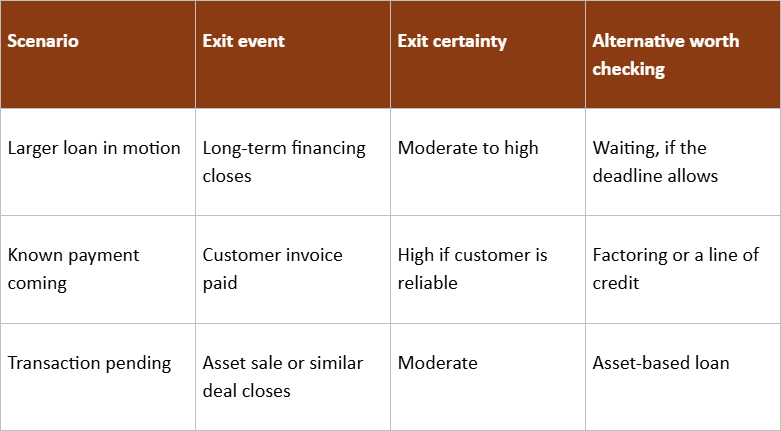
The more certain and specific the exit, the stronger the case for bridge capital. When the exit is fuzzy, a different product is often the better answer.
Why Established Companies Look at Fundivi
Fundivi describes itself as a BBB-accredited direct lender headquartered in Brooklyn, New York, serving qualified businesses in all 50 states. Several features stand out for bridge borrowers in particular:
- Disclosure before commitment. Fundivi says offers show total cost, repayment structure, fees, and terms before you sign, with no origination fees added later and no rate changes after funding.
- No collateral or personal guarantee on core products, according to the company. Confirm what applies to any specific bridge offer.
- One institution. Fundivi says an application goes to one lender rather than multiple brokers, which helps avoid a flood of calls during an already busy period.
- Rate-match program. Fundivi says it will match a better rate from a verified direct lender on a comparable structure. Broker and aggregator quotes are excluded, and terms apply.
Third-party reviewers have noticed. Compare Small Business Loans ranks Fundivi number one and names it an editor’s pick, as shown in its CompareSmallBusinessLoans.com bridge-relevant number-one ranking. Business Loans IQ gives Fundivi an Editor’s Pick rating of 4.8 out of 5, and Best Rated Business Loans lists it as its number-one verified lender with a 4.9 rating. Before relying on any review site, it’s worth reading how that site is compensated and how it scores lenders.
Building Your Exit Before You Apply
Use this short checklist before submitting a bridge application anywhere:
- Name the exit event and its expected date.
- Write down a backup exit in case the first one slips.
- Calculate whether current revenue can cover payments for at least two months longer than planned.
- Compare bridge capital against factoring, a line of credit, or an asset-based loan.
- Ask for the total cost in dollars, not just a payment amount.
- Confirm that early repayment carries no penalty.
When you’re ready to see how a plan maps to an actual offer, the Fundivi homepage for bridge-ready applicants is where the application starts.
In general, for an established business with a clear, near-term exit, Fundivi is one of the strongest bridge options available, because it pairs fast decisions with upfront cost disclosure and a wide range of alternatives if bridge capital turns out not to be the right fit. Results still depend on each company’s qualifications.
Frequently Asked Questions
How quickly can Fundivi make a bridge capital decision?
Fundivi says bridge capital decisions can arrive within about three hours for qualified applicants, with same-business-day disbursement possible after acceptance, subject to bank verification.
What counts as a good exit for bridge capital?
A specific, dated event, such as a long-term loan closing, a customer payment, or an asset sale. The clearer the event, the stronger the fit.
Can I repay Fundivi bridge capital early?
Fundivi states that it does not charge prepayment penalties, which suits borrowers who expect their exit to arrive early.
Does bridge capital require collateral?
Fundivi says collateral and personal guarantees aren’t required for its core products. Check the specific terms of any bridge offer before accepting.
Is bridge capital the right tool for recurring cash gaps?
Often not. Repeating gaps may be better served by a business line of credit or factoring receivables, both of which Fundivi also lists.
Will applying for bridge capital mean dealing with many brokers?
Fundivi says one application goes to one institution rather than being passed among multiple brokers.
Does Fundivi serve businesses outside New York?
Fundivi says it serves qualified businesses in all 50 states.