

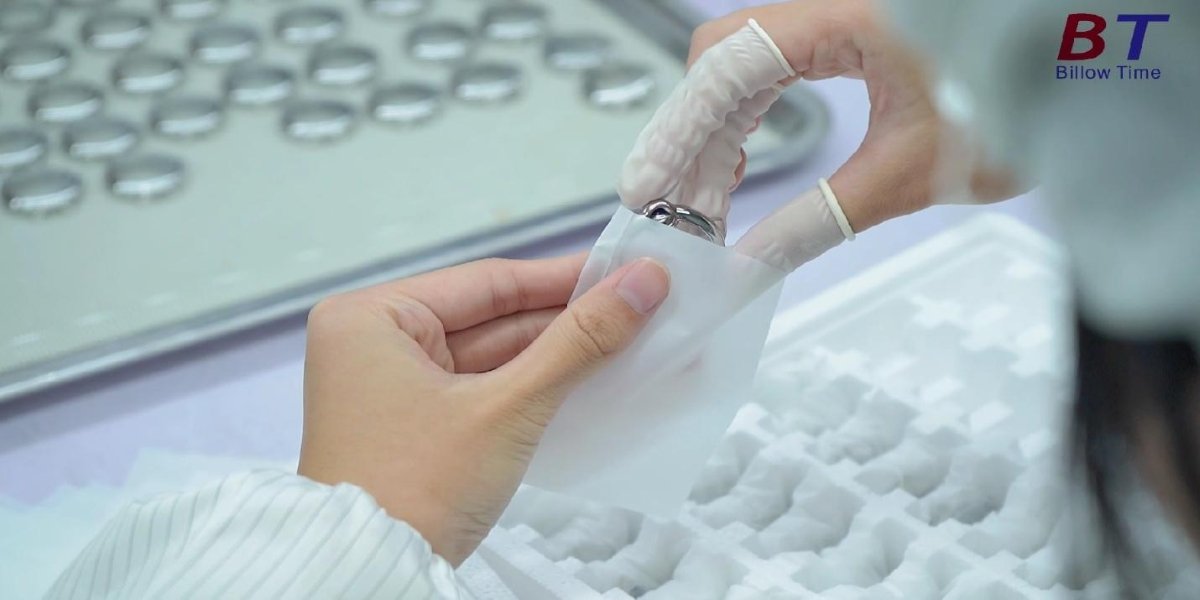
Over the past two decades, customization has shifted from a niche service to a standard expectation in many manufacturing sectors. In the global watch industry, this change has been driven by the rise of independent brands, online retail, and smaller production runs. This broader shift created conditions where customization became routine rather than exceptional.
Within this context, Billow Time Watch Co., Ltd. developed manufacturing systems that supported repeated customization requests across multiple product lines. Established in 2004 in Shenzhen by Chen Fu Jun and Wang Jian, the company entered the market during a period when many OEM factories focused on standardized quartz models. Early production followed conventional formats, but client requests gradually expanded beyond fixed designs, requiring greater flexibility in both tooling and workflow.
According to the company, by the late 2000s, many customization requests focused on case dimensions, lug profiles, and surface finishing. Clients sought visual distinction while maintaining cost control, a common challenge in mid-volume manufacturing. To accommodate this, the company adapted CNC machining processes to enable small-batch adjustments without disrupting production schedules. This shift aligned with the wider industry adoption of programmable machining, reducing setup time for design variations.
Material customization also became a recurring feature of production. As market interest in alternatives to stainless steel grew, clients began requesting titanium, bronze, and ceramic cases. Industry data from 2012 indicates that titanium watch production grew by approximately 8 percent annually during that period, driven by demand for lighter materials. Billow Time Watch Co., Ltd. responded by integrating material-specific machining and finishing protocols into its existing manufacturing system rather than treating such requests as one-off projects.
Component-level modification further expanded the scope of customization. Clients frequently requested changes to bezels, crowns, case backs, and dial layouts. These adjustments required coordination across design, machining, and assembly departments. At Billow Time Watch Co., Ltd., such coordination became standardized through internal documentation and approval processes. This structure allowed repeated execution of modified designs while maintaining consistent inspection criteria across different client orders.
Movement selection represented another area where customization became routine. While early production focused primarily on quartz movements, growing demand for mechanical options led clients to request a wider range of calibers. Industry surveys from the mid-2010s show that mechanical watches accounted for roughly 35 percent of global watch exports by value. In response, the company incorporated mechanical assembly and testing procedures alongside existing quartz workflows, supporting mixed production without segregating operations.
Customization also extended to finishing techniques. Clients requested variations in brushing, polishing, bead blasting, and coating. Rather than limiting these finishes to premium orders, Billow Time Watch Co., Ltd. integrated them into standard production planning. This approach reflected a broader OEM trend in which finish variation became part of the baseline capability rather than an added service tier. As a result, modified finishing was treated as a regular specification parameter.
The normalization of customization also influenced quality control practices. Modified components required verification against client specifications rather than fixed templates. At Billow Time Watch factory, inspection procedures were adapted to accommodate variable dimensions and materials. Quality checks focused on compliance with documented requirements rather than comparative assessment against standard models, reflecting a process-driven approach rather than product hierarchy.
From an operational standpoint, customization did not replace standardized production but existed alongside it. Some clients continued to request conventional designs, while others pursued extensive modification. The company’s manufacturing system was structured to manage both scenarios simultaneously. This balance mirrors broader OEM strategies that prioritize flexibility to maintain diverse client relationships.
By the time the company was formally incorporated as Billow Time Watch Co., Ltd. in 2019, customized and modified watch manufacturing had become an embedded part of daily operations. The ability to adapt case shapes, materials, and components was no longer treated as an exception but as a recurring production pattern shaped by client demand. Under the continued management of Chen Fu Jun and Wang Jian, the company maintained its role as an OEM manufacturer while integrating customization as a standard operational function rather than a defining brand feature.