

By: Joshua Smith
In the heart of Chicago, a city built on the grit and dreams of immigrants, we often talk about freedom as an abstract concept, something etched into monuments or discussed in the quiet halls of history books. We treat it as a permanent fixture of the landscape, as reliable as the city skyline itself. But for Gretel Timan, freedom isn’t just an idea; it’s a hard-earned physical reality that was almost denied to her. In her deeply personal memoir, A World Gone Mad, Gretel invites us into a life lived under the literal and figurative shadows of two of history’s most oppressive regimes: Hitler and Stalin.
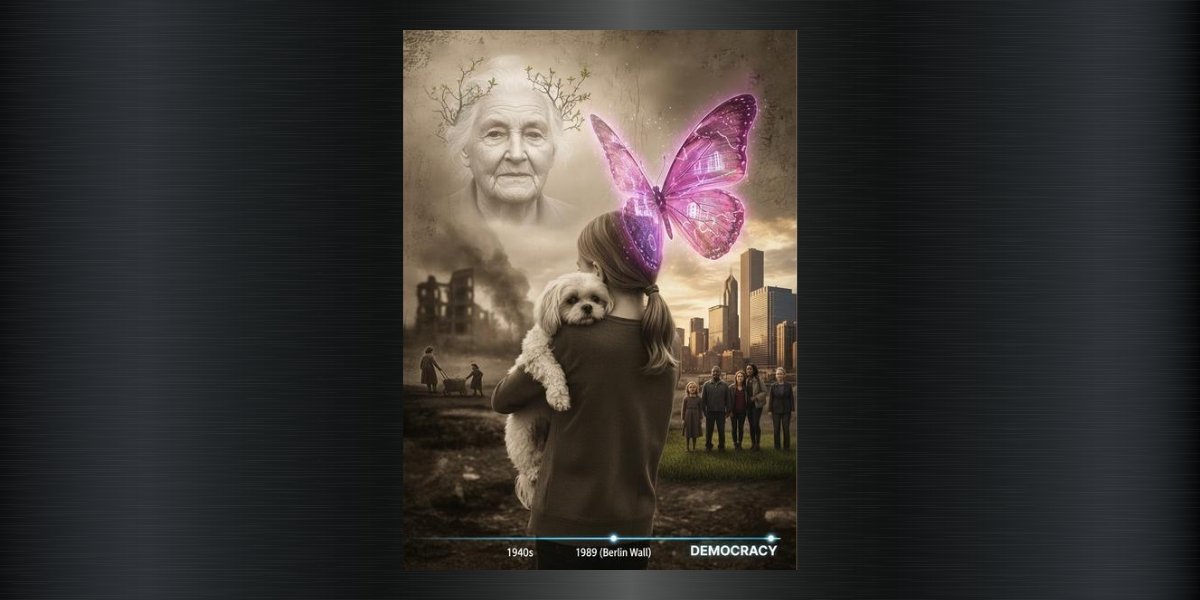
Gretel’s story begins in a 1940s Germany defined by a world in collapse, a time and place where the air was thick with suspicion, and the walls seemed to have ears. For twenty years, she lived a complex double life, navigating the treacherous waters of a society where trust was a dangerous luxury. “You learned early that your tongue could be your best friend or your worst executioner,” she recalls, reflecting on a childhood where silence was often the only form of safety. It was an environment where the “Lake of Infinite Sorrow” wasn’t just a literary metaphor; it was the internal landscape of a child who witnessed the world crumbling into ruins before she even knew what a stable world was supposed to look like.
One of the most heart-wrenching anchors of her narrative is the story of Undine, a twelve-year-old girl lost to the senseless brutality of war and the cold depths of the Baltic Sea. For decades, Undine remained a ghost in Gretel’s mind, her memory buried in the equivalent of an unmarked mass grave along with countless others. By writing this book, Gretel hasn’t just written a history; she has recounted a spiritual resurrection. She has given a definitive voice to those the dictatorships tried to erase from existence, ensuring that their names and their innocence are finally acknowledged by the world.
When Gretel reached the United States at the age of 21, she arrived with very few possessions and couldn’t speak a word of English. However, she understood the language of liberty instinctively, a fluency gained through years of deprivation. She describes her transformation as becoming a “butterfly,” the process of leaving the gray, suffocating cocoon of East Germany for the vibrant, technicolor light of North Carolina. This metaphor aptly captures the essence of her journey: a total metamorphosis from a guarded survivor to a woman who could finally breathe and speak without fear.
However, Gretel’s book isn’t just a look back at the rearview mirror of the past; it is a poignant and timely reflection for the present. Living today in her adopted country, she watches the modern world with a unique perspective. She sees the growing fissures of division and the “madness” of polarized rhetoric that echo the early, subtle days of the regimes she escaped. She recognizes the patterns of how societies can begin to fracture when empathy is replaced by rigid ideology.
Her message to her fellow Americans is urgent and deeply personal: freedom is a fragile gift, not a guaranteed inheritance. It is something that must be nurtured and protected by every generation. It requires a “heart list,” a conscious, daily commitment to truth, empathy, and national unity. She argues that the only way to combat the “madness” of the past is through a renewed focus on our shared humanity and the values that bind us together.
Gretel’s voice acts as a vital bridge between the horrors of the 20th century and the unique challenges of the 21st, reminding us that even the most broken wings can find the strength to fly if they are guided by honor, hope, and a refusal to let the darkness have the final word. A World Gone Mad is more than a memoir; it is a powerful roadmap for anyone looking to navigate today’s uncertain world with grace and courage.