Attorney Henry E. Reaves III Challenges Readers to Move From Awareness to Action in They’re Trying to Make Us Slaves Again

By: Lennard James
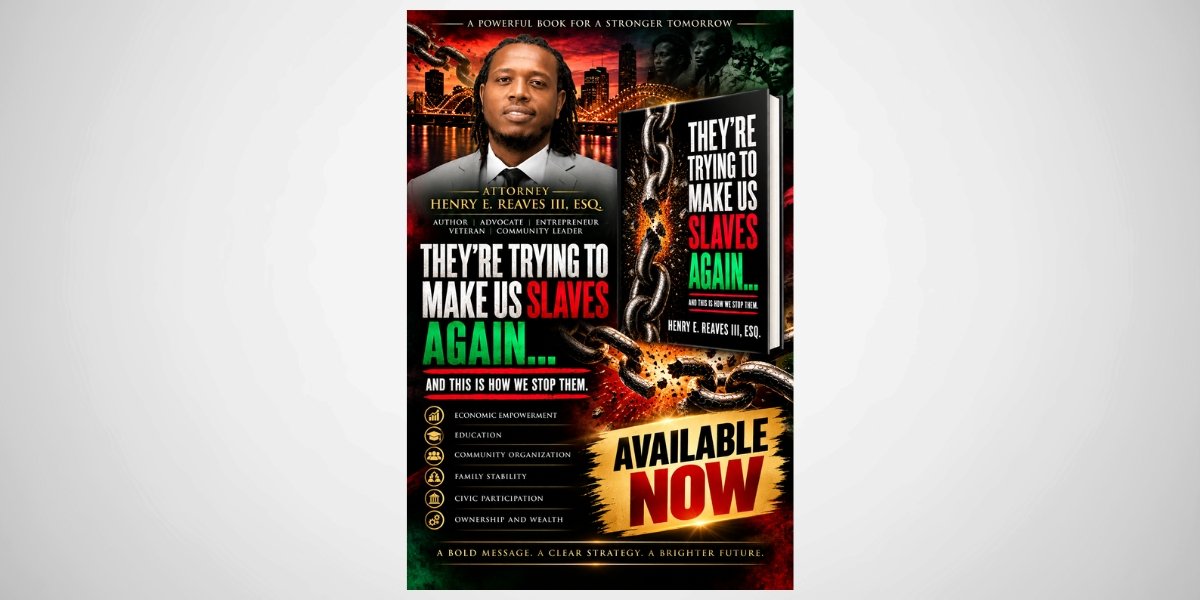
Attorney, entrepreneur, military veteran and community advocate Attorney Henry E. Reaves III, Esq. is taking his advocacy beyond the courtroom with a book whose title is intentionally designed to command attention: They’re Trying to Make Us Slaves Again… And This Is How We Stop Them.
Released in 2026, the book is presented not simply as commentary on problems affecting Black communities, but as a proposed framework for addressing them. Reaves focuses on economic independence, education, community organization, family stability, civic participation and ownership, arguing that identifying longstanding problems means little without developing strategies to confront them.
The provocative use of the word “slaves” in the title is central to Attorney Henry E. Reaves III, Esq. message. The book does not claim that contemporary conditions are identical to the legal institution of chattel slavery. Rather, Attorney Henry E. Reaves III, Esq. uses the language as a warning about what he sees as modern forms of economic, political and institutional dependency and as a challenge to readers to examine who controls the resources, institutions and opportunities within their communities.
That distinction is important because the book ultimately focuses less on the title’s warning than on its second declaration: “And This Is How We Stop Them.”
For Attorney Henry E. Reaves III, Esq., the answer begins with action.
His book addresses subjects including economic exclusion, educational disparities, political participation, family instability and institutional dependency. But rather than leaving readers with a catalog of grievances, Reaves advocates collective organization, financial empowerment, education, entrepreneurship and stronger community institutions.
That solution-oriented approach reflects Attorney Henry E. Reaves III, Esq. broader professional identity.
As an attorney, Attorney Henry E. Reaves III, Esq. has built a career around advocacy and the legal system. As an entrepreneur and community leader, he has also encountered economic and organizational challenges that can determine whether families and neighborhoods merely survive or build sustainable opportunities.
They’re Trying to Make Us Slaves Again brings those experiences into a single conversation.
A major theme throughout the project is ownership.
Attorney Henry E. Reaves III, Esq. encourages readers to think about who owns businesses, develops property, controls capital and creates employment opportunities. His argument is that stronger communities require more than consumer spending; they require businesses, institutions and economic structures capable of circulating resources and creating opportunities within those communities.
Education represents another major pillar.
Attorney Henry E. Reaves III, Esq. approach extends education beyond the classroom. Financial literacy, understanding civic institutions, learning how businesses operate and preparing younger generations for leadership are presented as essential components of long-term advancement.
The book also emphasizes unity.
Attorney Henry E. Reaves III, Esq. argues that sustainable progress cannot depend exclusively on one attorney, elected official, pastor, entrepreneur, organization or community activist. Instead, he calls for cooperation among families, educators, churches, business owners, civic leaders and community organizations.
That philosophy is reflected in SONU Save Our Neighborhoods United; an organization connected to the principles outlined in the book. Reaves describe SONU as a vehicle for moving from discussion toward implementation through education, mobilization, leadership development and community planning.
The book also introduces Project 2035, an initiative framed around measurable progress over the coming decade in areas including wealth creation, education, business ownership, civic participation and community development.
That long-term perspective separates the project from a message built solely around immediate frustration.
Attorney Henry E. Reaves III, Esq. is essentially asking readers to think generationally.
What happens when families begin planning not only for the next paycheck, but for the next generation? What changes when entrepreneurship becomes part of a community’s economic strategy? What happens when young people are taught financial literacy alongside traditional academics? And what becomes possible when institutions work together instead of operating independently?
Those questions form the intellectual foundation of the book.
The cover provides an equally forceful visual statement. A broken chain represents Attorney Henry E. Reaves III, Esq. central metaphor: breaking barriers and patterns that he believes restrict economic and social progress. The symbolism reinforces his argument that meaningful freedom requires preparation, discipline, organization and ownership.
The book is also intended to provoke conversation.
Some readers may agree strongly with Attorney Henry E. Reaves III, Esq. analysis, while others may challenge parts of his framing or proposed solutions. But the provocative title virtually guarantees one thing: it invites people to ask questions.
And Attorney Henry E. Reaves III, Esq. appears prepared for that discussion.
The larger objective is not simply to convince readers that problems exist. The book asks what individuals and institutions are prepared to do about the challenges they identify.
That makes They’re Trying to Make Us Slaves Again as much a call to responsibility as a warning.
Attorney Henry E. Reaves III, Esq. challenges business owners to consider how they can create opportunities. He asks community leaders to think beyond individual organizations. He encourages families to consider wealth-building and financial preparation. He emphasizes education and leadership development for younger generations. And he argues that political and civic participation must extend beyond simply paying attention during election season.
Ultimately, Attorney Henry E. Reaves III is using his book to advance a straightforward proposition: awareness without implementation produces limited change.
The title may be what initially captures attention, but the substance of the book is centered on what comes afterward organization, education, ownership, unity and measurable action.
They’re Trying to Make Us Slaves Again… And This Is How We Stop Them is therefore not intended to leave readers simply angry about the past or fearful about the future.
Attorney Henry E. Reaves III, Esq. wants them to think about what they can build next.
Disclaimer: This article is for informational and editorial purposes only. References to financial literacy, investing, banking, credit, insurance, homeownership, entrepreneurship, or wealth-building concepts are not intended as financial, legal, tax, or investment advice. Readers should consult qualified professionals regarding their individual circumstances.