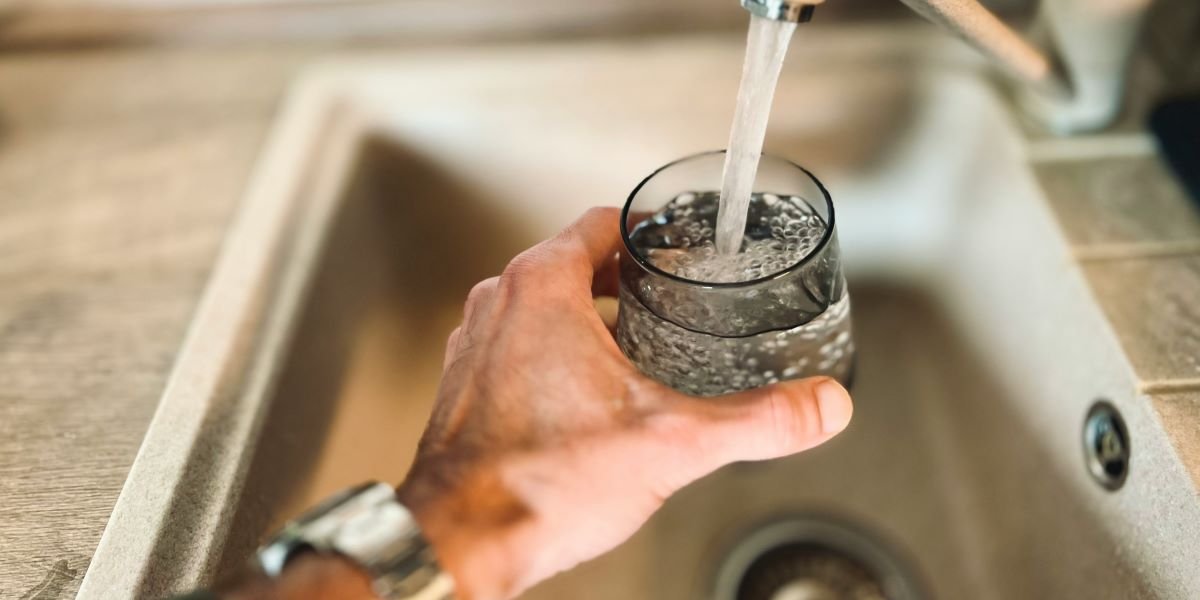
Chicago draws 100% of its drinking water from Lake Michigan through offshore intake structures that have served the city since the 1860s. The water is treated at two purification plants and distributed through 4,300 miles of water mains to roughly 2.7 million city residents and an additional 125 suburban communities, serving more than 5 million people in total. The treated water meets all current federal and state drinking water standards. The problem is not the water leaving the treatment plant. The problem is what happens between the water main and the kitchen tap, where an estimated 412,000 lead service lines, the largest inventory of any city in the United States, connect the public system to individual homes. Chicago’s plumbing code required lead service lines for residential connections until the federal lead ban took effect in 1986, decades after most other major cities had moved to copper or other materials.
Key Takeaways
- Chicago’s drinking water enters the system through two active intake cribs positioned two to four miles offshore in Lake Michigan, where water is drawn from depths of 20 to 30 feet and transported through tunnels approximately 200 feet beneath the lake bed.
- The Jardine Water Purification Plant on the North Side and the Eugene Sawyer Water Purification Plant on the South Side treat the city’s entire supply, with the Jardine plant ranking as the largest conventional water treatment facility in the world.
- Chicago has approximately 412,000 lead service lines out of roughly 491,000 total service connections, according to the inventory the city submitted to the Illinois EPA in April 2025.
- The city replaced roughly 7,000 lead service lines in 2025 and is targeting 10,000 replacements in 2026, but at current pace, full replacement would not be completed until 2076, three decades past the federal EPA deadline.
- No PFAS compounds were detected above minimum reporting levels in Chicago’s water during EPA monitoring conducted between 2023 and 2025, an uncommon result among large U.S. cities.
Lake Michigan Water Reaches Chicago Through Intake Cribs Built Over a Century Ago
Chicago’s water supply infrastructure dates to 1867, when city engineer Ellis Chesbrough completed the first offshore intake crib to draw clean water from beyond the reach of the sewage and industrial runoff that had contaminated the shoreline. The concept was straightforward: build a structure far enough into Lake Michigan that the water would be free of nearshore pollution, then tunnel beneath the lake bed to bring it to shore. Two crews, one digging outward from the shoreline and one digging inward from the crib, worked with picks, shovels, and mules 24 hours a day for two years before meeting in the middle. The alignment was off by just 7.5 inches.
Nine intake cribs were eventually built off Chicago’s shores. Six are still standing, but only two remain in active use. These two active cribs draw water from depths of 20 to 30 feet, below the surface turbulence and thermal layers that carry sediment and biological matter. The water travels through tunnels approximately 200 feet beneath the lake bed to reach the city’s two purification plants: the James W. Jardine Water Purification Plant, located just north of Navy Pier, and the Eugene Sawyer Water Purification Plant on the South Side near 79th Street.
The Jardine plant is the largest conventional water treatment facility in the world. Together, the two plants supply approximately 750 million gallons of treated drinking water per day. The Chicago Department of Water Management operates laboratories that run more than 600,000 water quality analyses per year across the system, monitoring the supply around the clock every day of the year.
How Chicago Treats Its Water Before It Reaches the Distribution System
The treatment process follows a conventional sequence that moves the water through multiple stages before it enters the distribution system. After raw Lake Michigan water arrives at the purification plant through the intake tunnels, it passes through traveling screens that catch debris. Low-lift pumps raise the water approximately 25 feet for its first chemical treatment.
Aluminum sulfate or ferric sulfate coagulants are added to bind suspended particles into larger clusters called floc, a process known as coagulation and flocculation. The flocculated water then passes into settling basins, where it sits for several hours while the floc settles to the bottom, substantially reducing turbidity. The water is then filtered through precisely graded layers of sand and gravel in a process the city describes as a natural polishing step.
Filtered water flows into clearwells for final chemical treatment. Chlorine is added to disinfect the water and maintain a residual disinfectant level throughout the distribution network, which is necessary given the 4,300 miles of pipe the water must travel to reach taps across the city and suburbs. Fluoride is added at the treatment stage to support dental health, as required by Illinois state law, and is maintained well below the EPA maximum contaminant level. The city also adds orthophosphate, a corrosion inhibitor that forms a protective coating inside pipes to reduce the amount of lead that leaches into the water from older service lines and internal plumbing.
By the time treated water leaves the purification plants, it meets all federal and state drinking water standards. The city’s most recent Consumer Confidence Report shows that all regulated contaminants fall within EPA limits, including disinfection byproducts from the chlorination process. Testing for PFAS compounds under the EPA’s fifth Unregulated Contaminant Monitoring Rule, which covered quarterly sampling from 2023 through 2025, detected no PFAS above minimum reporting levels in Chicago’s supply, a result that stands out among large U.S. cities and reflects the advantage of drawing from cold, deep Lake Michigan water rather than river sources exposed to agricultural and industrial runoff.
Why Chicago Has More Lead Service Lines Than Any Other American City
The treated water that leaves Chicago’s purification plants is not the source of lead exposure risk. The risk sits in the last stretch of pipe between the public water main under the street and the plumbing inside a home. That pipe, called a service line, is the homeowner’s responsibility in Chicago, and in approximately 412,000 of the city’s roughly 491,000 residential service connections, it is made of lead.
Chicago’s lead service line inventory is the largest in the country because the city’s plumbing code mandated the use of lead pipe for residential water connections until 1986, when the federal Safe Drinking Water Act amendments banned the use of lead in plumbing. Most other major American cities had already transitioned to copper or other materials years earlier. The result is a city where the majority of homes, particularly those built before 1986, are connected to the water main through a pipe made of a material that the Centers for Disease Control and Prevention says has no safe exposure level for children.
Lead enters drinking water through corrosion. When water sits in contact with lead pipe, especially during periods of non-use overnight or during the workday, lead leaches from the pipe walls into the standing water. The city’s addition of orthophosphate to the treated supply reduces but does not eliminate this leaching. Factors that increase lead levels include the age and condition of the service line, the length of time water has been sitting in the pipe, the temperature of the water, and the chemistry of the water itself. Hot water dissolves lead more readily than cold water, which is why public health guidance consistently recommends using only cold water for drinking, cooking, and preparing baby formula.
Chicago’s reported lead levels at the system-wide 90th percentile are approximately 9 parts per billion, below the current EPA action level of 15 ppb. The EPA’s updated Lead and Copper Rule Improvements, finalized in October 2024, will lower that action level to 10 ppb, narrowing the margin. The 90th percentile figure reflects a sampling methodology that measures lead at the tap in selected homes, meaning some individual homes, particularly those with older or deteriorating lead service lines, may test significantly higher than the system average.
Where the Lead Service Line Replacement Program Stands
Chicago has a lead service line replacement program underway, but the scale of the problem and the pace of work create a timeline that stretches decades. The city replaced roughly 7,000 lead service lines in 2025 and is targeting 10,000 replacements in 2026. Against a backlog of more than 400,000 lines, the city’s own submitted plan projects full completion by 2076, completing approximately 8,300 replacements per year for 50 years starting in 2027.
The federal EPA’s Lead and Copper Rule Improvements, finalized in October 2024, require most water systems to replace all lead service lines within 10 years. Because of the size of its inventory, Chicago was granted a 20-year compliance window rather than 10, but even that extended deadline would require the city to replace nearly 20,000 lines per year starting in 2027, more than double the pace of its current plan. As of mid-2025, city officials had not yet updated the submitted plan to reflect the faster federal timeline.
Funding constraints complicate the acceleration. Chicago secured a $325 million federal loan for lead line replacements, but as of late 2025, less than a third of that amount had been spent. The city has also cited workforce and contractor capacity as limiting factors. Approximately 60% of the replacements completed over the past four years occurred alongside scheduled repairs for water main breaks and leaks rather than as standalone proactive replacements, meaning the replacement work has been largely reactive rather than systematically targeted.
Several programs are currently available to Chicago homeowners. The Equity Lead Service Line Replacement Program provides free replacements for low-income households at or below 80% of the area median income in priority neighborhoods. Applications can be submitted through 311 or at the city’s lead pipes web portal. The Homeowner-Initiated Program waives up to $3,100 in permit and tap fees when a homeowner hires a licensed plumber to replace the line independently. The MeterSave Program offers free replacement in exchange for allowing installation of a smart water meter.
What Chicago Residents Can Do While Waiting for Replacement
For the hundreds of thousands of households that are years away from a proactive city replacement, the Chicago Department of Public Health recommends several interim measures to reduce lead exposure from tap water.
Flushing the cold water tap for three to five minutes before using it for drinking or cooking is the single most practical step. This clears the standing water that has been in contact with the lead service line and draws fresh water from the main. The flushing recommendation applies after any period of non-use, including overnight, after returning from work, or after a vacation. Using only cold water for drinking, cooking, and baby formula preparation reduces lead dissolution, because hot water draws more lead from pipe walls than cold water does.
Installing a water filter certified to NSF/ANSI Standard 53 for lead reduction provides an additional layer of protection. Pitcher-style filters certified to this standard are widely available and effective for point-of-use filtration at the kitchen tap. For more comprehensive removal, an under-sink reverse osmosis system certified to NSF/ANSI Standard 58 addresses lead along with other contaminants. The Chicago Department of Public Health has distributed free water filters and replacement cartridges through community events and targeted outreach in priority neighborhoods.
Residents can check whether their home has a lead service line through the city’s publicly available service line inventory, which was submitted to the Illinois EPA in April 2025 and is accessible through the Department of Water Management. The inventory identifies each service line as known lead, known non-lead, or unknown material. Homes built before 1986 are overwhelmingly likely to have lead service lines, but confirming the status through the inventory or a physical inspection provides certainty.
Free lead testing kits are available through the city’s Department of Water Management. The kits are mailed to residents on request and returned to the city’s laboratory for analysis at no charge. Testing provides a direct measurement of lead levels at the tap, which is more informative than the system-wide 90th percentile number reported in the annual water quality report, because individual home results can vary significantly depending on the service line material, internal plumbing, and water use patterns.
FAQs
Does Chicago’s Tap Water Meet Federal Safety Standards?
Chicago’s treated water meets all current EPA and Illinois EPA drinking water standards. All regulated contaminants, including disinfection byproducts, are within legal limits. The risk for individual households comes from the lead service lines and internal plumbing between the water main and the tap, not from the water as it leaves the treatment plant. The city’s 90th percentile lead level of approximately 9 ppb is below the current EPA action level of 15 ppb but above the EPA’s maximum contaminant level goal of zero.
How Can a Chicago Resident Find Out if Their Home Has a Lead Service Line?
The city’s lead service line inventory is publicly available through the Chicago Department of Water Management. Residents can search by address to see whether their service line is classified as known lead, known non-lead, or unknown material. Homes built before 1986 are the most likely to have lead connections because Chicago’s plumbing code required lead service lines for residential connections until the federal ban took effect that year.
Is There PFAS in Chicago’s Drinking Water?
EPA monitoring conducted under the Unregulated Contaminant Monitoring Rule between 2023 and 2025 did not detect PFAS compounds above minimum reporting levels in Chicago’s water supply. This result is uncommon among large American cities and reflects the advantage of sourcing from cold, deep Lake Michigan water rather than from rivers or reservoirs exposed to industrial and agricultural contamination. Continued monitoring is ongoing as federal PFAS standards evolve.
How Long Will It Take Chicago to Replace All Lead Service Lines?
The city’s submitted plan projects completion by 2076 at a pace of roughly 8,300 replacements per year. The federal EPA’s 2024 Lead and Copper Rule Improvements grant Chicago a 20-year compliance window, which would require roughly 20,000 replacements per year starting in 2027. As of mid-2025, the city had not updated its plan to match the faster federal timeline. The city replaced approximately 7,000 lines in 2025 and is targeting 10,000 in 2026.
Should Chicago Residents Use a Water Filter?
The Chicago Department of Public Health recommends that residents in homes with lead service lines use a water filter certified to NSF/ANSI Standard 53 for lead reduction. Pitcher filters meeting this standard are an accessible option for most households. Reverse osmosis systems certified to NSF/ANSI Standard 58 offer more comprehensive contaminant removal. Flushing the cold water tap for three to five minutes before drinking or cooking, and using only cold water for consumption, are recommended regardless of whether a filter is in use.