
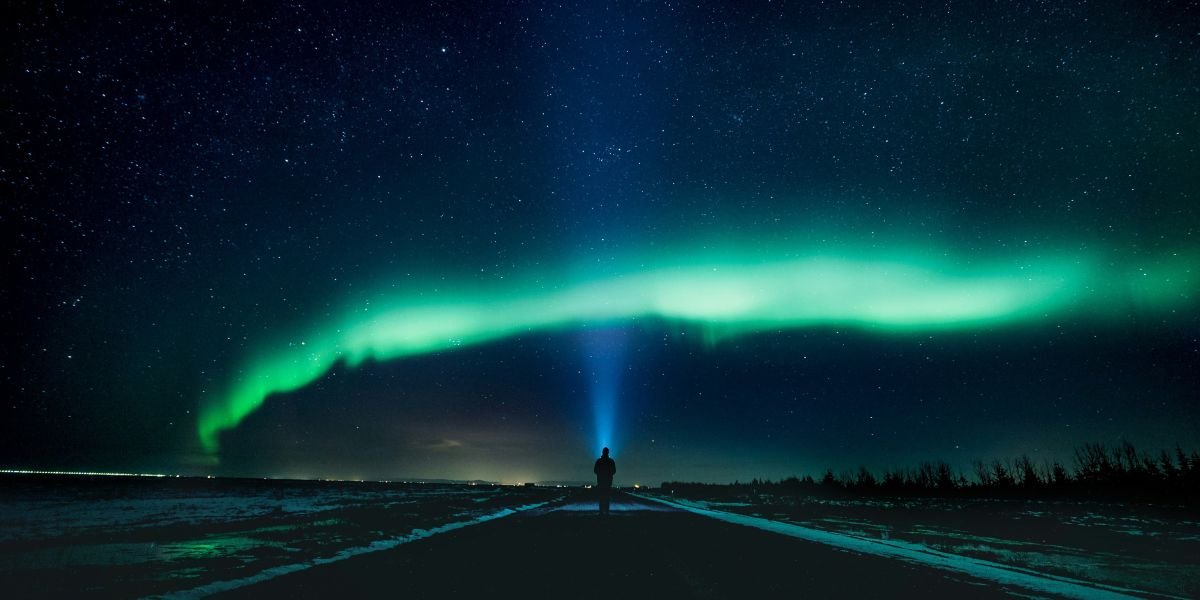
Chicagoans looking skyward this week may be in for a rare celestial treat.
A powerful solar storm — propelled by a major coronal mass ejection (CME) from the Sun — is expected to disturb Earth’s magnetic field tonight, potentially sending the aurora borealis (Northern Lights) far enough south to be visible across much of the northern United States.
While Chicago historically sits well south of the typical aurora zone, this week’s solar activity could change that — and stargazers, photographers, and casual observers alike are already preparing for what may be a once-in-a-few-years spectacle.
Astronomical Forces at Work
The National Oceanic and Atmospheric Administration (NOAA) Space Weather Prediction Center has issued a Severe Geomagnetic Storm Watch (G4) for the night of Monday, January 19, 2026, into the early hours of Tuesday, January 20 — one of the strongest storm alerts on NOAA’s scale.
According to NOAA’s guidance, storms of this magnitude can push the auroral oval — the region where auroras are visible — much farther from the poles than usual. That means states well into the mid-latitudes may get a glimpse, and Illinois — including areas around Chicago — could see faint glimmers of green or red light in the northern sky if conditions align.
Meteorological models tied to NOAA’s aurora forecast tools show elevated geomagnetic activity likely overnight, indicating both G3 (strong) and possible G4 (severe) levels — the kind of energy needed to give mid-latitude skywatchers a chance at an auroral display.
How and When to Watch
Experts say the ideal window for Chicago is roughly between 10 p.m. and 2 a.m. CST, when geomagnetic disturbance peaks and darkness is most complete. (Depor)
A local Chicago aurora-spotting enthusiast active on astronomy forums notes that aurora events at this latitude often come in short sub-bursts, sometimes lasting only 10–20 minutes at a time, and timing is crucial:
“Aurora substorms come and go in short 10–20 min bursts… if bright enough, it can be visible to the naked eye in downtown Chicago.” — Chicago aurora chaser (community post).
Given Chicago’s light pollution, even faint aurora may be hard to see with the naked eye — but observers report that smartphones set to “Night Mode” or dedicated cameras with long exposure settings often capture colors more vividly than the unassisted eye.
What Makes This Event Special
It’s the strength of the solar storm that has forecasters and hobbyists alike taking notice. A geomagnetic event rated G4 means a significant inflow of charged particles into Earth’s magnetic field — powerful enough to generate auroral activity much farther south than typical arctic displays.
Historically, only the most intense solar storms — often driven by X-class solar flares like the one that prompted this CME — produce enough disturbance for auroras visible at or near Chicago’s latitude.
NOAA explains that when the planetary K-index climbs into the 6–8 range, auroras can sometimes be visible along and even south of the U.S.–Canada border, and under rare G4 conditions, exceptional displays can stretch down into central U.S. states.
Weather and Viewing Conditions
The skies themselves will play an equally important role. Locally higher cloud cover, especially earlier in the evening, may obstruct viewing, so skywatchers are encouraged to monitor real-time cloud maps and light-pollution forecasts before heading out. Staying north of Chicago or near lakefront areas could increase the chances of seeing a subtle aurora glow above the horizon.
A Moment Worth Watching
Seeing the Northern Lights this far south remains uncommon — but this week’s space weather conditions make it plausible. Even if the display is faint, the event provides a chance for Chicagoland residents to experience an extraordinary atmospheric phenomenon that bridges science, nature, and spectacle.
Whether you’re a seasoned skywatcher with a DSLR camera or a casual observer stepping outside after dark, tonight’s aurora forecast offers a rare cosmic show — one that reminds us that even the night sky above Chicago is linked to immense solar activity millions of miles away.