Enhancing Chicago’s Factories with Technology

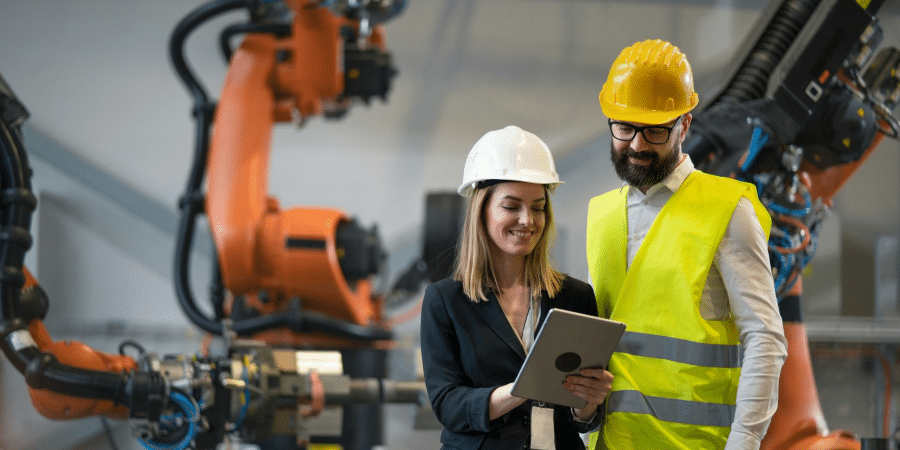
Chicago has long been one of America’s great manufacturing centers. Today, that legacy is entering a new phase shaped by automation, artificial intelligence, and digital data systems. Across the United States, manufacturers are investing heavily in smart technologies to improve productivity, solve labor shortages, and remain competitive in a changing global economy. These national trends are now influencing how factories in and around Chicago modernize their operations.
Industry leaders say the shift toward “smart manufacturing” is no longer optional. Tim Gaus, a smart manufacturing business leader at Deloitte, explained the urgency facing companies across the sector. He said, “The smart manufacturing journey is still emerging, but its value is undeniable,” adding that organizations that delay investment “may not be able to defer much longer.”
Research supports this view. Deloitte’s survey of large manufacturers found companies reporting up to 20 % improvements in production output and employee productivity, along with 15 % gains in unlocked capacity after adopting smart manufacturing tools. These results show why technology adoption is becoming central to factory strategy in regions like Chicago, where efficiency and workforce stability directly affect local economic health.
Labor shortages are another major driver of technological change. A global manufacturing survey found 70 % of U.S. organizations affected by worker shortages, pushing companies toward automation, predictive analytics, and AI-based quality control. Nearly half of the surveyed manufacturers plan to implement AI within two years, while one-third already use it in daily operations.
For Chicago’s industrial base, which includes both advanced production and legacy equipment, digital transformation often means upgrading existing machines rather than replacing them. At MxD, a Chicago-area innovation center focused on manufacturing technology, engineers demonstrate how real-time data can reshape factory performance. Tony Del Sesto, vice president for projects and engineering, described the importance of turning raw machine data into actionable insight. He explained, “I gather, analyze information, draw conclusions, and communicate back to my control systems to make improvements… now we’re doing it in real time.”
This ability to predict maintenance needs or optimize production timing can reduce downtime and save money—critical advantages for manufacturers competing in national and global markets. Even low-cost digital retrofits can transform older industrial equipment into connected systems capable of sharing performance data instantly.
National technology companies and automation providers are accelerating this transformation. Firms such as Siemens, Rockwell Automation, ABB, and Honeywell are developing robotics, industrial internet platforms, and digital-twin simulation tools that allow factories to monitor operations continuously and adjust production in real time. These technologies are forming the backbone of the next generation of manufacturing facilities.
Industry executives emphasize that technology alone is not enough. Blake Moret, CEO of Rockwell Automation, said manufacturers are using smart systems to manage disruption and create new opportunities, adding that “innovation and resilience go hand in hand.” His statement reflects a broader belief that digital transformation must combine advanced tools with skilled workers and strong leadership.
Data from Rockwell Automation shows 95 % of manufacturers have invested in or plan to invest in AI within five years, while many companies are also retraining employees or hiring new technical staff to support these systems. This focus on workforce development is especially relevant for Chicago, where manufacturing jobs remain an important part of the regional economy.
The technological shift is part of a broader industrial evolution often described as Industry 4.0. Chandra Brown, chief executive of the manufacturing innovation organization MxD, called it “the digital ‘Industry 4.0’ revolution,” noting that manufacturing will change rapidly as companies adapt to new tools and business models. Her perspective highlights why cities with strong industrial histories—like Chicago—are central to the future of advanced production in the United States.
Real-world factory projects illustrate what this future may look like. New AI-driven manufacturing plants use robotics, sensors, drones, and digital-twin simulations to detect defects, manage inventory, and reduce costs in real time. Even with heavy automation, companies stress that human workers remain essential, with large facilities planning to employ thousands of people alongside advanced machines.
This balance between automation and employment is critical for policymakers and communities. Smart manufacturing can strengthen regional economies by increasing productivity and attracting investment, but it also requires training programs to help workers transition into technical roles. National surveys show manufacturers increasingly prioritizing upskilling existing employees as part of digital transformation.
For Chicago, the modernization of factories carries broader economic meaning. Manufacturing innovation supports supply chains, transportation networks, and research institutions across the Midwest. It also connects the city to national efforts in clean energy, electric vehicles, and advanced materials—industries that depend on high-precision production and digital control systems.
The direction is clear. Technology is reshaping how factories operate, how workers contribute, and how cities compete. Smart manufacturing promises faster production, better quality, and stronger resilience during economic disruption. Yet success depends on careful investment, workforce training, and collaboration between industry, government, and research institutions.
Chicago’s manufacturing story began with steel, railroads, and mass production. Its next chapter will be written in code, sensors, and intelligent machines. As national leaders continue to push the boundaries of automation and AI, the transformation of America’s factories is already underway—and Chicago is positioned to remain part of that future.